
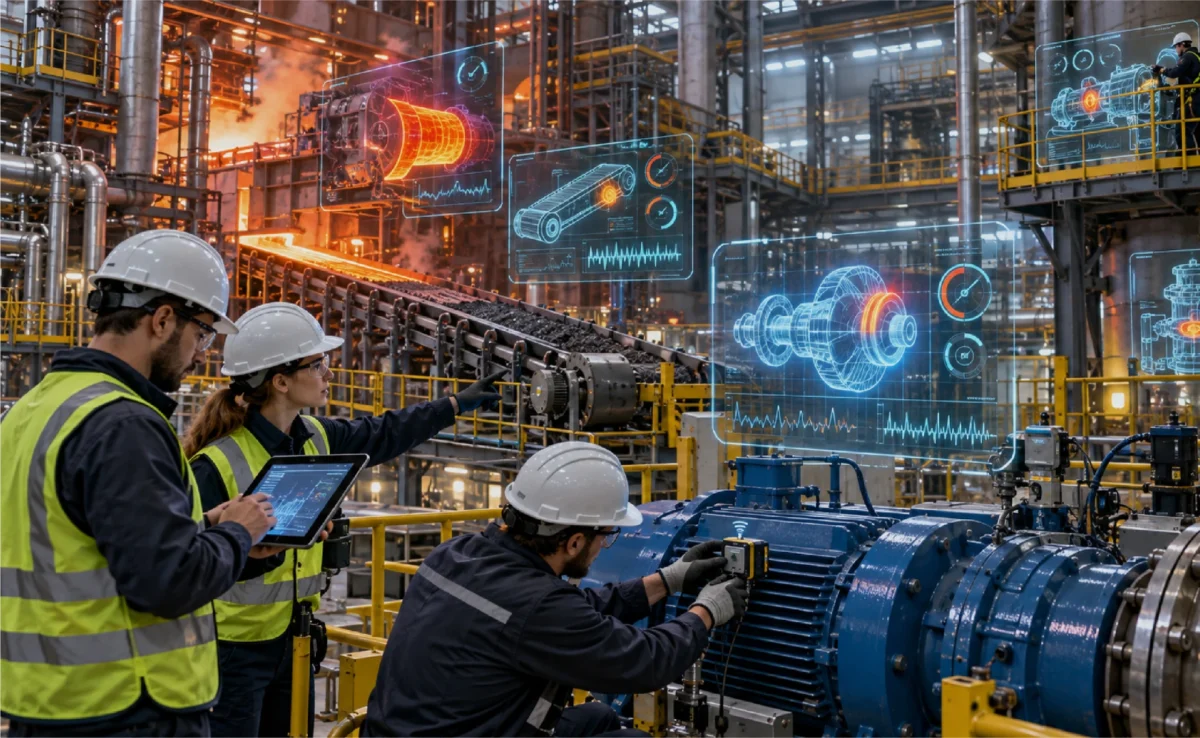
Six Places Your Customer’s Plant Can’t See
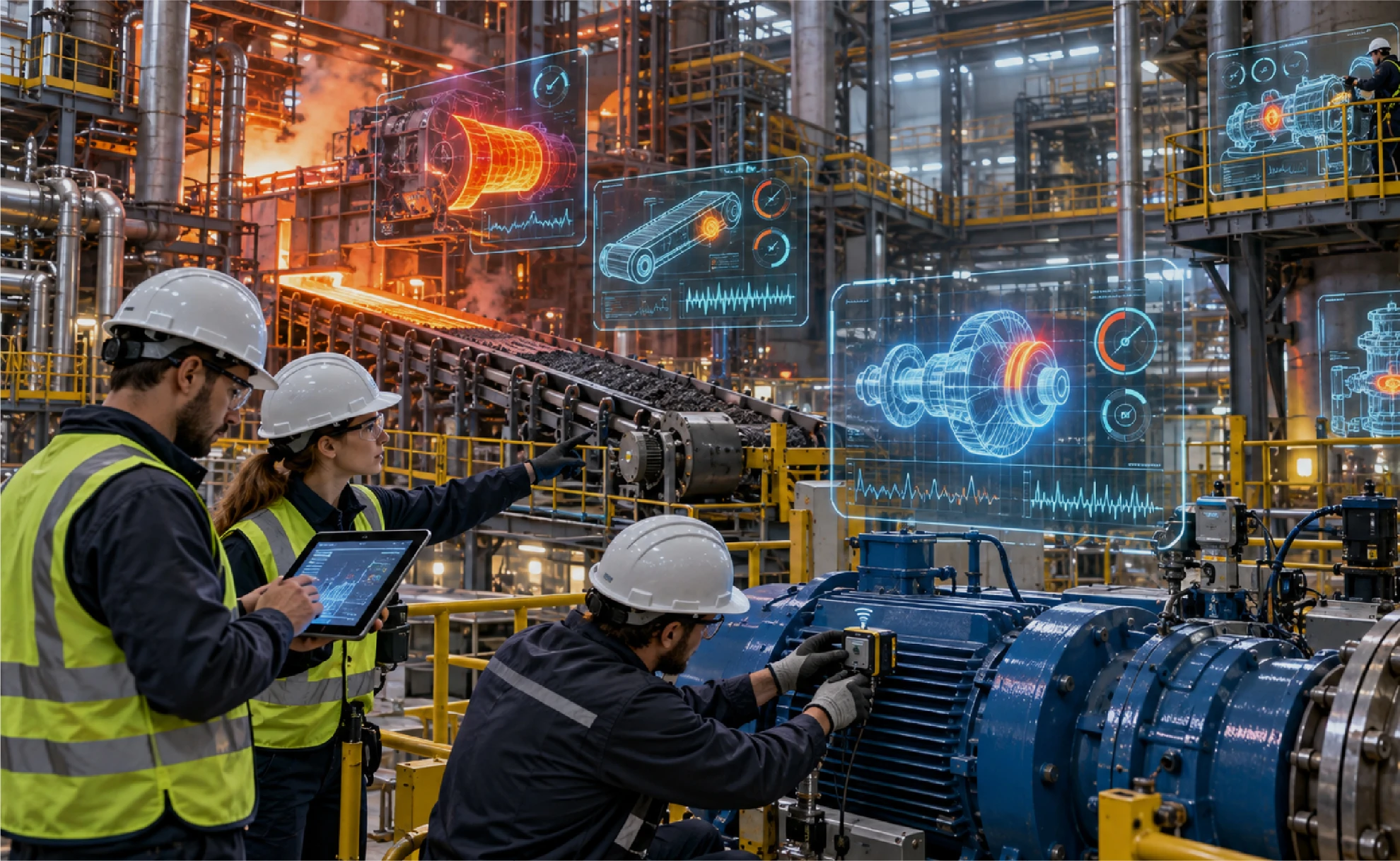
Walk into a plant that already runs a condition monitoring program and ask the reliability engineer which failures caught them out last year. The answer is rarely an asset on the route. It’s the kiln drive nobody could get a clean reading from, the crane that only works in bursts, the fan behind a barrier that can’t be approached while the line is running.
Those gaps aren’t random. They fall into six patterns, and once you can name them, you can walk a plant with your customer and point at them. That conversation tends to go a lot further than asking whether they’ve thought about AI.
01. THE SIX BLINDSPOTS
Where Conventional Monitoring Runs Out
Too slow
Kiln girth gears, ladle turrets, slew drives, agitators and stackers turn at speeds where bearing and gear defect energy sits at very low frequencies. General purpose sensors and short handheld captures struggle to resolve it, so an early defect looks like noise until it’s a crack.
Too fast
Compressors, blowers, mill drive trains and other high speed machines put their useful diagnostic content well above the range a quick route measurement captures. Sample too slowly and the early signs of a developing fault never make it into the data at all.
Too hot
Around furnaces, kilns, casters and hot rolling lines, the mounting location itself can sit above 100 degrees Celsius, with steam, spray and scale on top of that. Standard sensors and cabling either drift or fail, so the assets closest to the heat tend to be the least instrumented in the plant.
Intermittent duty
Cranes, charging cars, presses and anything else that works in bursts spends most of the day idle. A timer based measurement mostly records that idling. The fault only shows itself under load, which is the exact window a fixed schedule is most likely to miss.
Hazardous or unreachable areas
Some assets can’t be approached safely while the line runs, or sit in a classified area, or need a permit and a shutdown to reach. The route quietly stops there. The gap doesn’t show up as a missing asset on a report, it shows up as a failure nobody saw coming.
Frequent changeovers
Paint shops, mixers, extruders and packing lines change speed, load and product all day. A baseline set on one condition raises false alarms on the next. After a few weeks of nuisance alerts, the plant stops trusting the system, which is worse than not having one.
02. WHAT THE SIX HAVE IN COMMON
The Measurement Has To Understand The Machine
None of these are gaps in willingness. Plants know these assets matter. The problem is that a general purpose sensor and a fixed capture schedule don’t know anything about the machine they’re attached to, so they apply the same measurement to a 3 rpm drive and a variable speed extruder.
Closing the gaps means the capture itself has to be aware of what the asset is doing: measuring when the crane is actually lifting rather than parked, resolving low frequencies on a slow turning gear, surviving the temperature at the mounting point, and holding a baseline that shifts as the line changes product. That’s what physics aware and vertical aware means in practice, and it’s the part of the job most teams underestimate.
Then comes the second half. A flagged fault still has to reach the plant as something a planner can act on. PlantOS™, the Industrial Outcome Intelligence Engine behind the AI Shield family, has every flagged fault checked by a CAT III or CAT IV vibration analyst before it goes out, and what reaches the plant is a prescription: which asset, what’s wrong, how urgent, and what to do about it. Prediction on its own doesn’t protect a single hour of production.
A Proven Engine Behind You
PlantOS™ has unlocked operator validated outcomes across 1,000+ plants in 28 countries and nine heavy-industry verticals, covering exactly these awkward assets: kilns, mills, cranes, furnaces, mixers, extruders and dryers.
03. HOW TO USE THIS ON SITE
Three Questions On Your Next Plant Walk
You don’t need a pitch for this. On your next visit, ask the maintenance manager three things:
- Which assets aren’t on the route, and why not? The answer is usually one of the six above.
- What surprised you in the last twelve months? Then check whether that asset was slow, fast, hot, intermittent, hard to reach or constantly changing.
- What does your team do with an alert today? If the honest answer is a walk-down and a shrug, the gap isn’t sensing. It’s what happens after the alert.
Those three answers give you the shape of a first project, and they come from your customer rather than from a vendor deck. If you want a second pair of eyes on it, Infinite Uptime will walk one of your plants with you and put the findings into a Reliability Blindspot Audit at no cost, with your team leading the conversation and ours in the room alongside you.
Stronger Outcomes, Delivered Under Your Name
Pick one plant where you already know the maintenance manager, and one asset on it that nobody has been able to measure properly. That’s the conversation to bring to the Infinite Uptime partnerships team.
Frequently Asked Questions
It’s an asset a plant cares about but can’t measure properly with the monitoring it has. In practice these fall into six groups: machines that turn too slowly, machines that turn too fast, assets in high temperature areas, equipment that runs intermittently, assets in hazardous or unreachable locations, and lines with frequent changeovers. They are the failures that surprise a plant that already runs a monitoring program.
Because the defect energy on a slow turning gear or bearing sits at very low frequencies, and a short handheld capture with a general purpose sensor struggles to resolve it. The reading looks normal for months. By the time the signal is obvious on a route, the damage is usually well advanced.
Yes, but only with hardware rated for the mounting location rather than the ambient air. Around casters, kilns and hot rolling lines the mounting point can sit above 100 degrees Celsius, with steam, spray and scale as well. Hardware that isn’t built for that either drifts or fails, which is why the hottest assets are often the least instrumented in the plant.
By triggering the measurement on load or speed instead of on a timer. A crane, charging car or press spends most of the day idle, so a fixed schedule mostly records idling. Capturing the moment the asset is actually working is what puts the fault window in the data.
By judging the machine against its current operating condition rather than one fixed baseline. On paint shops, mixers, extruders and packing lines, speed, load and product change all day, so a single threshold set on one condition raises nuisance alerts on the next. A few weeks of those and the plant stops trusting the system.
Nothing. Infinite Uptime provides the hardware, the AI models and the 24/7 diagnostics. Your team scopes, installs, commissions and services the deployment, keeps the customer relationship, and gets first call on the work the diagnostics generate. Every deal is co-sold, with our team in the room alongside yours.
It’s a plant walk we run with you at no cost. We go through the site with your customer’s team, identify which assets fall into the six blindspots, and write up what we find. Your team leads the conversation and ours supports it, which usually gives you the shape of a first project in a single visit.
Exact Sources
1. “Revised positioning frameworks: six plant reliability blindspots and six-layer plant reliability trust scorecard,” Infinite Uptime, 23 September 2026. Source for the six blindspots and reliability sequence in Sections 01–02. (Internal document.)
2. “IU Official Boiler Plate.docx,” Infinite Uptime, September 2026. Source for PlantOS™ positioning, key messaging, operator-validated outcomes, and figures of 1,000+ plants, 28 countries and nine heavy-industry verticals. (Internal document.)
3. “01 - AI Shield Partner System (Deck),” Infinite Uptime, September 2026. Source for partner responsibilities, hardware and AI delivery, 24/7 diagnostics, co-selling and customer ownership. (Internal document.)
4. Infinite Uptime, Critical Equipment Reliability, verified 30 September 2026. Confirms AI Shield applications across critical heavy-industry equipment.
5. Infinite Uptime, How System Integrators Can Deliver Prescriptive Maintenance Without Building It From Scratch, September 2026. Source for load-gated capture, temperature-rated mounting and CAT III/CAT IV analyst validation of flagged faults.
6. “ROT AI Shield Technical Module v1.1,” Infinite Uptime internal documentation. Source for RPM-gated acquisition and the 120°C mounting rating, described as “above 100°C” without naming the product line. (Internal document.)