Categories
Prescriptive Maintenance
How Prescriptive AI Cuts Plant Downtime

How Prescriptive AI Cuts Plant Downtime

Read Time: 11–13 minutes | AuthorRahul Narvekar

How Prescriptive AI Cuts Plant Downtime
Key Takeaways

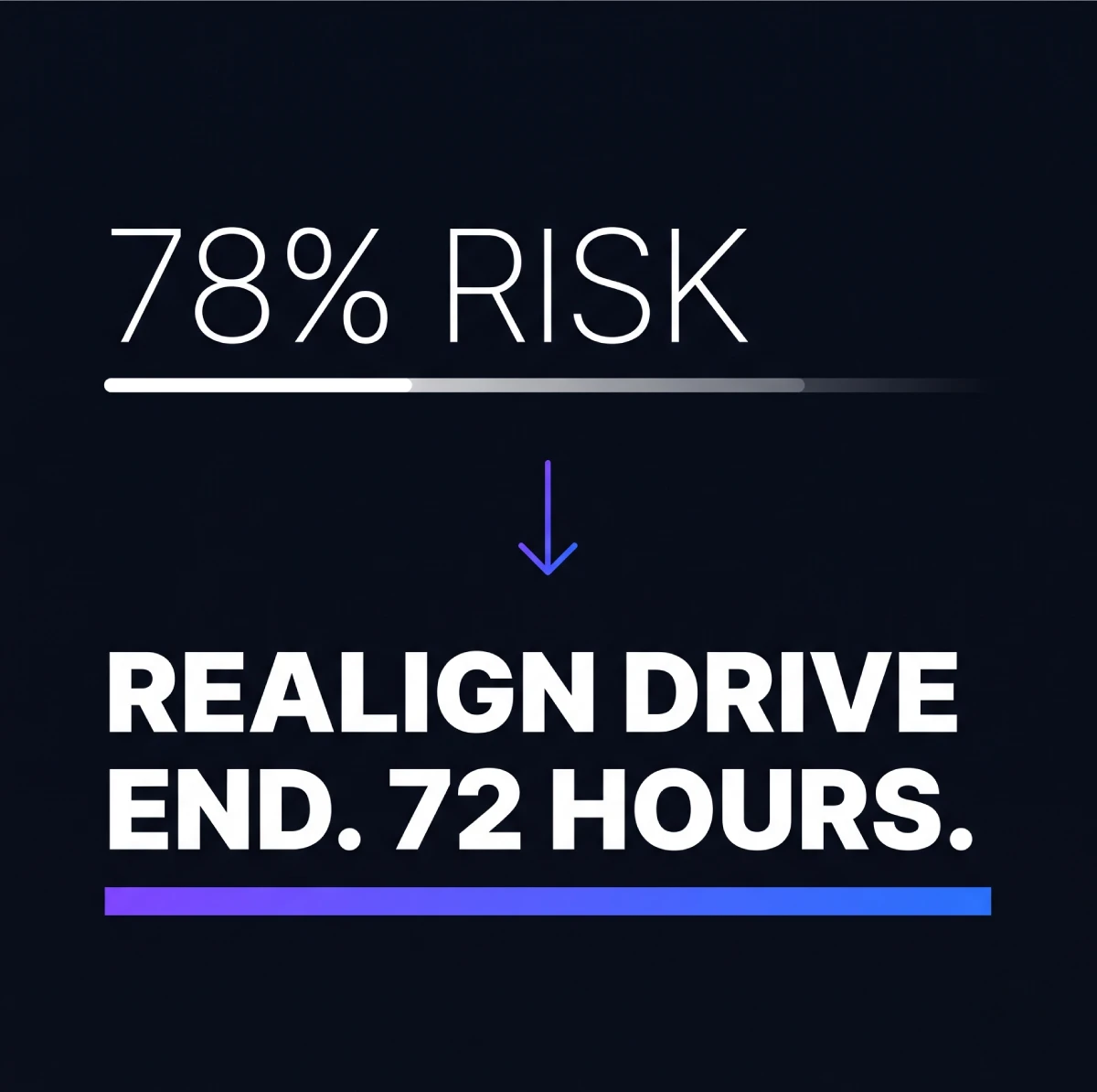
In short: Detection alone does not recover downtime hours. Prescriptive AI cuts unplanned downtime by compressing the interval between a fault appearing on an asset and a corrective job being completed on the floor.

  • Downtime is a delay problem, not only a detection problem. Most lost hours accumulate after the anomaly is already visible, inside diagnosis, prioritization and scheduling.
  • Process data completes the diagnosis. Reading PLC and historian signals alongside vibration exposes the operating condition driving the fault, not just the symptom.
  • Prioritization protects the production plan. Faults are ranked by production impact, so the critical line is defended before the standby pump is.
  • The instruction reaches the person who can act. A prescription carries a named action and a deadline, and it closes with a digital signoff rather than a risk chart.
  • Validated outcomes compound. Across the PlantOS™ install base, up to 99 % of prescriptions are acted upon, contributing to 167,837 hours of unplanned downtime saved.

Ask a reliability engineer why a critical asset stopped last quarter and the answer is rarely that nothing was seen. Something was seen. A vibration reading drifted, an alert was raised, a screenshot went into a WhatsApp group, and the job was scheduled for the next planned window that arrived too late.

The hours were not lost at detection. They were lost in everything that followed.
Prescriptive maintenance solutions attack that interval directly. Here is how Prescriptive AI converts equipment and process data into prioritized maintenance actions, and where each stage removes downtime hours from the plant.

Where the downtime hours actually go

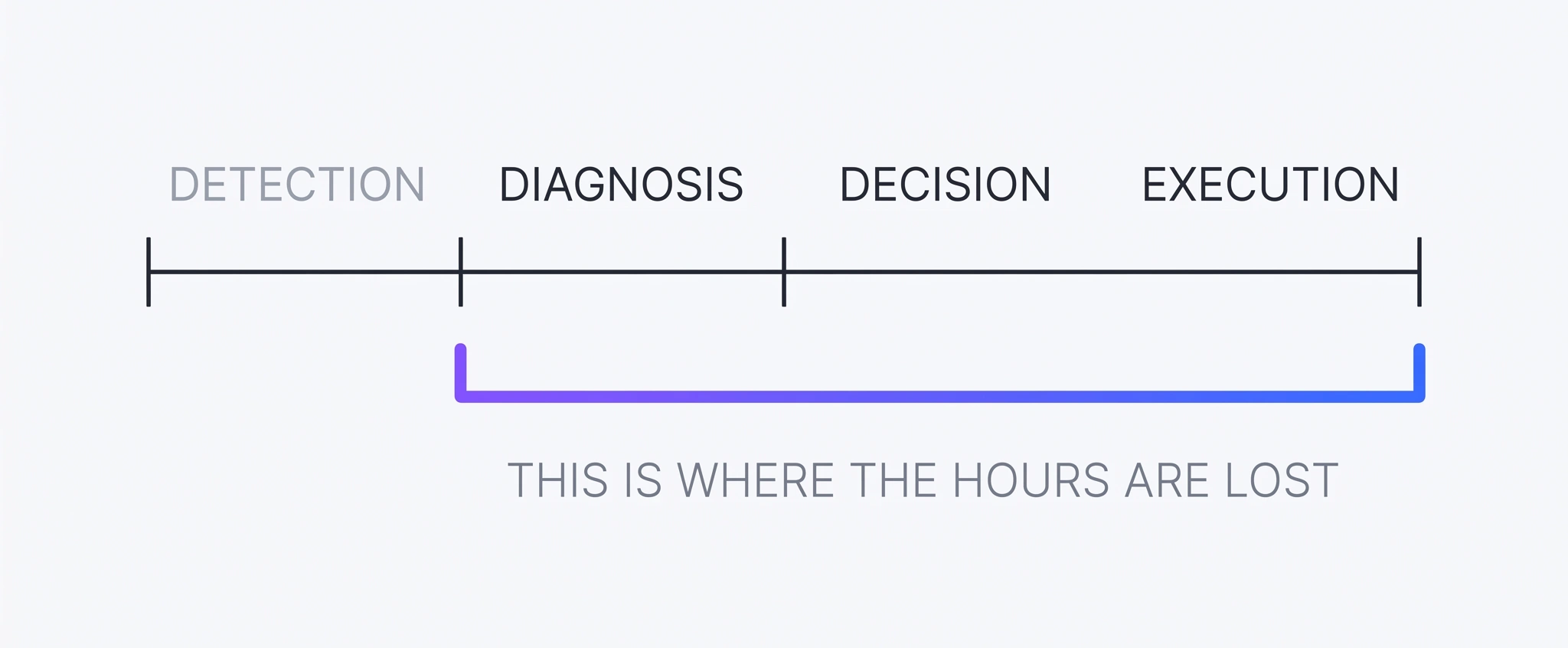
Unplanned downtime is the sum of four intervals, and only the first belongs to detection.


The detection lag is the time between degradation starting and the system noticing. Condition monitoring already handles this well. The diagnosis lag is the time between noticing and knowing what is wrong, which usually depends on one experienced engineer finding time to read a waveform. The decision lag is the time between knowing and agreeing that this job outranks the other fourteen open jobs. Finally, the execution lag covers work order creation, spares availability, and closure on the floor.

Prescriptive AI downtime timeline showing detection, diagnosis, decision, and execution gaps
Only the first interval belongs to detection

A predictive programme compresses the first interval and hands the other three back to your team. That is why plants with mature sensor coverage still report breakdowns. Detection was never the bottleneck. Everything downstream of it was.

1. It reads the process, so the diagnosis does not stall

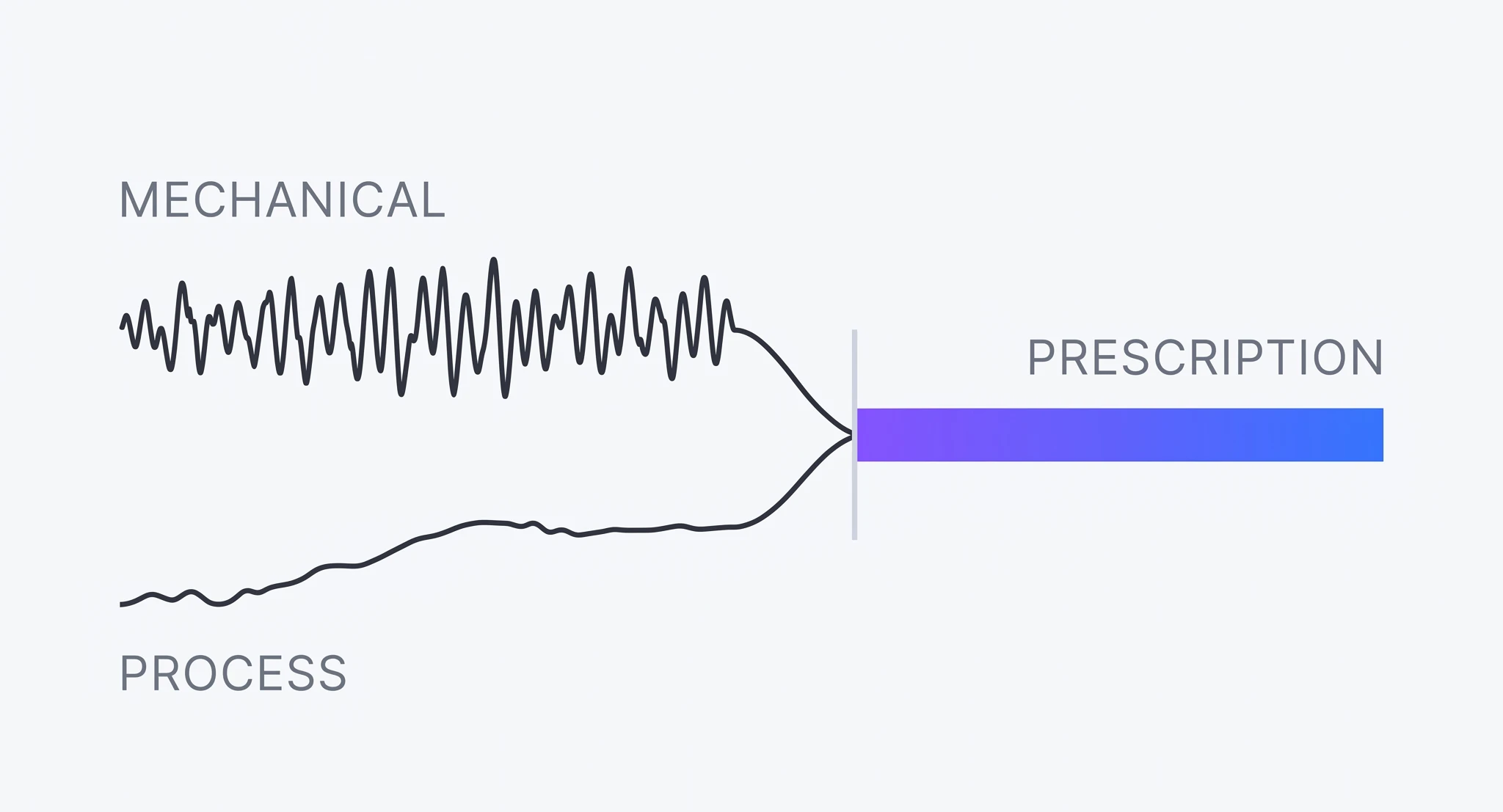
Mechanical fault signatures explain only part of what actually fails on a heavy plant. A large share of mechanical damage is induced from outside the machine by kiln ring formation, thermal overstress, cyclone coating buildup, ladle heat profile drift, or web tension drift. These conditions degrade the asset well before a clean mechanical signature appears.

Prescriptive AI combining mechanical and process data to diagnose industrial equipment faults
Two streams in, one instruction out

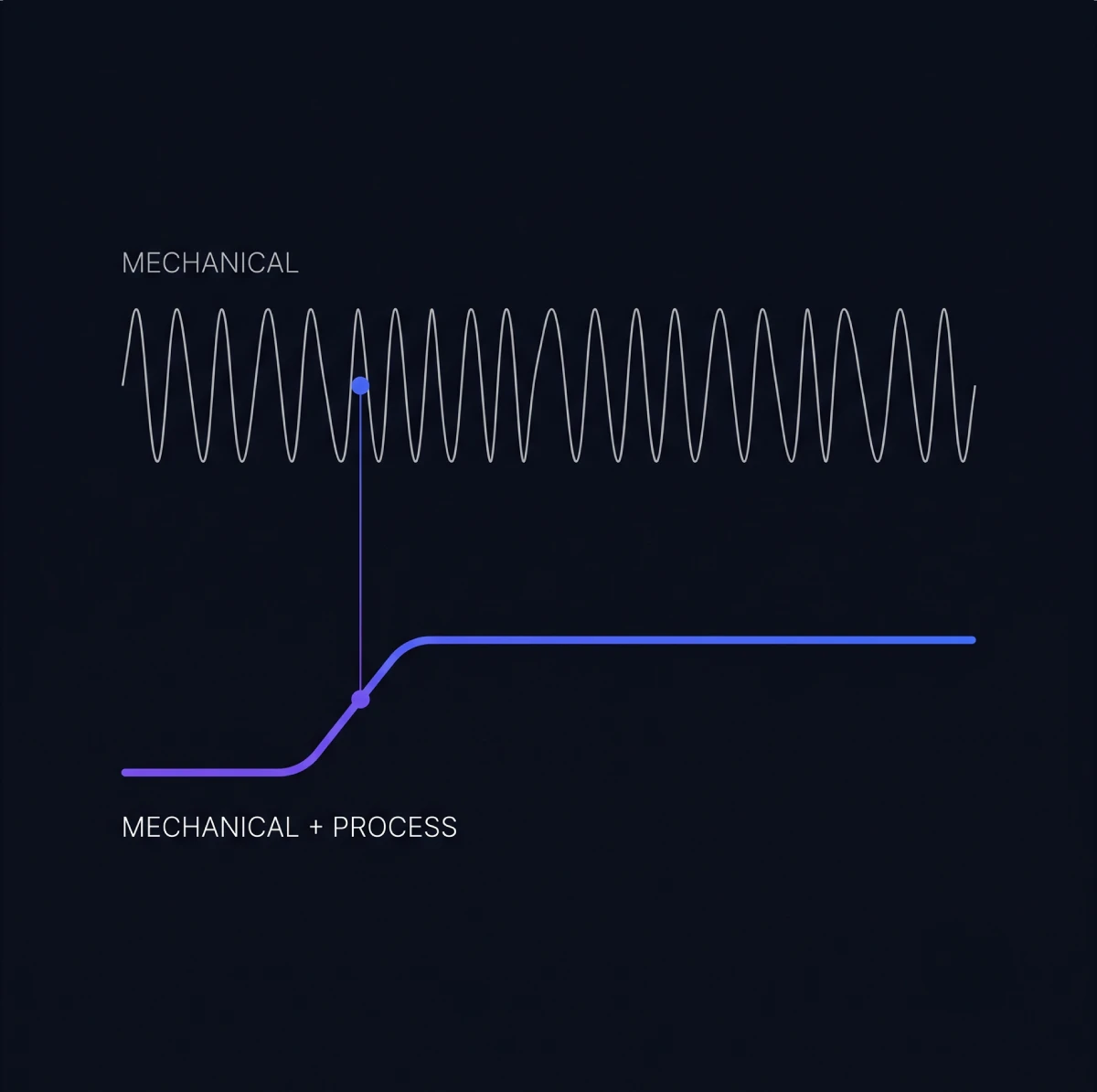
Prescriptive AI contextualizes equipment data alongside process data from the PLC and historian. The fault is explained by its cause rather than described by its symptom, which is what allows a diagnosis to be issued automatically instead of queued for interpretation. Diagnosis lag drops from days to the length of a shift handover.

2. It names the fault mode, so the right job gets raised

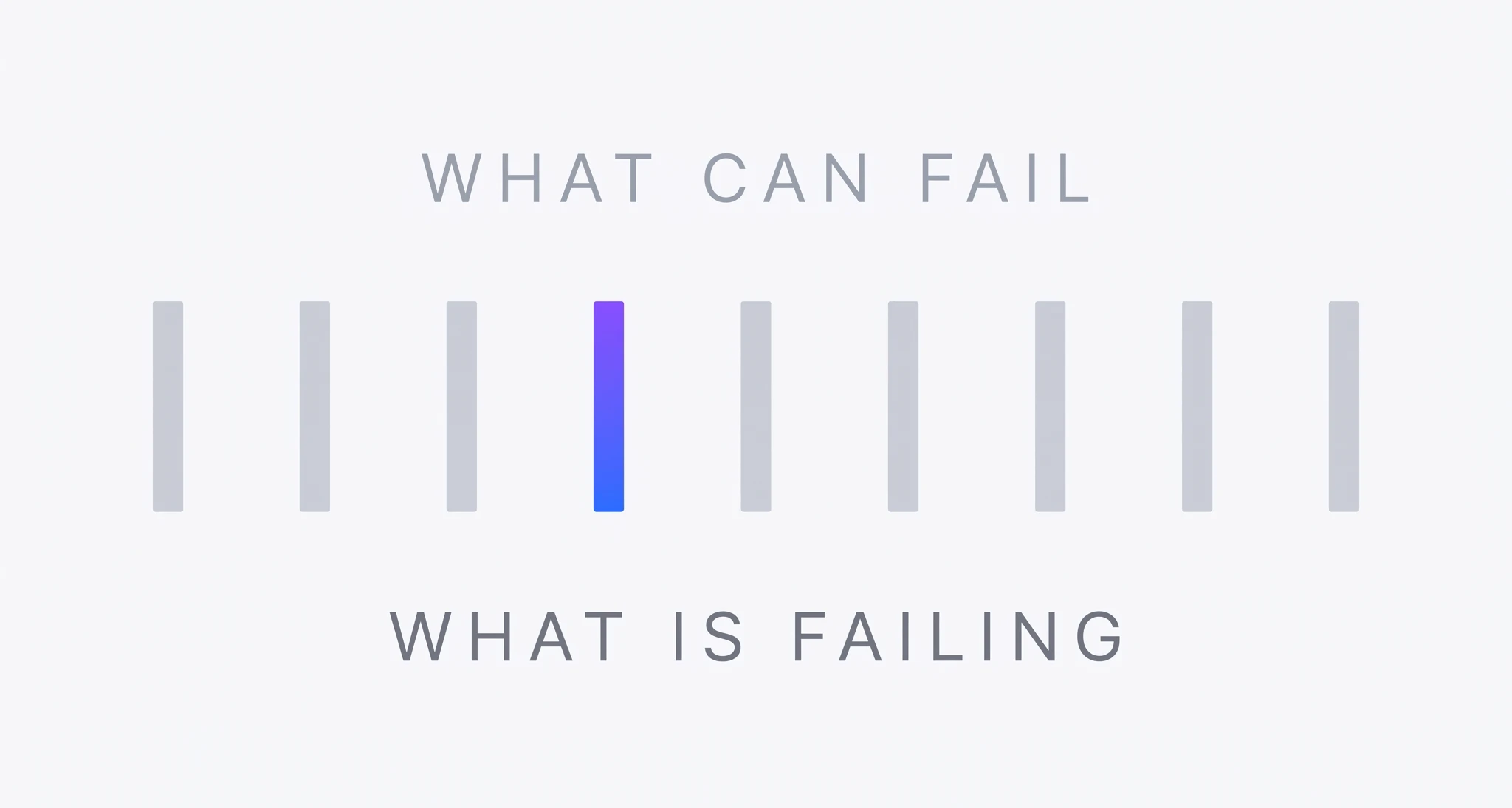
A general anomaly model finds deviation on a mill. An equipment-specific model names gear-mesh backlash and links it to the load condition that caused it. That distinction decides whether the resulting work order fixes the failure or replaces a healthy component while the real fault keeps developing.

Prescriptive AI identifies specific equipment fault modes to generate the right maintenance work order
A known taxonomy, and the one mode developing today

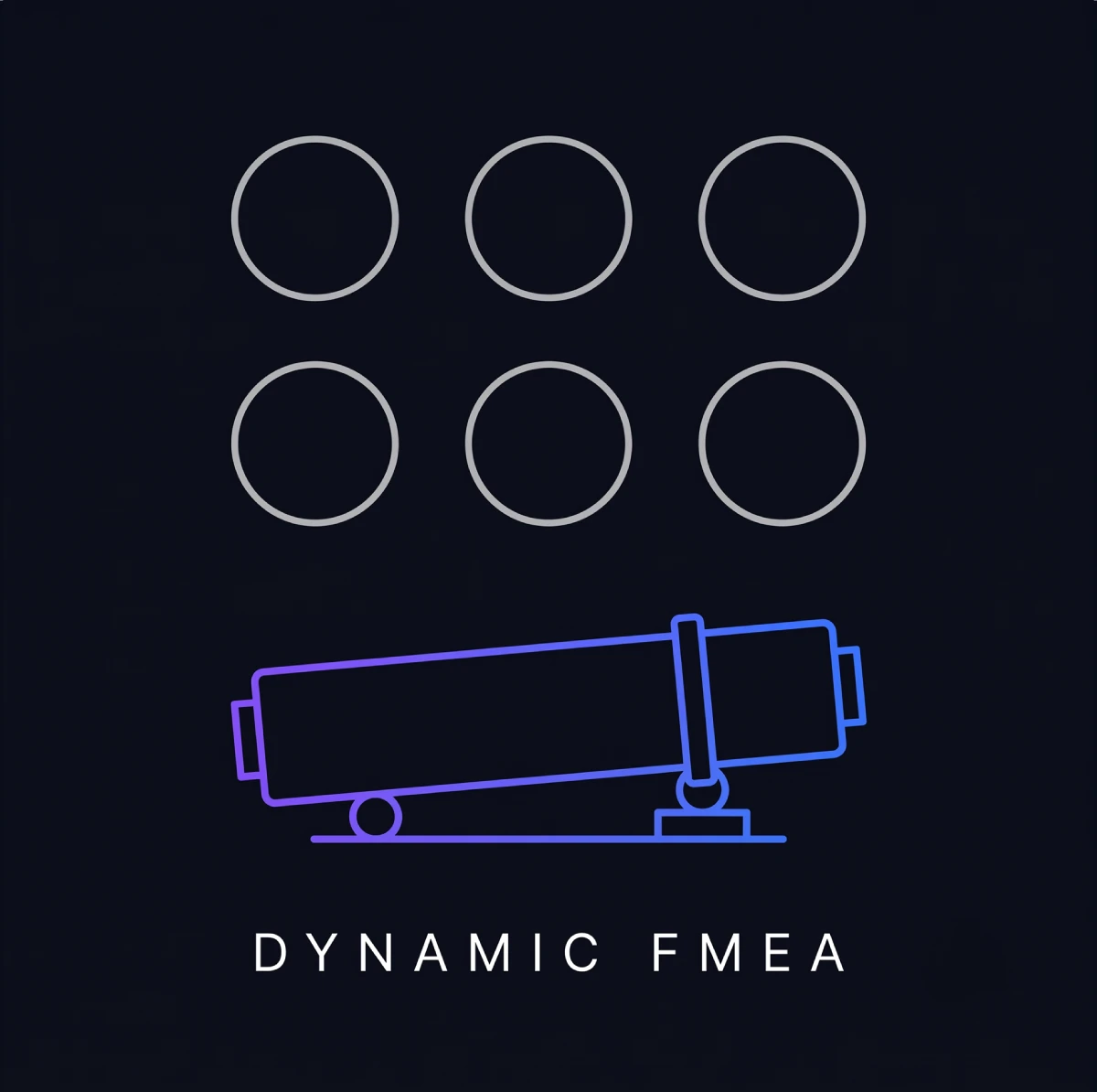
Infinite Uptime’s PlantOS™ delivers this through AI Shields, equipment-specific models built on Dynamic FMEA for kilns, mills, cranes, furnaces, mixers, extruders and dryers. Naming the fault mode removes the rework loop, and rework is downtime counted twice.

3. It ranks by production impact, so the critical line is defended first

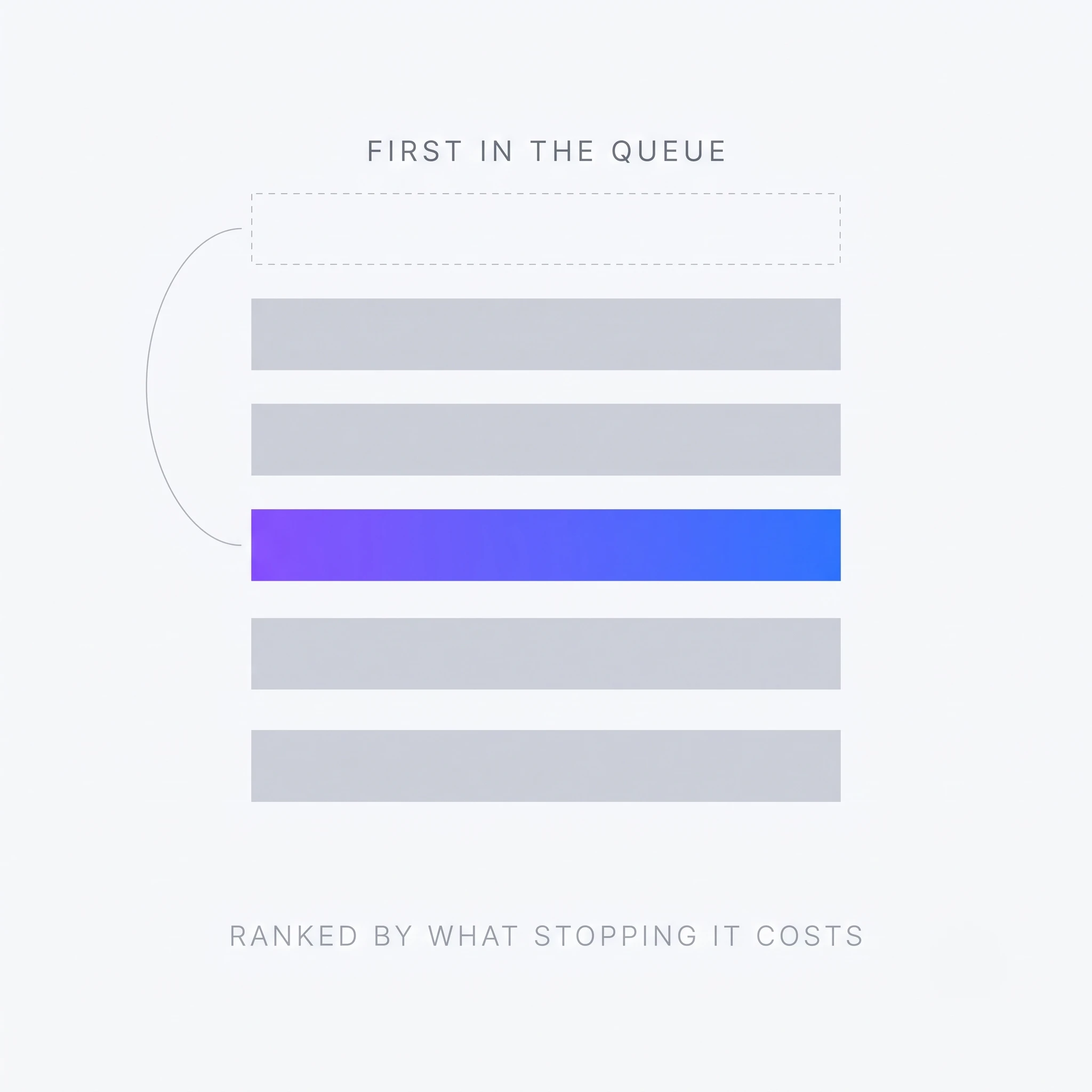
Alarm severity tells you how sick an asset is. It does not tell you what stopping that asset costs. A moderate fault on a single-line kiln outranks a severe fault on a redundant pump every time, and most maintenance backlogs are not sorted that way.

Prescriptive AI prioritizes maintenance tasks by urgency and production impact
Ranked by what stopping it costs

Prescriptive AI ranks every open prescription by urgency and production impact, so the daily queue reflects tonnes at risk rather than decibels. Decision lag collapses because the argument about sequencing has already been settled by the data.

4. It ends at a work order, so the fix actually happens

This is where most deployments quietly stall. The insight lives in one system and the maintenance plan lives in another, with the translation depending on someone having a free afternoon.


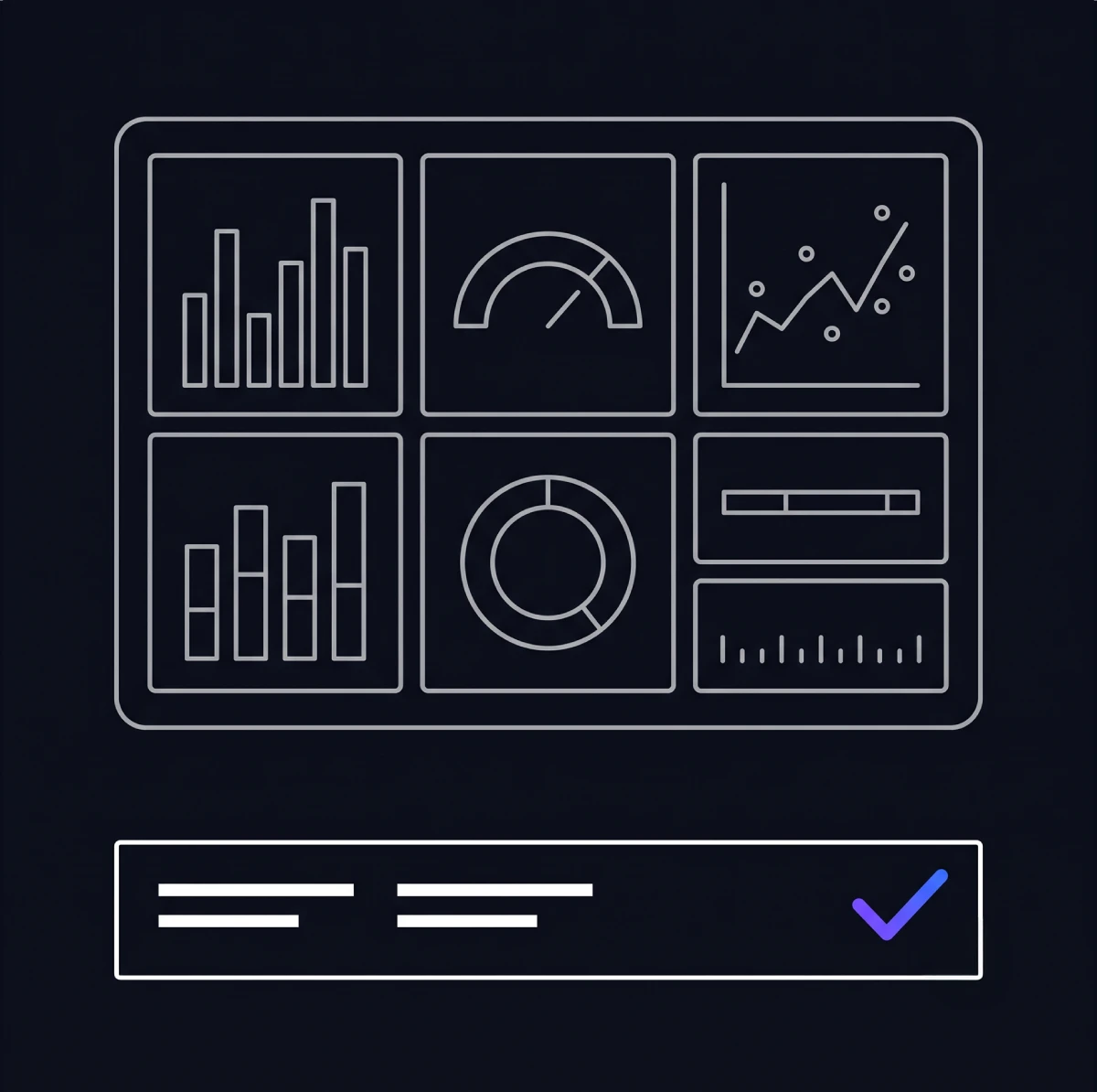
A prescription reaches the operator on dashboard, email and mobile, carries a defined corrective action and a deadline, and is closed with a digital signoff. What the plant head opens in the morning is a prioritized daily queue instead of a risk chart. SPCC replaced reactive firefighting with exactly that queue and reported 9X ROI in under six months.

“Our team is no longer running from one breakdown to the next. We now start our day with a prioritized list from the system, telling us which machine needs attention. The system is amazing.”

Mr. Alaa Farrag, Maintenance Manager, SPCC

Anatomy of a prescription

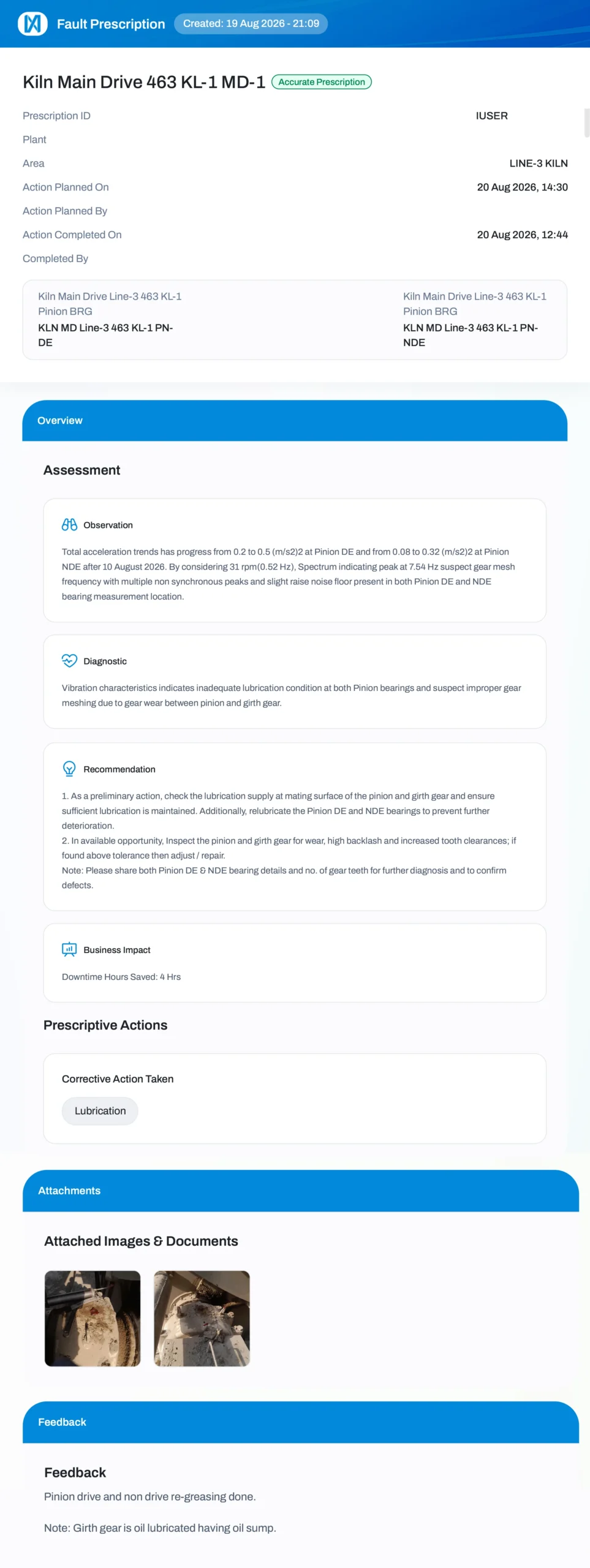
Everything described above arrives as one document. Below is a live prescription issued by PlantOS™ on a cement kiln main drive, closed by the plant’s own maintenance engineer.

Click any number (1–8) on the document to view details
  1. 1
    The header and the verdict

    The document is titled a Fault Prescription, not an alert, and it carries a status chip reading Accurate Prescription. That chip is the plant's judgement on whether the diagnosis held, not the model's own. This is what accuracy measured by customer validation means in practice.

  2. 2
    The asset, down to the bearing

    Not “kiln” but Kiln Main Drive Line-3 463 KL-1, monitored at the pinion bearing drive end and non-drive end. A generic model would report an anomaly on a kiln. An equipment-specific model knows the pinion and girth gear set exists and knows how it fails.

  3. 3
    The clock

    Created 19 August at 21:09, planned for 20 August at 14:30, completed at 12:44 the same day. The decision lag and the execution lag are visible as timestamps, and the job closed ahead of its own window rather than waiting for the next shutdown. (Where the downtime hours actually go)

  4. 4
    Observation

    Total acceleration climbing from 0.2 to 0.5 (m/s²)² at the drive end and 0.08 to 0.32 at the non-drive end after 10 August, with a spectral peak at 7.54 Hz read against a 31 rpm running speed. This is the part a predictive layer delivers on its own, and it is where most systems stop.

  5. 5
    Diagnostic

    The step that usually waits for an analyst. Inadequate lubrication at both pinion bearings, with improper gear meshing suspected from wear between pinion and girth gear. The trend has become a named fault with a cause attached.

  6. 6
    Recommendation

    Two actions in deliberate sequence. Restore lubrication at the pinion and girth gear mating surface and relubricate both bearings immediately, then inspect the gear set for wear, high backlash and tooth clearance at the next available opportunity. Immediate protection is separated from planned intervention, so the production plan is defended without calling a stoppage.

  7. 7
    Business impact

    The prescription states its own value on the document at four hours of downtime saved, in the same view as the technical evidence. The number is not reconstructed afterwards for a quarterly review.

  8. 8
    Closure and feedback

    Corrective Action Taken records lubrication as the work performed, with field photographs attached from the floor. Below that, the engineer writes back: pinion drive and non-drive end re-greasing done, with a note that the girth gear is oil lubricated and has an oil sump. That last line is plant knowledge the model did not have, entering the system through the person holding the grease gun.
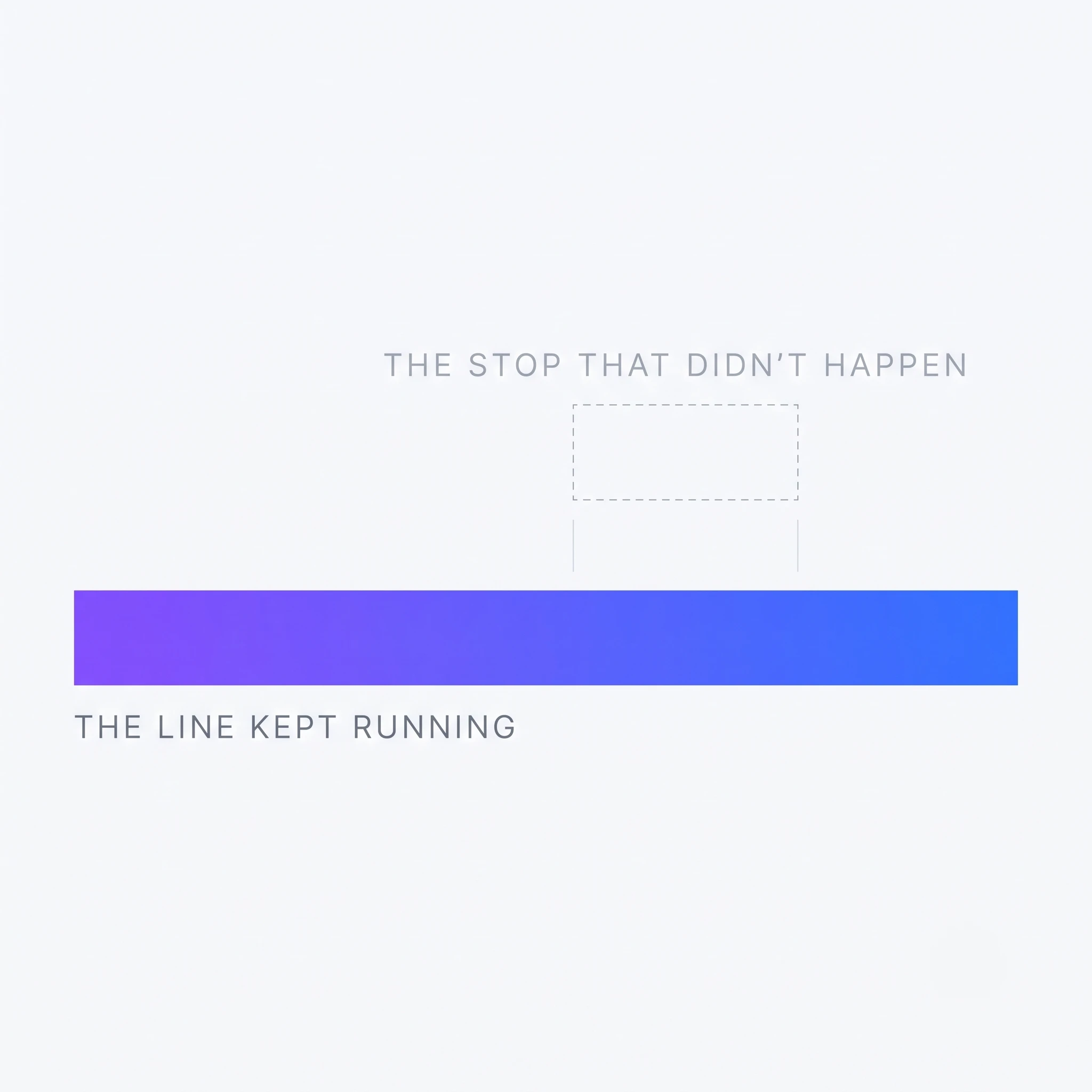

One prescription, one asset, one shift. Repeat that across 1,000 plants and it becomes 167,837 hours of unplanned downtime saved.

5. It records the outcome, so next quarter is faster than this one

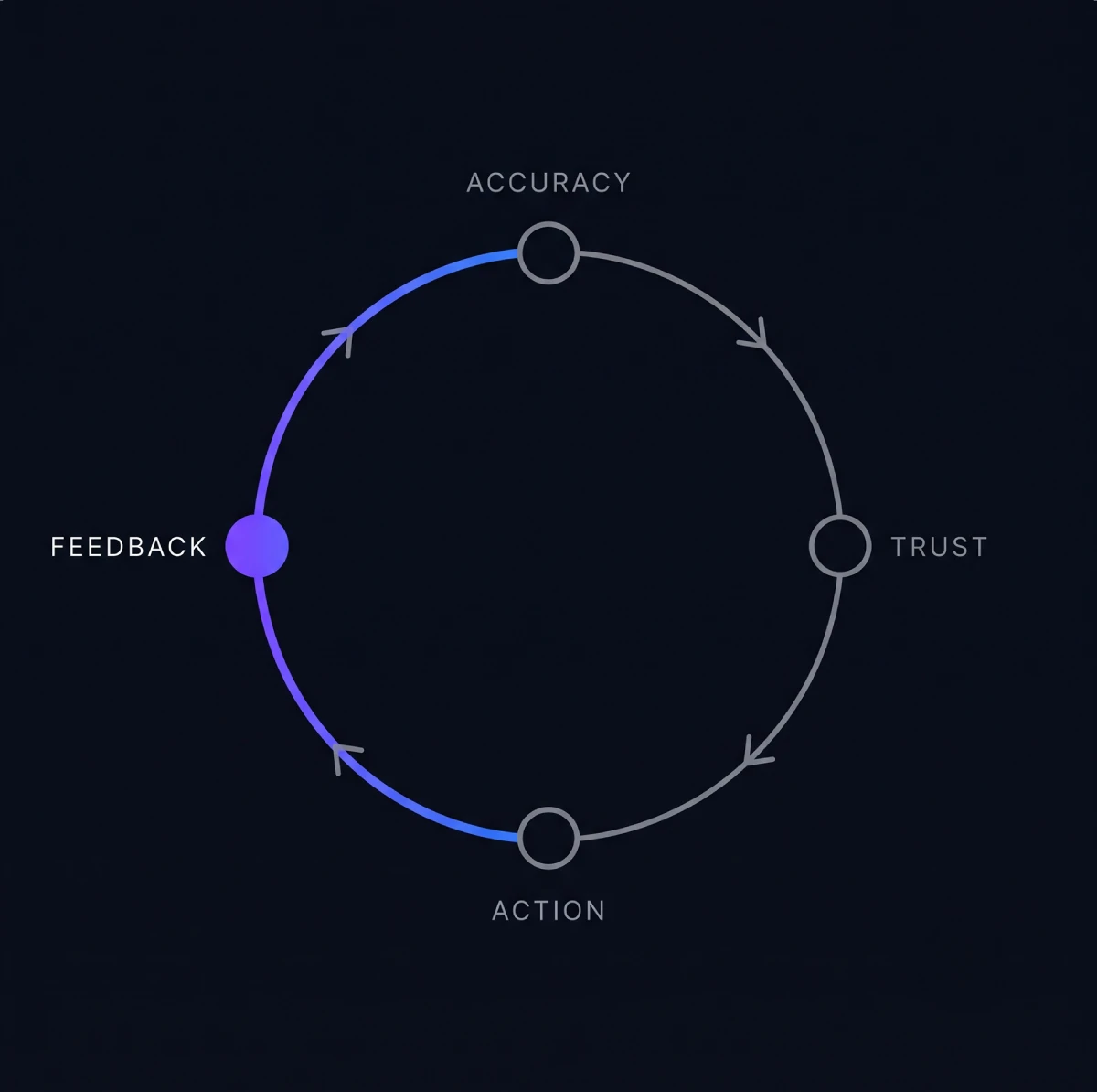
When an operator validates whether the prescribed fix was correct, that signoff becomes a labelled outcome, and labelled outcomes train sharper models. PlantOS™ formalizes this as the 99% Trust Loop: accuracy builds trust, trust drives action, action produces validated feedback, and feedback improves the next prescription. A prescriptive deployment is therefore worth more in year three than in year one, because the fault library is now built from your own assets.

What the compression is worth

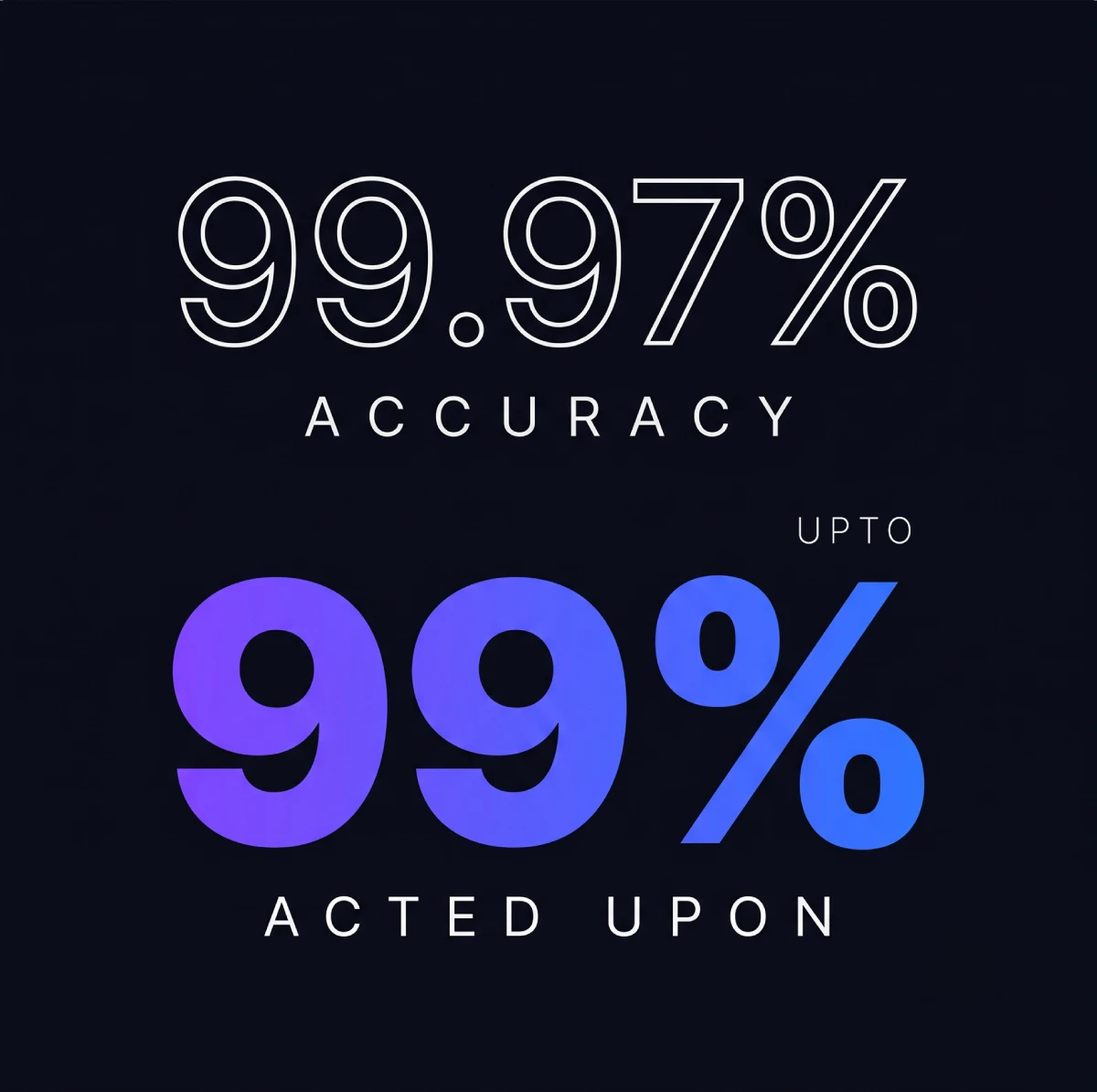
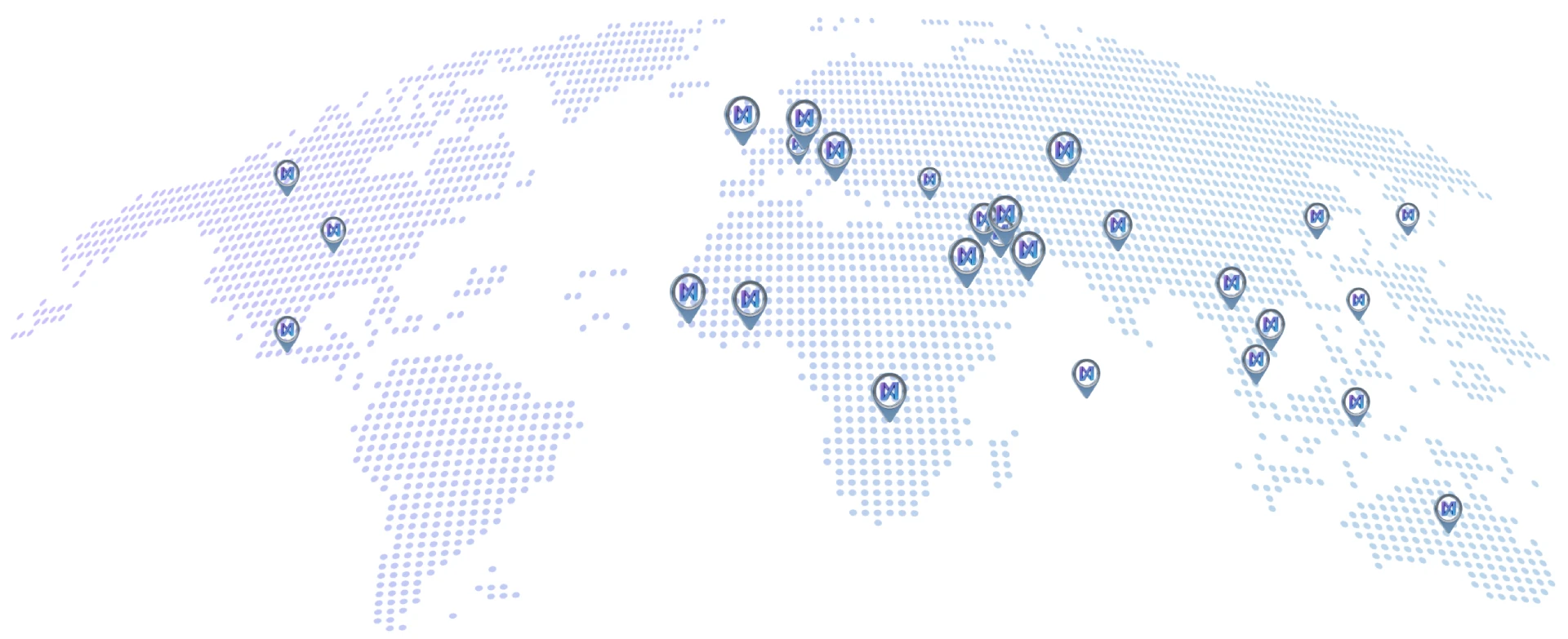
PlantOS™ is live across 1,000 plants in 28 countries, running at 99.97 % prediction accuracy with up to 99 % of prescriptions acted upon. Customers see up to 10 % lower maintenance cost and up to 2.5 % higher throughput, with every figure signed off by their own reliability and operations teams. Hindustan Zinc Ltd of Vedanta Group reported over $700K in savings as published by Vedanta Spark, while JSW Steel runs the platform across 139 plants and Coromandel International across 27.

PlantOS Prescriptive AI preventing unplanned downtime and keeping the production line running
The stop that didn't happen

Auditing your own downtime in one shift

Pull the last four unplanned stops on your most critical line and answer four questions.

1

Was the degradation visible in the data before the stop?

2

How many days passed between the first signal and a confirmed diagnosis?

3

Was the job ranked against production impact or against alarm severity?

4

Did the recommendation become a work order, and was the outcome recorded anywhere the model could learn from?

If detection was fine and the answers to the last three are uncomfortable, the plant does not have a sensing gap. It has an instruction gap.

Start with your most critical line. Try PlantOS™

Frequently Asked Questions

It reduces the time between a fault developing and a corrective job being completed. Prescriptive AI diagnoses the fault mode automatically, ranks it by production impact, issues a corrective action with a deadline to the operator, and records the signoff. Detection is only the first of four intervals that create downtime, and prescriptive maintenance solutions compress the remaining three.

Each prescription carries the observed trend and spectral evidence, a diagnostic naming the fault and its cause, a sequenced corrective action, a planned date, the operator who closed it, the corrective action actually performed, field photographs, written feedback from the floor, and the downtime hours saved. The example above shows a kiln main drive lubrication and gear wear fault closed inside sixteen hours for four hours of downtime saved.

Savings scale with production value per hour rather than asset count. Across the PlantOS™ install base, 167,837 hours of unplanned downtime have been saved, with customers reporting up to 10 % lower maintenance cost and up to 2.5 % higher throughput.

The first prescription is typically issued within two weeks of installation, with a structured 90-day path to measurable production outcomes. Self-powered wireless sensors install without gateways or plant cabling, so commissioning does not require a shutdown.

No. Prediction remains the detection engine, and Prescriptive AI adds diagnosis, prioritization, instruction and validation above it. Plants with existing sensor coverage and asset baselines usually reach value faster.

No. PlantOS™ operates alongside existing PLC, historian, SCADA and CMMS environments rather than displacing them, so the prescription lands inside the maintenance workflow your team already uses.

Track prescription action rate, which is the percentage of issued prescriptions executed on the floor, alongside mean time from signal to closure. A platform with high accuracy and a low action rate has an adoption problem rather than a modelling problem.

Categories
Prescriptive Maintenance
7 Ways Prescriptive Maintenance Is Different from Standard Predictive Maintenance

7 Ways Prescriptive Maintenance Is Different from Standard Predictive Maintenance

Read Time: 7–9 minutes | AuthorRahul Narvekar
Prediction is not equal to Outcomes
Key Takeaways

In short: Predictive maintenance tells you an asset is likely to fail. Prescriptive Maintenance tells your operators which fault to fix, why, and by when, then captures whether the fix worked.

  • From score to instruction. Predictive outputs a probability. Prescriptive outputs a named fault, a corrective action, and a deadline, ranked by production impact.
  • From equipment data to equipment plus process data. Mechanical signatures alone miss the operating conditions that accelerate failure.
  • From accuracy to action rate. Alerts prove nothing until they are executed. Across the PlantOS™ install base, up to 99 % of prescriptions are acted upon.
  • From dashboard to work order. The prescription reaches the operator on a dashboard, email, and mobile and closes with a digital signoff, not a risk chart.
  • From licence to outcome. Infinite Uptime's PlantOS™ is delivered as Production Outcomes as a Service, committed against less downtime, more throughput, and lower cost per ton.

Most large plants already have predictive maintenance. Sensors are mounted, models are trained, and a dashboard somewhere lists assets by risk score. Yet unplanned downtime persists, work orders still get raised after the noise starts, and the reliability review still opens with a breakdown post-mortem.

The gap is not detection. The gap is instruction.
Prescriptive maintenance solutions close that gap by moving from a forecast to a directive: which fault, why it is developing, what to do, and by when. For maintenance managers and reliability leaders evaluating prescriptive AI software against their existing stack, here are the seven differences that actually change plant outcomes.

  1. 01

    Predictive forecasts failure. Prescriptive assigns the fix.

    A predictive model outputs probability. It tells you an asset is trending toward failure within a window, and it hands the diagnosis back to your team to complete.

    Prescriptive AI completes the diagnosis itself and issues an instruction. The output is a specific fault mode on a specific asset, ranked by urgency and production impact, with the corrective action attached. Your reliability engineer stops interpreting a waveform and starts scheduling a job. That single shift is what separates prescriptive maintenance platforms from an alerting layer.

    Predictive forecasts failure, Prescriptive assigns the fix
  2. 02

    Predictive reads the equipment. Prescriptive reads the equipment and the process.

    Traditional predictive maintenance is built on mechanical fault signatures: bearing wear, unbalance, misalignment, looseness, lubrication degradation. Those are real, and they matter.

    But in heavy manufacturing, a large share of mechanical failure is induced from outside the machine. Kiln ring formation, thermal overstress, cyclone coating buildup, ladle heat profile drift, and web tension drift all accelerate degradation without producing a clean mechanical signature early on. Prescriptive AI contextualizes equipment data alongside process data from the PLC and historian, so the fault is explained by its cause rather than described by its symptom.

    Predictive reads the equipment, Prescriptive reads the equipment and the process
  3. 03

    Predictive is generic. Prescriptive is equipment specific.

    A general anomaly detection model treats a kiln, a Banbury mixer, and an EOT crane as variations of rotating equipment. It finds deviation. It rarely finds the failure mode.

    Vertical AI is tuned to the failure taxonomy of the asset itself. Infinite Uptime's PlantOS™ delivers this through AI Shields, equipment-specific models built on Dynamic FMEA for kilns, mills, cranes, furnaces, mixers, extruders, and dryers. The difference shows up in coverage and explainability. A generic model flags an anomaly on a mill. An equipment-specific model names gear-mesh backlash and links it to the load condition that caused it.

    Predictive is generic, Prescriptive is equipment specific
  4. 04

    Predictive is measured on accuracy. Prescriptive is measured on action.

    Ask most industrial maintenance software vendors for their headline metric and you will get accuracy or alert volume. Neither tells you whether anything got fixed.

    The metric that governs a prescriptive program is the action rate: what percentage of prescriptions issued are actually executed on the floor. Across the PlantOS™ install base, up to 99 % of prescriptions are acted upon, against 99.97 % prediction accuracy. Accuracy earns trust, trust drives action, and action is where downtime hours are recovered. A platform with high accuracy and low action rate has an adoption problem, not a modelling problem.

    Predictive is measured on accuracy, Prescriptive is measured on action
  5. 05

    Predictive ends at the dashboard. Prescriptive ends at the work order.

    This is where most predictive deployments quietly stall. The insight lives in one system, the maintenance plan lives in another, and the translation between them depends on one experienced engineer having time to do it.

    Prescriptive maintenance solutions are designed to terminate in the maintenance workflow, not in a visualization. The prescription reaches the operator on mobile, carries a defined action and deadline, and is closed with a digital signoff. What the plant head sees is not a risk chart but a prioritized daily queue. SPCC replaced reactive firefighting with exactly that queue and reported 9X ROI in under six months.

    Predictive ends at the dashboard, Prescriptive ends at the work order

    “Our team is no longer running from one breakdown to the next. We now start our day with a prioritized list from the system, telling us which machine needs attention. The system is amazing.”

    - Mr. Alaa Farrag, Maintenance Manager, SPCC
  6. 06

    Predictive learns from data. Prescriptive learns from data and operators.

    A predictive model retrains on more of the same signal. Its ceiling is set by the labels it was given at the start.

    Prescriptive AI closes the loop with the people who work the machine. When an operator validates whether the prescribed fix was correct, that signoff becomes a labelled outcome, and labelled outcomes train sharper models. PlantOS™ formalizes this as the 99% Trust Loop: accuracy builds trust, trust drives action, action produces validated feedback, feedback improves the next prescription. Every cycle compounds, which is why a prescriptive deployment gets more valuable in year three than it was in year one.

    Predictive learns from data, Prescriptive learns from data and operators
  7. 07

    Predictive is delivered as software. Prescriptive is delivered as an outcome.

    The commercial model is the difference reliability leaders underestimate. Industrial maintenance software is typically licensed per asset or per seat, and the value case rests on the buyer to prove after the fact.

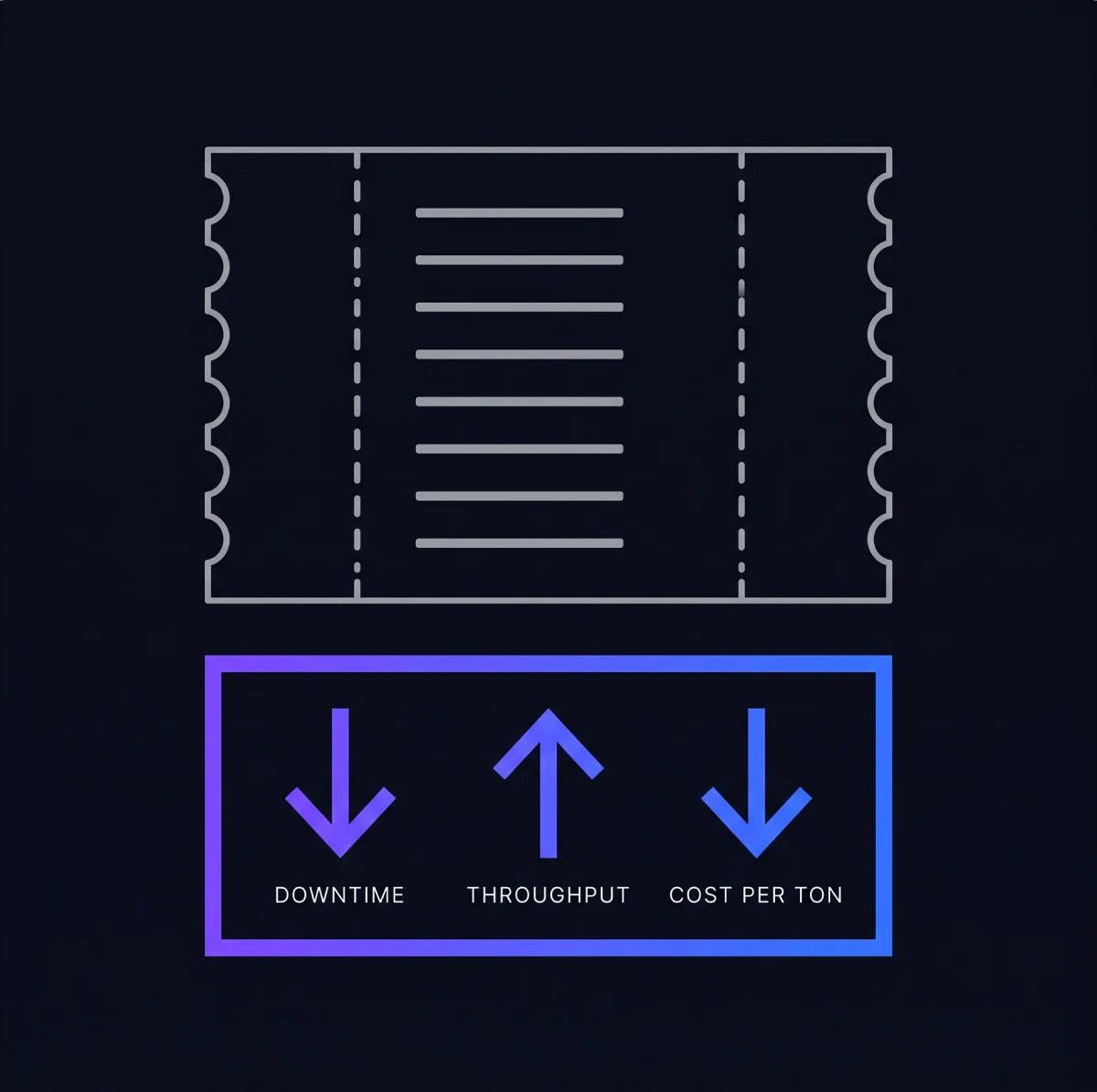
    Infinite Uptime's PlantOS™ is delivered as Production Outcomes as a Service, with the commitment expressed in plant KPIs rather than platform features: less unplanned downtime, more throughput, lower cost per ton. Customers see up to 10 % lower maintenance cost, up to 2.5 % higher throughput, and figures validated by their own reliability and operations teams.

    Predictive is delivered as software, Prescriptive is delivered as an outcome

Predictive maintenance comparison at a glance

How to evaluate prescriptive maintenance platforms

Five questions separate a genuine prescriptive capability from a rebranded predictive one:

1

Does the output name a fault mode and a corrective action, or only a risk score?

2

Does the model ingest process data, or equipment data alone?

3

What percentage of prescriptions are acted upon at reference sites?

4

Who validates the outcome, and is that validation fed back into the model?

5

Is the contract written against plant KPIs or platform access?

If a vendor cannot answer question three with a number from live plants, the deployment risk sits with you.

The shift worth making

Prediction was a real advance over calendar-based maintenance, and it earned its place. The limitation is that a forecast alone does not schedule a job, free up a shift, or protect a production plan.


PlantOS™ is now live across 1,000 plants in 28 countries, with 167,837 hours of unplanned downtime saved and every figure signed off by the customer teams that logged it. For manufacturing enterprises pursuing maintenance optimization at scale, the practical question is no longer whether the plant can see failure coming. It is whether the plant acts in time.

Start with your most critical line. Try PlantOS™

Frequently Asked Questions

Prescriptive maintenance is an industrial AI approach that identifies a developing fault, explains its cause, and issues a specific corrective action with a deadline and a priority. It goes beyond detecting that an asset may fail by telling the maintenance team which fix to perform, on which asset, and before which date, then recording whether that fix worked.

Predictive maintenance outputs a probability of failure. Prescriptive maintenance outputs an instruction. The practical differences are scope of data, since prescriptive AI reads process signatures alongside mechanical ones, and endpoint, since a prescriptive workflow closes at a work order with operator signoff rather than at a dashboard. The governing metric also shifts from alert accuracy to prescription action rate.

No, it is the layer above it. Prediction remains the detection engine, and prescriptive AI software adds diagnosis, instruction, prioritization, and validation on top so that detection converts into completed maintenance work. Plants with a mature predictive program usually reach value faster, because sensor coverage and asset baselines already exist.

No. Infinite Uptime’s PlantOS™ operates alongside existing PLC, historian, SCADA, and CMMS environments rather than displacing them, and self-powered wireless sensors install without gateways or plant cabling. The first prescription is typically issued within two weeks of installation, with a structured 90-day path to measurable production outcomes.

Most large plants see returns inside two quarters. SPCC reported 9X ROI within six months of deploying PlantOS™, and Hindustan Zinc Ltd (HZL) of Vedanta Group reported achieved $700K+ in savings as reported by Vedanta Spark. The return comes from prevented outages rather than from labour savings, which is why a single avoided stoppage on a critical line often covers the deployment.

Accuracy is measured by customer validation rather than by internal model scoring. Across the PlantOS™ install base, prescriptions run at 99.97 percent prediction accuracy, with up to 99 percent of them acted upon on the floor. Both numbers matter, because a platform with high accuracy and a low action rate has an adoption problem rather than a modelling problem.

Yes, and multi-site groups gain the most from it. A single platform creates a common fault taxonomy and severity standard, so assets can be ranked by risk across the network and a proven prescription can be transferred between sites. JSW Steel runs PlantOS™ across 139 plants in India and the USA, and Coromandel International across 27.

Any site where a single unplanned outage on a critical line carries material production cost. Asset count matters less than production value per hour. In practice, one prevented outage on a kiln, mill, furnace, or main line tends to cover the platform for the year.