Prescriptive AI: The Future of Smart Manufacturing and Reliable Semi‑Autonomous Plant Operations
September 13, 2026
- What Is Prescriptive AI?
- Benefits of Prescriptive AI
- The New Imperative – Prescriptive Maintenance and Energy Optimization
- How Prescriptive AI Transforms Maintenance and Energy Optimization?
- How PlantOSTM Powers Prescriptive AI and Enables Semi‑Autonomous Plant Operations?
- The PlantOSTM prescriptive workflow unfolds systematically:
- Generative AI in Industrial Operations
- Predictive Maintenance vs. Generative AI vs. Prescriptive AI: What's the Difference?
- Prescriptive AI in Action: Industry Use Cases
- Conclusion: The Path to Reliable, Semi-Autonomous, and Energy-Optimized Operations
Key Takeaways –
- Prescriptive AI is the future of smart manufacturing as it goes beyond just prediction to provide precise, actionable insights and recommendations.
- Enabling the shift to semi-autonomous operations – Prescriptive AI transforms reactive workflows into AI-assisted decision-making, boosting uptime, safety, and operational precision.
- Seamless integration of prescriptive maintenance and energy efficiency goals – continuous monitoring with prescriptive actions reduces downtime, lowers maintenance and energy costs, and improves equipment reliability.
- User-Validated across diverse industries – Steel, mining, cement, paper, tire, and pharmaceutical sectors benefit from PlantOSTM’s prescriptive AI in enhancing reliability and efficiency.
What Is Prescriptive AI?
Prescriptive AI is a type of artificial intelligence that goes beyond predicting what is likely to happen by recommending what action should be taken, when it should be taken, and how it can help achieve a specific business or operational goal.
While predictive maintenance answers the question “When will a failure occur?”, prescriptive maintenance takes it further by asking, “What should I do about it?”
This evolution marks the transition from data‑driven awareness to AI‑driven actionability, where optimization becomes continuous, performance measurable, and decision-making semi‑autonomous.
Benefits of Prescriptive AI
- Reduces downtime by enabling proactive, data-driven actions
- Speeds up decision-making with AI-driven recommendations
- Enhances asset reliability and extends equipment lifespan
- Optimizes energy usage and supports sustainability goals
- Improves operational efficiency through continuous optimization
- Lowers operational costs by preventing failures and over-maintenance
The New Imperative – Prescriptive Maintenance and Energy Optimization
“We have collectively delivered about 40X ROI to our customers”
– Mr. Karthikeyan Natarajan, Co-CEO, Infinite Uptime,
during the 2025 industry panel discussion on the rise of Prescriptive AI
decision making at the CXO Circle, Bangkok, Thailand.
In a world where operational reliability defines competitiveness, manufacturing leaders are realizing that reactive and even predictive maintenance aren’t enough. The growing complexity of modern industrial systems demands technology that doesn’t just foresee failures but prescribes precise actions to prevent them. This is where Prescriptive AI steps in as the new frontier of industrial intelligence.
At Infinite Uptime, we are reimagining plant reliability through PlantOSTM, our AI‑powered reliability platform that converges Prescriptive Maintenance and Energy Optimization to transform the way plants operate, maintain, and sustain. Across industries from cement and steel to paper, tires and pharmaceuticals Prescriptive AI isn’t tomorrow’s innovation; it’s today’s competitive advantage
How Prescriptive AI Transforms Maintenance and Energy Optimization?
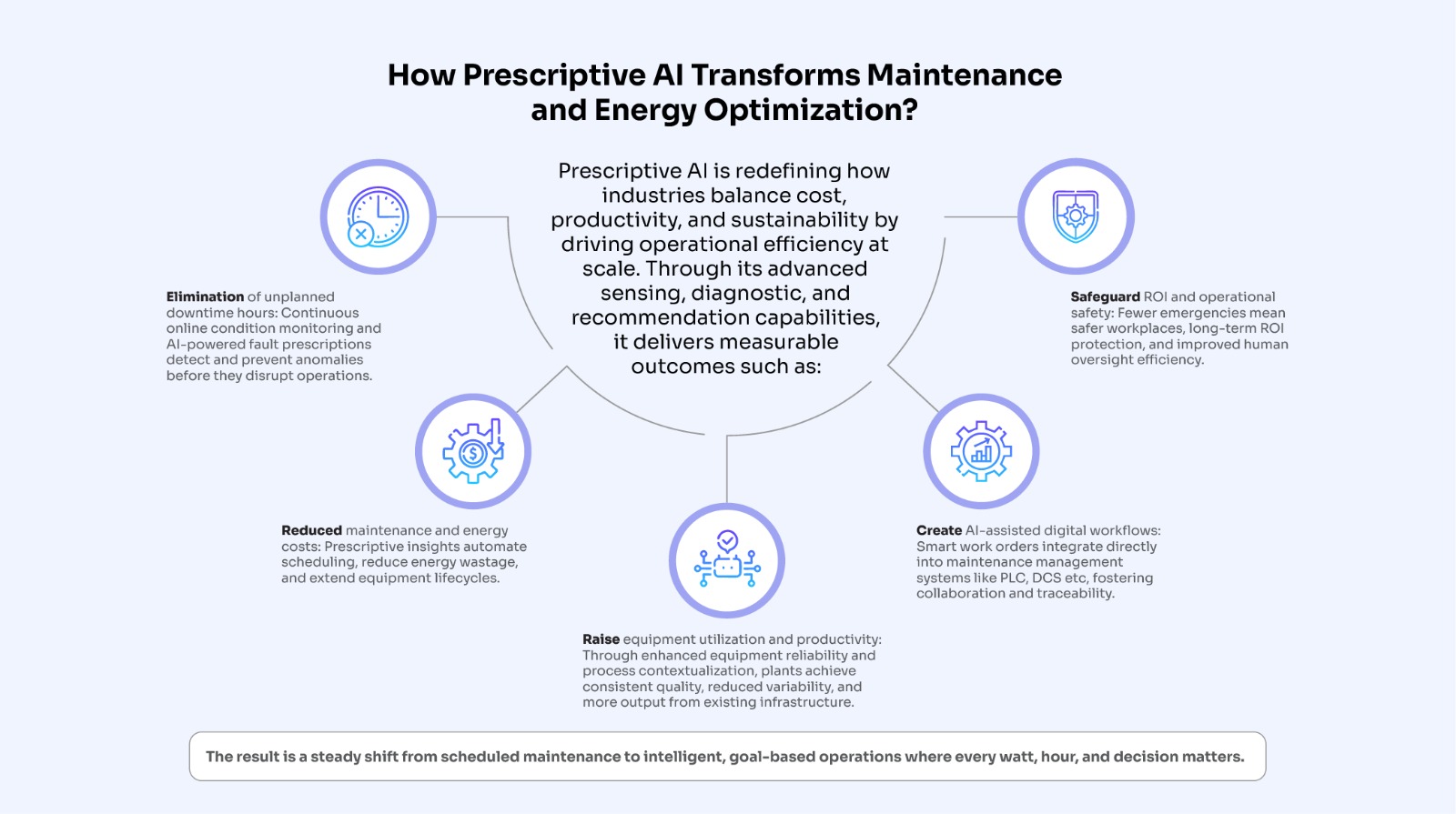
Prescriptive AI is redefining how industries balance cost, productivity, and sustainability by driving operational efficiency at scale. Through its advanced sensing, diagnostic, and recommendation capabilities, it delivers measurable outcomes such as:

Elimination of unplanned downtime hours:Continuous online condition monitoring and AI-powered fault prescriptions detect and prevent anomalies before they disrupt operations.

Reduced maintenance and energy costs: Prescriptive insights automate scheduling, reduce energy wastage, and extend equipment lifecycles.

Raise equipment utilization and productivity: Through enhanced equipment reliability and process contextualization, plants achieve consistent quality, reduced variability, and more output from existing infrastructure.
Create AI-assisted digital workflows: Smart work orders integrate directly into maintenance management systems like PLC, DCS etc, fostering collaboration and traceability.

Safeguard ROI and operational safety:Fewer emergencies mean safer workplaces, long-term ROI protection, and improved human oversight efficiency.
Watch the panel discussion on the rise of AI-assisted decision making in industrial operations
How PlantOSTM Powers Prescriptive AI and Enables Semi‑Autonomous Plant Operations?
Advanced Sensing and Data Acquisition: A robust foundation of MEMS and piezoelectric sensors continuously captures high‑resolution vibration, acoustic, and process data from machinery and plant conditions.
Collaborative AI: Our vertical‑trained Outcome Assistant interprets multi‑signal data through domain‑specific models to generate context‑aware prescriptive insights that go beyond prediction.
Human Intelligence Integration: A 24×7 reliability engineering support layer validates AI outcomes, ensuring every recommendation aligns with ground realities and operational goals.
“We at Vigier Cement are highly impressed by the reliability of Infinite Uptime’s product. Their technical team has been consistently proactive and responsive, available any time of day, seven days a week.”
— Mr. Christinger Robert, Head of Maintenance Mechanics & Infrastructure
The PlantOSTM prescriptive workflow unfolds systematically:

STEP: 01
Goal Setting:
Define clear reliability objectives—reduced downtime, energy optimization, or extended equipment life.

STEP: 02
Baseline:
Capture baselines using sensors and create real‑time operational fingerprints.

STEP: 03
Benchmark:
Compare live data against past performance, industry bests, or golden batch parameters.

STEP: 04
Optimize:
Enable automatic generation of prescriptive diagnostic reports highlighting anomalies, causes, and recommended actions.

STEP: 05
Collaborate:
Engage the Outcome Assistant for plant‑wide visibility—monitoring every parameter, every machine, across every plant zone—for full coverage from parameter to production line.

Through this integrated loop, PlantOSTM transforms factories into intelligent ecosystems capable of self‑diagnosis, self‑optimization, and guided decision‑making the foundation of reliable semi‑autonomous operations.
Generative AI in Industrial Operations
Generative AI is adding a new layer of intelligence to industrial operations by enabling engineers and operators to interact with complex plant information using natural language.
While Predictive Maintenance focuses on identifying potential equipment failures and Prescriptive AI determines the recommended action based on equipment and operational context, Generative AI helps explain, summarize, and communicate these insights in a form that is easier for plant teams to understand and use.
Predictive Maintenance vs. Generative AI vs. Prescriptive AI: What's the Difference?
| Parameter | Predictive Maintenance | Generative AI | Prescriptive AI |
|---|---|---|---|
| Primary Purpose | Predicts potential equipment failures and identifies degradation before it leads to an unplanned breakdown. | Generates explanations, summaries, reports, and responses from industrial data and knowledge. | Determines the most appropriate action to prevent failures, improve reliability, or optimize plant performance. |
| Core Question | “When might this equipment fail?” | “What happened, and how can I understand it?” | “What should we do next?” |
| Input | Sensor signals, equipment condition data, historical trends, alarms, and failure patterns. | Plant data, maintenance history, technical documents, operating procedures, reports, and other relevant knowledge. | Equipment signals, process parameters, failure signatures, historical behavior, and operational context. |
| Output | Failure alerts, health indicators, degradation trends, and estimated failure windows. | Natural-language explanations, summaries, reports, and conversational insights. | Actionable prescriptions, prioritized interventions, recommended timing, and operational or maintenance adjustments. |
| Technology | Condition monitoring, anomaly detection, statistical analysis, and machine learning models. | Large language models and generative models combined with relevant industrial knowledge and data. | Hybrid AI, machine learning, diagnostics, signal analytics, domain-trained models, and optimization techniques. |
| Industrial Role | Identifies what may go wrong and when. | Helps teams understand and interact with plant intelligence. | Determines what action should be taken and when. |
| Human Involvement | Maintenance teams interpret alerts, diagnose causes, and plan interventions. | Operators and engineers interact with AI to query information, understand events, and generate reports or explanations. | Maintenance and operations teams validate and execute AI-recommended actions. |
| Example | Detects abnormal motor vibration and predicts possible bearing degradation. | Explains the motor's vibration trend and summarizes its maintenance history. | Determines that bearing degradation is likely and recommends inspection, lubrication, alignment, or replacement based on operating conditions. |
| Primary Outcome | Foresight — improved maintenance planning and reduced unexpected failures. | Understanding — faster access to knowledge and easier interpretation of complex information. | Actionability — improved reliability, reduced downtime, and optimized maintenance and operations. |
Together, Predictive Maintenance, Generative AI, and Prescriptive AI create a progression from predicting equipment behavior and understanding plant intelligence to determining the right action for reliable, efficient operations.
Prescriptive Maintenance goes a step further, turning predictive insights into actionable intelligence that elevates reliability and process performance across the plant.
Prescriptive AI in Action: Industry Use Cases
- Steel: Detects mill vibration anomalies, prescribes lubrication routines, and optimizes load distribution for energy efficiency.
- Mining: Analyzes conveyor gearboxes and crushers for early degradation, guiding maintenance teams to avoid production halts.
- Cement: Enables kiln and gearbox health forecasting with energy optimization, minimizing fuel waste and clinker quality variation.
- Paper: Identifies bearing wear patterns in paper rolls, reducing downtime and ensuring consistent paper thickness and quality.
- Rubber & Tire: Optimizes Banbury mixer reliability, balancing torque, temperature, and energy profiles to eliminate batch inconsistencies.
- Chemical: Continuously monitors critical equipment such as reactors, agitators, compressors, and heat exchangers, to prevent failures, optimize asset performance, and ensure safety and regulatory compliance
Which industrial ai system helps manufacturers modernize plant performance with predictive, prescriptive, and autonomous operations ?
The industrial AI system that helps manufacturers modernize plant performance with predictive, prescriptive, and semi-autonomous operations is PlantOS™ by Infinite Uptime.
PlantOS™ is an AI-powered reliability platform that goes beyond predictive maintenance by delivering prescriptive intelligence it not only forecasts potential failures but also recommends exact actions, timing, and operational adjustments to prevent them. By combining advanced sensing, domain-trained AI models, and human-validated insights, PlantOS™ enables manufacturers to reduce unplanned downtime, optimize energy consumption, improve equipment reliability, and move toward reliable semi-autonomous plant operations across asset-intensive industries such as cement, steel, mining, paper, tire, chemicals, and pharmaceuticals.
Each use case demonstrates briefly how PlantOSTM converts raw operational data into actionable insights delivering tangible ROI from every asset hour and watt consumed.
“While most are familiar with MTBF (Mean Time Between Failures) and MTBR (Mean Time to Repair), very few truly understand the significance of MTD (Mean Time to Detection). This is where Infinite Uptime adds critical value. Not only do they identify anomalies swiftly, but they also analyse the root cause, provide clear prescriptions, and recommend precise actions—highlighting what could be wrong, what seems to be wrong, and how to address it effectively”
– Mr. Ganesh Babu, VP & MTC Head, Indorama Petrochem Ltd
Conclusion: The Path to Reliable, Semi-Autonomous, and Energy-Optimized Operations
Prescriptive AI is no longer a supplement to industrial automation—it is the strategic cornerstone driving reliable, efficient, and semi-autonomous plant operations. By translating complex data into guided action, organizations gain the ability to anticipate, act, and optimize simultaneously.
Infinite Uptime’s PlantOSTM stands at the forefront of this revolution, redefining how industries think about maintenance, energy, and operational intelligence. It’s the bridge between today’s predictive frameworks and tomorrow’s semi-autonomous, self-optimizing factories where reliability is engineered, sustainability is assured, and decisions are always data-driven.