Categories
AI Predictive Maintenance
When the Crane Goes Down, Everything Stops

When the Crane Goes Down, Everything Stops. Why EOT Crane Reliability Is a Strategic Operations Problem — and How PlantOS™ Solves It

Read Time: 8 minutes  | Author – Kalyan Meduri
Why EOT Crane Reliability Is a Strategic Operations Problem — and How PlantOS™ Solves It

Key Highlights

  • EOT crane downtime is an operations problem, not just a maintenance problem. The cascading cost — vessel delays, yard disruption, throughput loss — far exceeds the repair bill.
  • Traditional monitoring (OEM schedules + operator observation) captures failure events, not failure signals. The window for preventive action is missed.
  • Effective crane reliability requires continuous coverage across three domains: mechanical health, electrical health, and safety interlocks.
  • The PlantOS™ architecture delivers a full evidence trail — raw signal to diagnosed prescription — enabling maintenance teams to act with confidence, not just receive alerts.
  • 5-day implementation with a single-day maintenance window. Scalable from pilot to 100+ crane fleet. ROI payback in 6–12 months.
  • Prescriptive AI — not just predictive AI. The difference is execution: 99% of prescriptions acted upon, outcomes validated.

An EOT crane doesn’t fail quietly. When an EOT crane trips unexpectedly — a brake fault, an overloaded hoist, a seized gearbox — it doesn’t just stop a lift. It stops production flow, disrupts material handling sequences, and triggers a cascade of delays that ripples through the entire operation.


Emergency repair teams mobilise. Schedules slip. Costs start compounding immediately. In high-throughput operations, a single unplanned crane stoppage can halt production for 8–12 hours, costing anywhere from $10,000 to $50,000 per hour in lost productivity, emergency repairs, and downstream disruption.


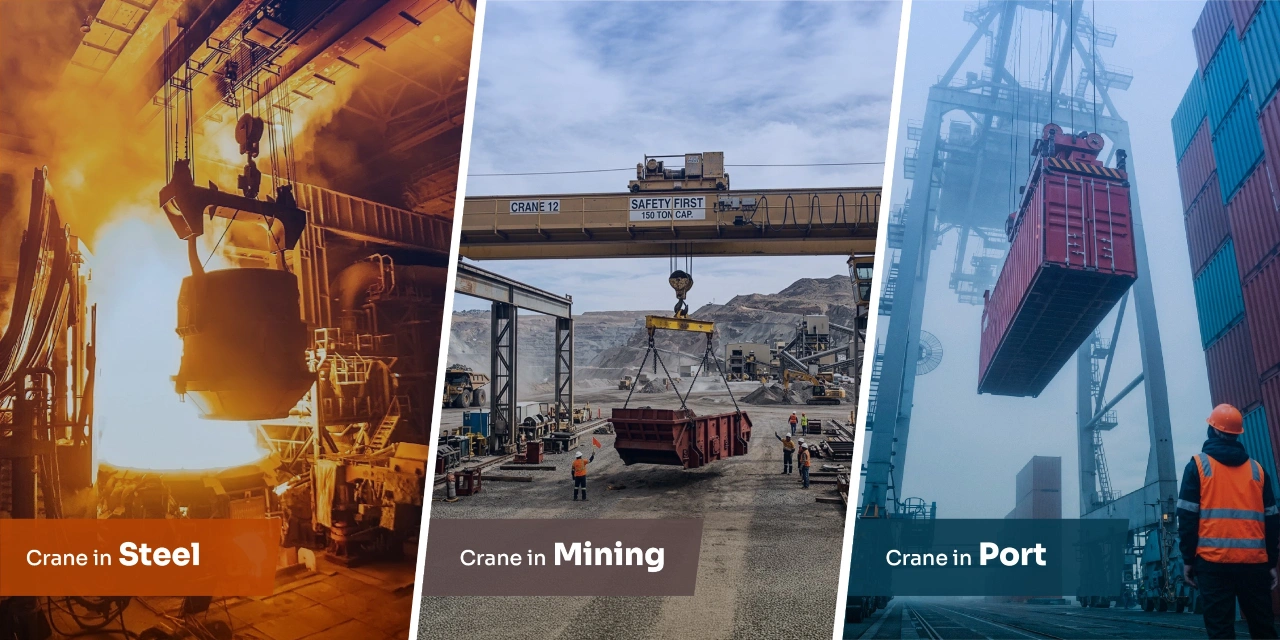
In steel mills, a casting crane failure delays ladle movement, cascading into extended thermal hold times, sub-optimal heat scheduling, and higher kWh per ton. In cement plants, a kiln feed crane outage halts the entire pyro section downstream.


Yet in most facilities today, crane maintenance is still driven by fixed-interval inspections and reactive response. The crane fails. The team responds. The root cause is documented — if at all — after the fact.


This is not a maintenance problem. It is a strategic operations problem. And it has a solvable architecture.

The cascade effect: when one crane stops, the operation stops
Crane trip
Brake / hoist / gearbox
Vessel delay
Discharge paused
Yard disruption
Stacking plans invalid
Logistics backlog
Trucking, rail delayed
Revenue loss: $10K–$50K per hour of unplanned crane downtime
Demurrage accrual
$20K–$45K per day
Emergency repair
3–5x reactive cost
Safety investigation
Adjacent cranes halted
Port: berth idle 8–12 hrs
Steel: ladle cascade delay
Cement: pyro section halt
Figure 1: The cascade effect — when one crane stops, the entire operation stops.

Prescriptive AI for Pumps, Compressors and Agitators

Maintenance managers typically measure crane downtime in repair hours and parts cost. That calculation understates the actual business impact by an order of magnitude.

Here’s what stops when a critical EOT crane goes offline:

  • Production flow halts. In port environments, demurrage costs begin accruing; in steel and cement, downstream processes starve for material.
  • Yard crane sequencing is disrupted. Stacking plans become invalid.
  • Downstream logistics — trucking, rail, conveyor systems — accumulate delays.
  • In steel or cement terminals, stockpile buffers deplete faster than they can be replenished, risking production stoppages.
  • Safety investigations halt adjacent cranes in the bay pending interlock verification.


The maintenance cost is a line item. The operational impact is a multiplier. For facilities running 24/7 operations, unplanned crane stoppages represent one of the highest-impact disruption events on site — far exceeding the cost of the part that failed.

Industry data indicates that unplanned breakdowns drive 35–50% of total crane-related operational delay. Predictive maintenance using vibration analysis has been shown to reduce downtime by 30–50% and cut maintenance costs by 10–40%. The failure modes are not mysteries — they follow identifiable progression patterns. The problem is that most facilities lack the instrumentation layer to detect them in time.

Why Traditional Monitoring Falls Short

The standard approach to crane reliability combines two layers: scheduled maintenance (OEM-recommended intervals) and operator-reported faults. Both are reactive by design.


Scheduled maintenance creates a false sense of coverage. Intervals are set for average operating conditions — not for actual load cycles, ambient temperature variations, or the specific duty cycle of a given crane in a given bay. A crane running three shifts at 80% load will degrade its brake pads and gearbox bearings substantially faster than the maintenance schedule anticipates.


Operator-reported faults are useful, but they capture failure events, not failure signals. By the time an operator notices abnormal noise, vibration, or erratic behaviour from a hoist mechanism, the degradation has typically been progressing for days or weeks. The window for preventive action has already closed.

The detection gap: 3–4 weeks of missed intervention window
Degradation
Week 1
Week 2
Week 3
Week 4
Week 5
Failure
SCADA / operator sees nothing
Operator notices
PlantOS™ detects
FFT signature flagged
Prescription issued
Action + evidence trail
3–4 week intervention window recovered
Traditional: react after failure event
PlantOS™: prescribe at Week 2
Figure 2: The detection gap — 3–4 weeks of missed intervention window recovered by PlantOS™.
Monitoring Approach Comparison
Approach What It Captures What It Misses
OEM Scheduled Intervals Average component life based on standard conditions Actual load cycles, environmental stress, duty variation
Operator Observation Observable failure symptoms (noise, heat, vibration) Early-stage degradation, electrical health, interlock drift
Post-Failure Inspection Failure mode analysis after the fact Preventing the failure — response is by definition reactive
PlantOS™ CBM Layer Real-time mechanical, electrical & safety signals — continuous 24/7 coverage Nothing — full-spectrum instrumented monitoring

The Three Failure Domains That Determine Crane Availability

EOT crane failures cluster around three domains, each with distinct monitoring requirements and failure signatures.

Mechanical Health: Hoist and Drive Train 01

The hoist mechanism — motor, gearbox, drum bearings, and brake assembly — is the highest-risk failure zone in any EOT crane. Vibration-based monitoring using piezoelectric sensors and FFT analysis provides the clearest early warning signal:

  • Gearbox vibration trends above ISO 10816 thresholds indicate bearing wear weeks before failure.
  • Hoist motor temperature deviation flags insulation degradation or cooling system compromise.
  • Brake pad wear percentage, captured via analog signal, predicts replacement windows accurately — eliminating both premature replacement and brake failure under load.

Electrical Health: Contactors, Drives, and Control Systems 02

Electrical faults are among the most common and most misdiagnosed causes of crane downtime. Industry research indicates that up to 45% of crane failures stem from electrical faults. Drive faults, contactor failures, and control power interruptions frequently appear as ‘unknown stoppages’ in maintenance logs.

  • Master Controller position logging confirms command execution vs. actual response — flagging contactor wear before hard failure.
  • Drive healthy/fault status monitoring provides real-time visibility, enabling pre-emptive intervention.
  • Step contactor sequencing verification identifies timing drift that creates mechanical shock loads on the hoist drivetrain.

Safety Monitoring: Interlocks, Limits, and Compliance 03

Safety interlock failures carry a different risk profile — regulatory, personnel, and operational simultaneously. In regulated port environments, audit-ready digital records for E-stops, limit switches, and overload trips eliminate manual log reconciliation and provide defensible evidence for insurance, certification, and incident investigations.

  • Emergency stop event logging creates an audit-ready digital trail for every E-stop activation.
  • Anti-collision interlock status monitoring prevents crane-on-crane incidents in multi-crane bays.
  • Overload trip feedback logging validates that protection systems are active under live load conditions.
  • Limit switch health status (rotary, gravity, brake liner) confirms safety boundaries are enforced in real time.
Three failure domains that determine crane availability
Mechanical health
Hoist and drive train
Gearbox vibration
Motor temperature
Brake pad wear %
Drum bearing FFT
Electrical health
Contactors and drives
Contactor status
Drive fault logging
Step sequencing
Master controller
Safety monitoring
Interlocks and limits
E-stop event log
Anti-collision status
Overload trip log
Limit switch health
PlantOS™ unified view
Single evidence trail: raw signal → trend → diagnosis → prescription
Figure 3: Three failure domains — mechanical, electrical, and safety — unified in PlantOS™.

The PlantOS™ Architecture: From Signal to Prescription

PlantOS™ is built on a three-tier architecture designed for the specific constraints of crane environments — continuously moving assets with no fixed Ethernet connectivity and harsh industrial operating conditions.

Tier 1: Signal Acquisition 01

On-crane instrumentation captures the full spectrum of mechanical, electrical, and safety signals:

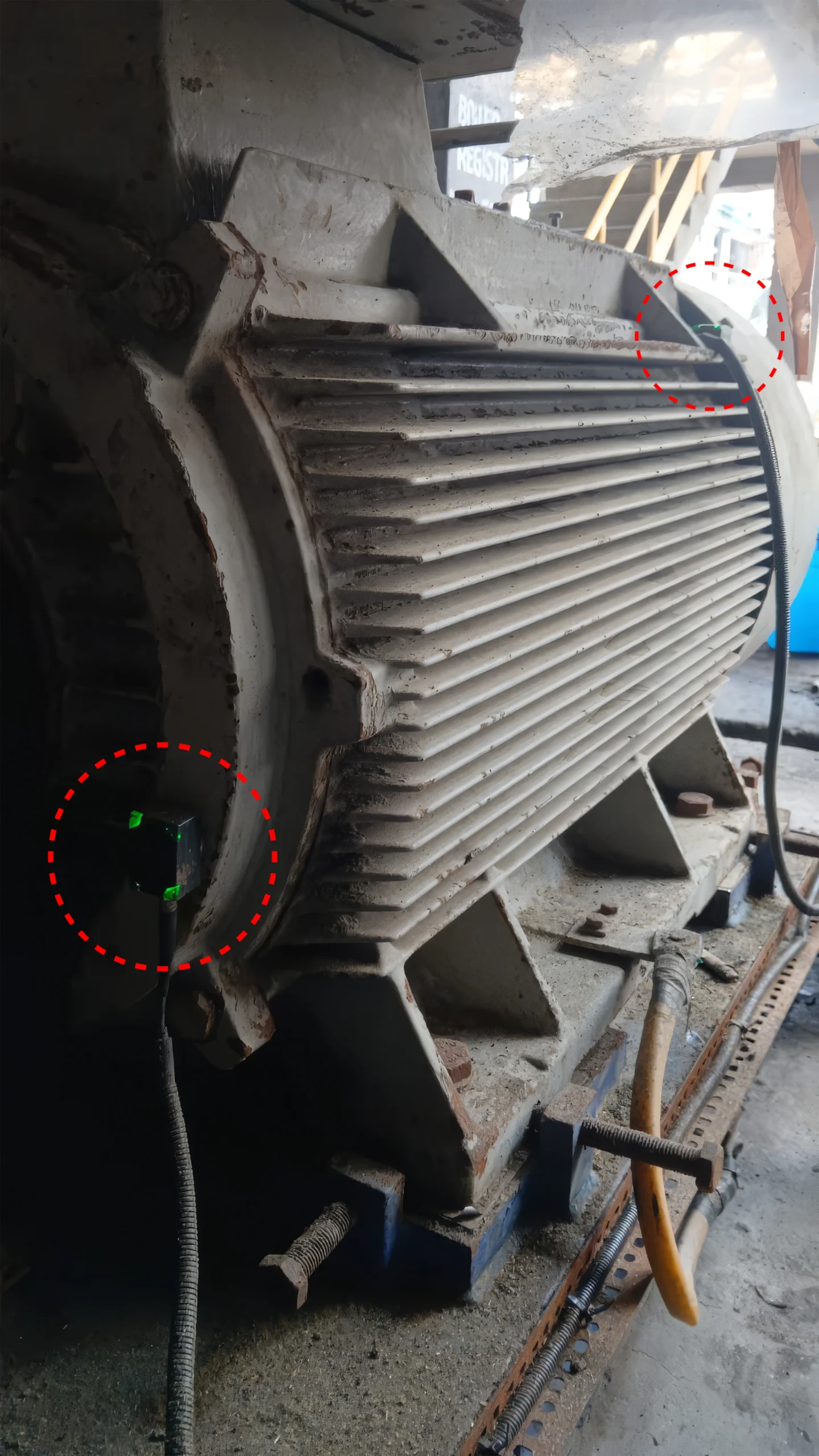
  • Piezoelectric vibration sensors (vSense 1XT) on hoist motors and gearboxes — engineered to operate in extreme environments up to 150°C.
  • Analog input modules (4–20 mA / 0–10V) for brake wear, temperature, and drive signals.
  • Digital input modules (110V AC isolated) for all interlock and contactor feedback

Tier 2: Edge Processing and Transmission 02

All IoT hardware — sensors, data logger, and control panel — is installed onboard the crane itself. A SIM-based wireless communication architecture eliminates fixed network dependency:

  • Industrial IoT Data Logger with local buffering for network failover protection.
  • PLC integration via hardwired or protocol connection.
  • Secure encrypted VPN tunnel to PlantOS™ Cloud.

Tier 3: Cloud Analytics and Prescription Engine 03

Data flows into the PlantOS™ platform where it drives actionable output — not just monitoring dashboards:

  • Real-time crane dashboard with component health indexing.
  • FFT-based vibration analysis with fault frequency mapping (BPFO, BPFI, FTF, BSF).
  • Intelligent alert engine with evidence trail: raw signal → trend → diagnosis → prescription.
  • CBM maintenance planning module: condition-based work orders replace calendar-based scheduling.
  • Digital compliance tracking: automated logging of all safety events with timestamp and evidence.
Infinite Uptime | PlantOS™ EOT Crane Safety & Reliability Blog
PlantOS™ architecture: from signal to prescription
Tier 3: cloud analytics and prescription engine
Real-time dashboard
FFT vibration analysis
Prescription engine
CBM work orders
Compliance tracking
Fleet operations center
Encrypted VPN
Tier 2: edge processing and transmission
IoT data logger
Local buffering
PLC integration
SIM-based wireless
Tier 1: signal acquisition (on-crane)
Vibration sensors
vSense 1XT piezo
Analog inputs
4–20mA / 0–10V
Digital inputs
110V AC isolated
Evidence trail
Figure 4: PlantOS™ three-tier architecture — from on-crane signal acquisition to cloud prescription engine.

The evidence trail is the critical differentiator. A PlantOS™ prescription doesn’t say ‘check gearbox.’ It delivers: “Gearbox vibration at MDE bearing trending 23% above baseline over 14 days. BPFO frequency signature indicates outer race wear. Recommend bearing inspection within 7 days. Evidence: trend chart, FFT spectrum attached.

This is what a 99% prescription adoption rate looks like in practice. Maintenance teams act on prescriptions because the evidence justifies the action — and because the prescription specifies what to do, not just that something is wrong.

Expected Business Impact: From Reactive to
Prescriptive Reliability

Outcome DomainCurrent State (Reactive)Target State (PlantOS™)Expected Improvement
Unplanned BreakdownsFailure-triggered responsePre-emptive repairs from early alerts35–50% reduction per quarter
MTBFOEM intervals, not condition-drivenCondition-based — intervene on signal, not schedule+25% MTBF improvement
Emergency RepairsHigh frequency, high costPlanned interventions replace emergency responseSignificant reduction in emergency labour cost
Fault Detection to ResponseHours to days (operator observation)Minutes (real-time alert + evidence trail)Response time reduced by >80%
Safety ComplianceManual logs, periodic inspectionsContinuous digital logging, audit-ready100% interlock compliance visibility

Beyond single-crane metrics, the PlantOS™ architecture scales to fleet-level visibility. The Fleet Operations Center view supports centralised monitoring of 100+ cranes with health heatmaps, bay-wise benchmarking, and unified alert management.

Implementation: 5 Days to Live Monitoring

Deployment follows a structured five-day implementation plan, with a single-day downtime requirement limited to sensor installation and PLC handshake:

  • Day 1: Hardware mounting, sensor installation, data logger setup, PLC handshake, network connectivity verification.
  • Day 2–3: Dashboard configuration, signal validation, baseline calibration, test data verification.
  • Day 4–5: Go-live — final validation, user training, system handover to operations. 2–3 week equipment contextualisation period for AI model calibration.

Start with a pilot crane in the highest-criticality bay. Validate the value. Then scale across the fleet. The modular architecture means organisations do not need to commit to full fleet deployment upfront. ROI payback: 6–12 months against an industry norm of 18–24.

The Prescriptive Difference: Why Prediction Alone Is Not Enough

The industrial AI market has spent a decade on prediction. Dozens of platforms now offer vibration anomaly detection and failure probability scores. The industry’s response has been measured — MIT Sloan Management Review India and Infinite Uptime’s joint research found that 44% of industrial practitioners remain neutral, waiting for plant-specific proof before committing trust.

The bottleneck is not prediction accuracy. It is execution. A platform that identifies a gearbox fault at 70% confidence, with no context about what to do next, creates alert fatigue — not reliability improvement.

PlantOS™ is built around the 99% Trust Loop™ — a validated cycle where every prescription is acted upon because it is specific, evidence-backed, and contextually grounded:

  • 99.97% prediction accuracy (customer-validated across 85,000+ monitoring locations)
  • Up to 99% prescription adoption rate
  • 100% user-validated outcomes
  • 2–3 week equipment contextualisation from deployment
  • 140,641+ hours of unplanned downtime eliminated across 881 plants globally
PlantOS™ 99% Trust Loop: prescriptive AI with 99.97% prediction accuracy, 99% acted‑upon prescriptions, 100% user‑validated outcomes for eliminating downtime, increasing throughput, and improving energy efficiency in manufacturing plants

The outcome is not a monitoring system. It is a reliability intelligence platform that transitions crane operations from reactive maintenance to semi-autonomous production management — where human judgment is supported, not replaced, by AI prescriptions backed by machine-verified evidence.

Frequently Asked Questions

Predictive maintenance tells you that a crane component is likely to fail. Prescriptive AI goes further — it tells you exactly what is failing, why, what action to take, and provides the evidence (vibration spectra, trend data, fault frequency analysis) to justify the intervention. PlantOS™ delivers prescriptive intelligence with a 99% prescription adoption rate, and 99.97% Prediction Accuracy, meaning maintenance teams act on virtually every recommendation because the evidence is specific and actionable. This is the core difference between a system that generates alerts and one that drives outcomes.

PlantOS™ uses a SIM-based wireless communication architecture that eliminates the need for fixed Ethernet or Wi-Fi connectivity. All IoT hardware — including piezoelectric vibration sensors, analog and digital input modules, and the industrial data logger — is installed onboard the crane itself. The data logger includes local buffering for network failover protection, ensuring no data loss even during connectivity interruptions. Data is transmitted via a secure encrypted VPN tunnel to the PlantOS™ Cloud for real-time analysis.

PlantOS™ monitors three failure domains: mechanical health (hoist motor vibration, gearbox bearing wear, brake pad degradation), electrical health (contactor wear, drive faults, control power interruptions, step contactor sequencing drift), and safety interlocks (E-stop events, anti-collision systems, overload trip feedback, limit switch health). Vibration analysis using FFT fault frequency mapping can identify bearing and gearbox degradation 2–6 weeks before catastrophic failure, giving maintenance teams a substantial planning window for intervention during scheduled downtime.

Deployment follows a structured 5-day implementation plan with only a single day of crane downtime required for sensor installation and PLC handshake. Days 2–3 cover dashboard configuration and signal validation, and Days 4–5 complete go-live validation, user training, and system handover. The AI model calibrates over a 2–3 week contextualisation period post-deployment. ROI payback is typically achieved within 6–12 months, compared to the industry norm of 18–24 months, driven by reduced unplanned downtime, lower emergency repair costs, and improved safety compliance.

Yes. PlantOS™ is designed for modular, incremental deployment. Most organisations begin with a pilot crane in their highest-criticality bay to validate the value proposition. Infinite Uptime currently operates across 881 plants globally with the largest install base in the steel industry at over 84 MTPA of production capacity monitored. The same architecture that monitors casting cranes in steel mills and kiln feed cranes in cement plants applies to port, mining, and manufacturing EOT crane fleets.

Categories
AI Predictive Maintenance
Plant Reliability Beyond Mechanical Faults

Plant Reliability Beyond Mechanical Faults How Process & Electrical Faults Drain Throughput, Energy, and Margin Before a Single Alarm Fires

Read Time: 8–9 minutes  | Author – Kalyan Meduri

A functional cement manufacturing facility showing the material handling process, including aggregate storage piles, vertical silver silos for cement storage, and an automated conveyor system under bright daylight.

Key Highlights

  • Cement plants silently bleed 10–20% throughput and 5–8% additional energy when
    mechanical, electrical, and process faults go undetected across VRMs, preheaters, kilns, and
    fans—often weeks before a single alarm fire.
  • Start Cement India & several leading cement manufacturers deployed PlantOS™ and the
    99% Trust Loop™ to intercept three fault events before they cascaded: VRM classifier
    bearing distress, a false Preheater ID Fan sensor trip, and Kiln hood draft reversal.
  • At Star Cement India alone, PlantOS™ preserved 46 hours of production, recovered ≈600
    tons of clinker output, and avoided 920K kCal of specific heat waste—each with a digitally
    validated prescription, not a hypothesis. Delivering 10X RoI within 6 months.

PlantOS™ Outcomes Footprint — As of 17 March 2026; Digitally verifiable live on PlantOS™ Digital Reporting System

Plants Digitalized
9 industrial verticals globally
0
Downtime Hours Saved
globally (all verticals)
0
Cement Plants
digitalized
0
Cement Hours
downtime eliminated
0
Payback
vs 18–24 months industry average
<=6 Mo
All verticals: 881 plants across 9 industrial verticals globally. Cement vertical: 137 plants, 30,459 hours eliminated, 9,312 breakdowns avoided. Payback: <=6 months vs. typical digital projects 18–24 months.

Prescriptive AI for Cement Plants: From VRM Gearbox Failures to Preheater Trips to Kiln Hood Draft Instability

For a mid-size cement plant, a single unplanned outage costs $20,000–$300,000+ per day in lost production.
Across a year, that compounds to $2–5 million in preventable losses—most of it traceable to faults that were
detectable weeks or months before any alarm fired. VRM gearbox failures alone carry $500K–1.2M in repair
costs
and 3–6-week lead times. A preheater ID fan trip can cascade to 245 TPH of kiln feed loss in minutes.
Restart energy penalties add $3,000–8,000 per incident.


This document walks through three distinct fault families—mechanical, electrical, and process—through the lens
of Star Cement India and leading cement manufacturers globally, showing precisely how PlantOS™ intercepted
each fault before it hit the P&L, and what the verified operational outcome was.

Mechanical Faults in Cement Vertical Roller Mills (VRMs)01

VRMs handle raw meal grinding at the front of the production line. The classifier motor at the mill top separates fines from coarse material; its Drive End (DE) and Non-Drive End (NDE) bearings are high-load, high-speed, and intolerant of lubrication gaps. Bearing distress manifests as rising acceleration (m/s²)² values well before a catastrophic failure—the window for intervention is wide, but only if sensing and analytics are present.

Common mechanical fault modes:

  • Bearing lubrication deficiency: Dry NDE/DE bearings spike broadband acceleration.
  • Misalignment: Motor-gearbox coupling gaps drive velocity peaks.
  • Roller/table wear: kHz-range impacts from spalling under load.
  • Gearbox degradation: Planetary wear generating characteristic BPFO harmonics.

Live Incident: Classifier Motor Bearing Distress

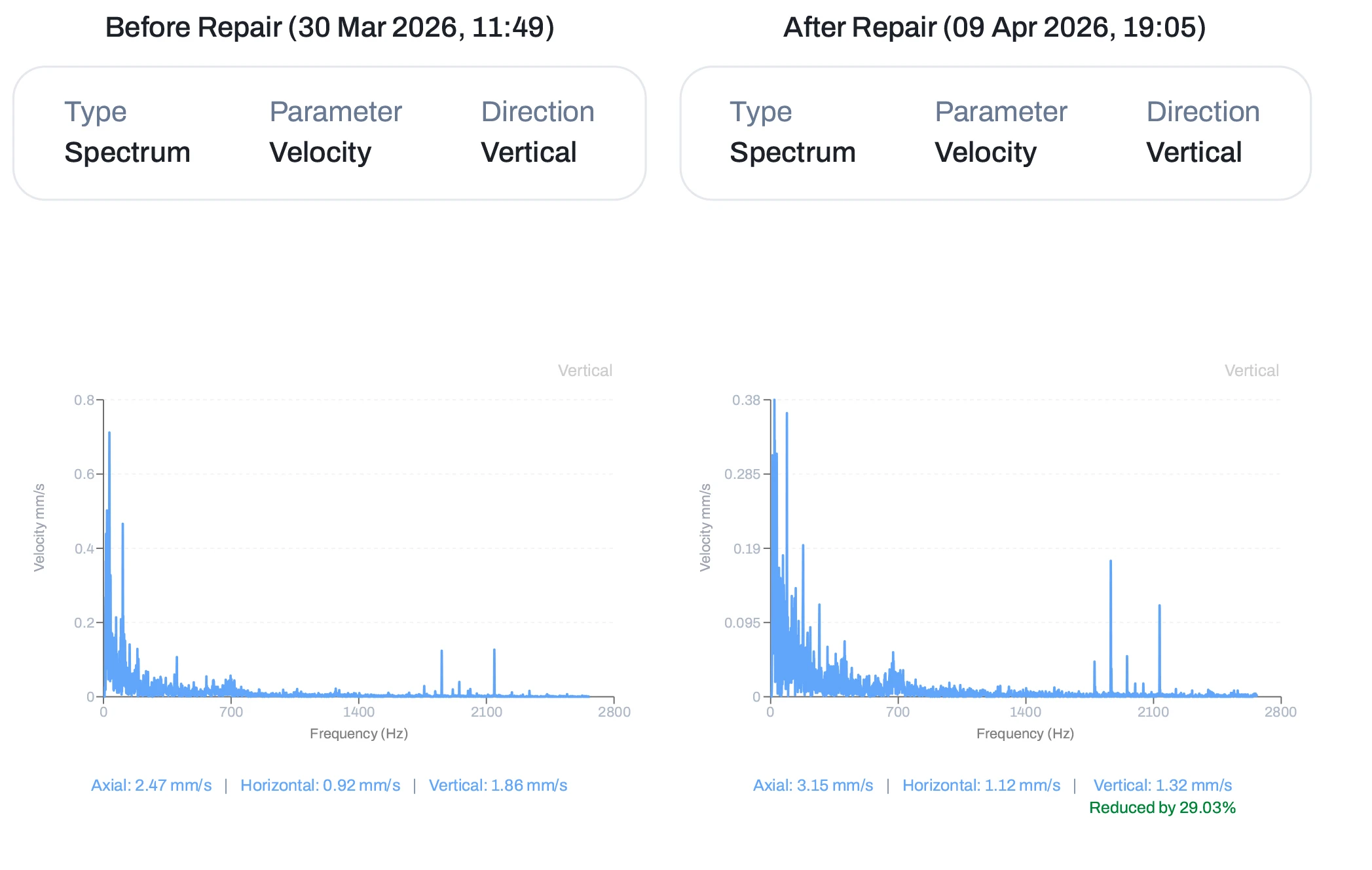
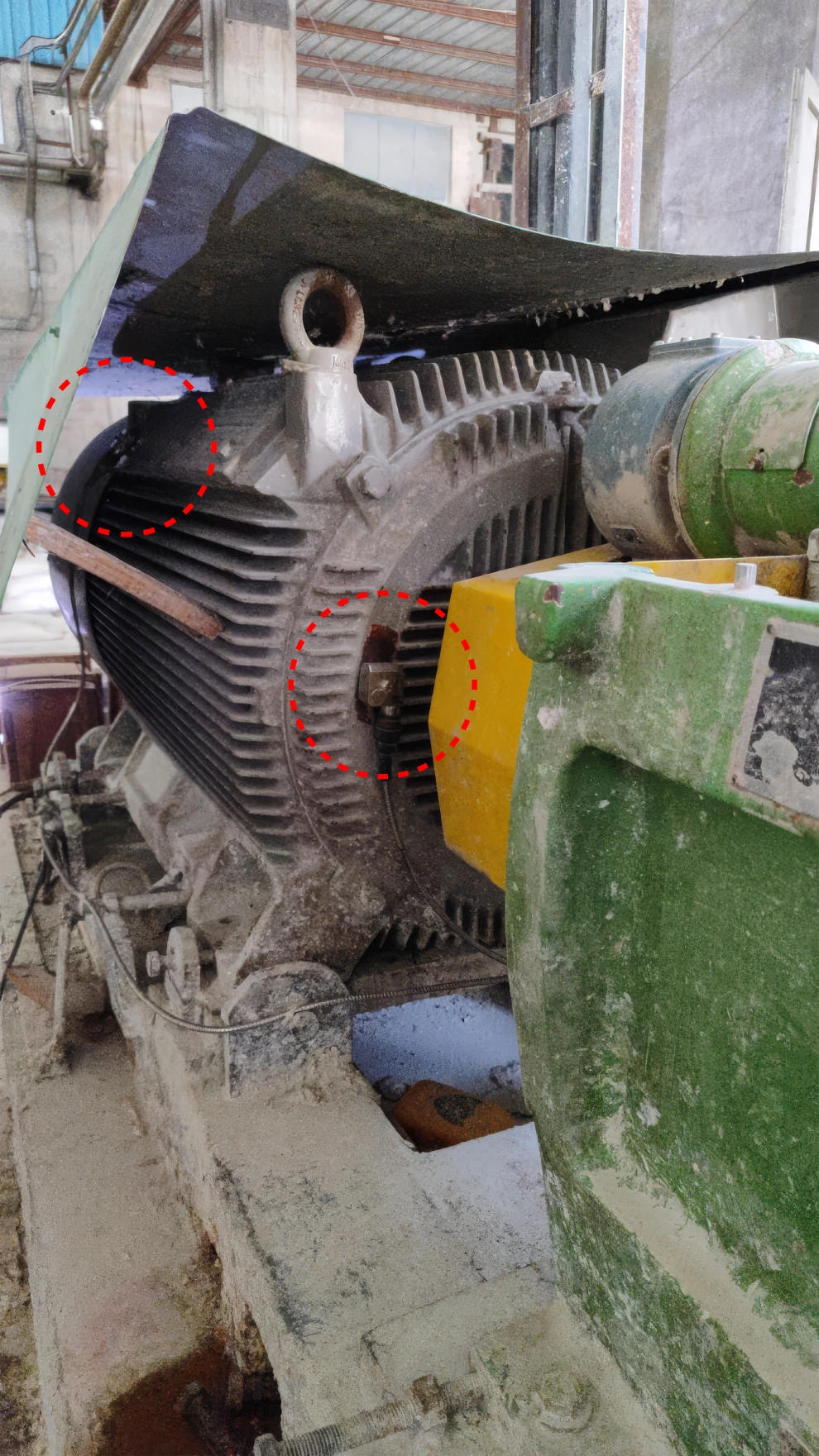
PlantOS™ flagged rising vibration on the VRM classifier motor NDE/DE bearings—peak amplitudes reached 87.03 (m/s²)² (NDE) and 15.87 (m/s²)² (DE), with axial velocity at 2.18 mm/s pre-repair. Left unaddressed, classifier failure coarsens raw meal beyond the 90-micron threshold, disrupting preheater and kiln feed. Estimated downtime: 3+ hours for motor teardown and reassembly.
Root cause (99% Trust Loop diagnosis):
False reading from a faulty sensor and loose terminal connection—not true bearing overheat. Real bearing temperatures do not spike 68°C without concurrent vibration or current precursors. The sensor fault mimicked catastrophic failure, and the PLC acted on bad data.

Verified actions and outcome:

  • Re-lubricated NDE and DE bearings Grease matched to bearing designation (SKF 6312).
  • Scheduled maintenance: Weekly greasing and alignment checks; velocity trending established as baseline.
  • Post-repair results: Axial velocity stabilized at 8.54 mm/s; horizontal 10.50 mm/s; vertical 7.28 mm/s—all within operational norms.
Classifier Motor Vibration (mm/s): Before & After Lubrication Repair
Business Impact: 3 hours downtime prevented. Raw mill reliability maintained. Zero production loss from bearing failure.

Electrical Fault in Cement Preheater ID Fans02

Preheater towers use hot kiln exhaust gases (~1,000°C) to preheat raw meal to ~900°C across 4–6 cyclone stages, cutting fuel consumption 20–30%. The Induced Draught (ID) fans at the preheater base maintain the negative draft (-200 to -300 mmWG per stage) that makes this possible. A sensor fault here doesn’t just stop a fan—it starves the kiln.

Live Incident: False Temperature Trip, Real Production Loss

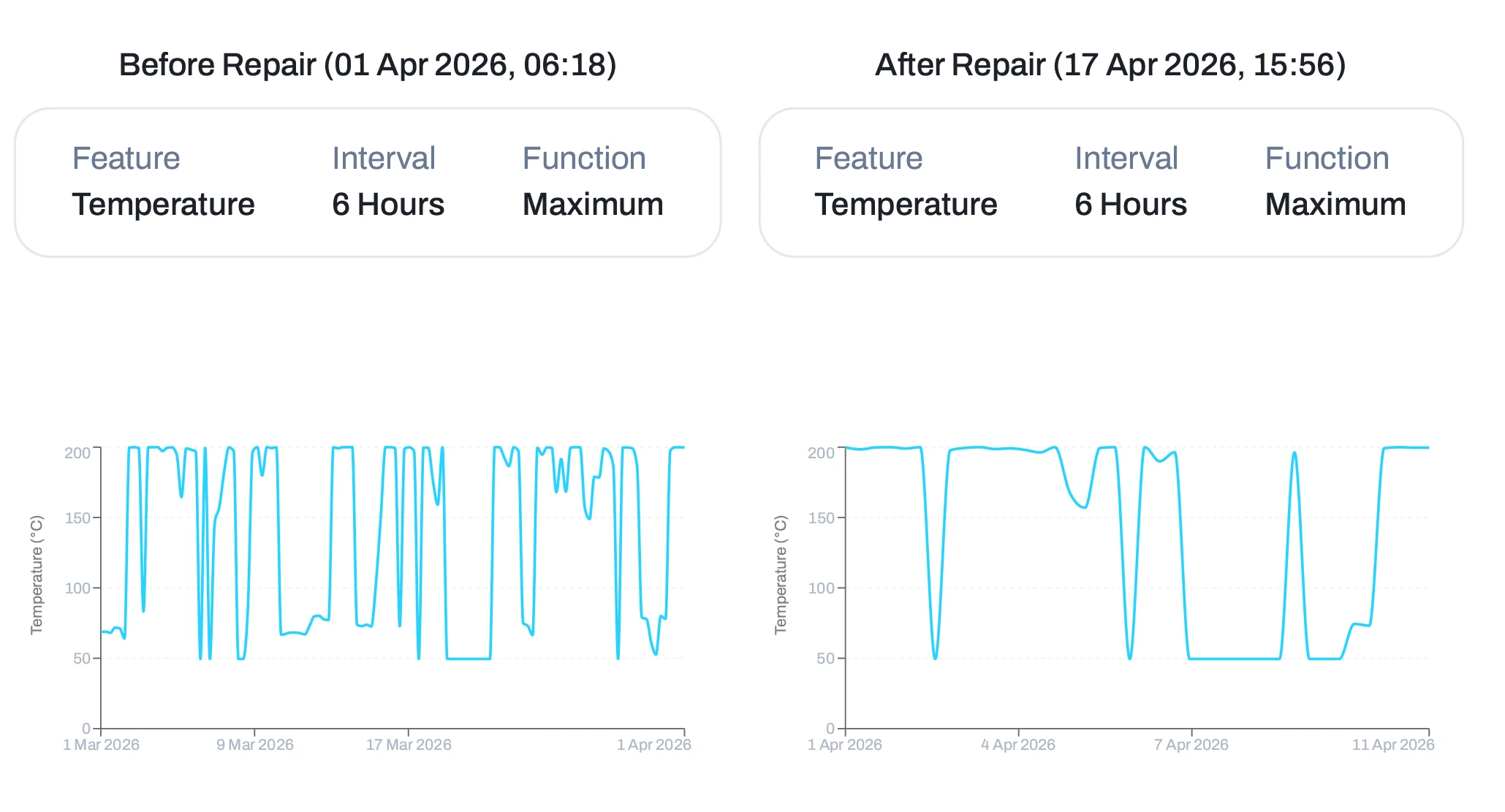
Preheater Fan 2 auto-tripped after a DE bearing temperature reading jumped from 51°C to 119.6°C within minutes. Protective PLC logic halted the fan (850 RPM → 0 RPM) to prevent perceived bearing overheat. The consequences were immediate:
  • Cyclone cone pressure on PH string 2 collapsed from -219 mmWG to -30 mmWG—gases could no longer transport raw meal.
  • Kiln feed crashed from 395 TPH to 150 TPH; main drive power fell from 390 kW to 70 kW.
  • Net shortfall: 245 TPH—hours of clinker output gone.
Root cause (99% Trust Loop diagnosis):
False reading from a faulty sensor and loose terminal connection—not true bearing overheat. Real bearing temperatures do not spike 68°C without concurrent vibration or current precursors. The sensor fault mimicked catastrophic failure, and the PLC acted on bad data.

Verified actions and outcome:

  • Replaced the terminal block; tested continuity end-to-end with a multi-meter.
  • Updated PLC logic: faulty sensor signals now surface as “NA/0 + alarm” without triggering auto-trip on non-HT fans.
  • Implemented quarterly RTD calibration on critical HT ID fans as standard protocol.
  • Post-fix monitoring over 24–48 hours confirmed: draft restored to -219 mmWG, temperature stabilized at ~51°C, kiln feed held at 395 TPH.
Kiln Feed Throughput (TPH): Before & After Sensor Repair
Business Impact: 50 tons of production recovered. 5,000 kCal specific heat preserved. Fan restarted within hours, no recurrence.

Process-Induced Faults in Cement Rotary Kilns 03

The rotary kiln burns preheated raw meal at 1,450°C to form clinker—the irreplaceable intermediate product of cement. The kiln hood at the feed end must maintain negative draft (-3 to -10 mmWC) for safe combustion. When process parameters—feed rate, draft balance, coating build-up—destabilize this equilibrium, the consequences cascade rapidly across the entire production line.

Common process fault modes:

  • Feed/moisture imbalance overloading rollers and spiking bearing temps.
  • Shell overheat (>350°C) from refractory gaps or flame impingement.
  • Coating build-up at kiln inlet and down-comers restricting airflow.
  • Fan/damper faults causing positive hood draft and reversed gas flow.
  • Calciner instability from coal firing fluctuations driven by draft swings.

Live Incident: Kiln Hood Draft Reversal

Kiln feed dropped twice in quick succession—from 561 TPH to 501 TPH and from 571 TPH to 501 TPH. Simultaneously, kiln hood draft flipped positive: from -3 mmWC to +12 mmWC. Positive hood pressure risks combustion gas blowback and flame instability. The cascade unfolded as follows:
  • Calciner disruption: coal firing fluctuated; outlet and inlet temperatures destabilized.
  • RABH (Raw Meal Auxiliary Bag House) inlet draft blocked, compounding airflow restriction.
  • Sustained shortfall: 60–70 TPH for multiple hours; full stoppage risk active.
Root cause (99% Trust Loop diagnosis):
Material build-up at the TA Duct (Tertiary Air Duct) take-off caused a sudden release, spiking hood pressure positive. Coating at the kiln inlet and down-comer, combined with damper imbalance, restricted compensating airflow.

Verified actions and outcome:

  • Installed blasters at TA Duct take-off to clear material accumulation.
  • Added two new pressure transmitters at kiln hood for continuous draft monitoring.
  • Established threshold: maintain hood draft <–3 mmWC; quarterly transmitter calibration.
  • Post-fix: draft stabilized negative; feed restored to 560+ TPH; pre-fix pressure spikes absent in subsequent monitoring.

Kiln Hood Draft (mmWC): Before &amp; After Intervention

Business Impact: 500–750 tons of production preserved. 10–15 hours of potential breakdown prevented. Kiln stability restored and instrumented.

PlantOS™ and the 99% Trust Loop™: What COOs, CFOs, and CDOs Need to Know

Cement plants don’t fail from a single catastrophic event—they bleed reliability, throughput, and energy margin from fault families that conventional systems miss until they’re already costing money. PlantOS™ interrupts this by detecting anomalies across the full production line and delivering prescriptions that are specific, sequenced, and closed-loop verified.
COO Guaranteed plant uptime and capex discipline. Surprise trips become a managed exception, not a recurring cost. TPH targets are protected by prescriptions, not prayers.
CFO 6–12 month payback vs. the 18–24 month industry norm. Star Cement India reached 10x ROI in under six months. Every prescription carries a financial outcome that is tracked and reported—not estimated after the fact.
CDO Digitally verifiable AI outcomes—not black-box predictions. The 99% Trust Loop™ closes prediction-to-action-to-validation in one platform, integrating with PLC, DCS, SCADA, historian, SAP, and MES. 99.97% prediction accuracy. 99%+ prescription adoption rate. Outcomes the board can audit.

Powered by the 99% Trust Loop™, every alert delivers three verifiable outcomes in a single prescription:
Reliability (zero surprise trips), Throughput (stable TPH, more clinker), and Efficiency (lower SHC, kWh/ton).
Fault chaos → predictable production wins.

Frequently Asked Questions
Most tools stop at trend charts or generic alarms, leaving interpretation to already stretched engineers. PlantOS™ combines high-fidelity sensing with industry-specific prescriptive AI and the 99% Trust Loop™, so teams receive clear, asset- and process-level prescriptions—what to do, where, and why—and then close the loop by confirming whether those actions resolved the fault. The outcome is validated, not inferred.
Global deployments average <=6-month payback—significantly ahead of the 18–24 months typical of industrial digital projects. In cement, plants have translated early fault detection into avoided outages, 10–20% recovered throughput, and up to 2% energy reduction per ton. Star Cement reached 10x ROI in under six months.
PlantOS™ functions as a plant orchestration layer, ingesting data from edge sensors, existing vibration/condition monitoring systems, PLC, DCS, SCADA, historian databases, SAP, and MES. This enables multi-asset, multi- parameter views across VRMs, preheaters, kilns, coolers, and finish mills—so reliability and energy decisions are made in full process context, not asset-by-asset silos.
The loop closes the gap between prediction and action: PlantOS™ predicts and prescribes, operators execute, and outcomes are formally validated inside the platform. Over time, this filters noise, improves models using real field feedback, and achieves 99%+ prescription adoption and up to 99.97% prediction accuracy. When PlantOS™ calls a fault, leadership knows it is both real and actionable—not a noise event.
PlantOS™ covers the full cement production line: rotating assets (VRMs, fans, mills), process stability (preheater draft, kiln hood pressure, cooler performance), and energy performance (SHC, kWh/ton KPI tracking). One platform. Three outcome classes. No parallel initiatives.
Categories
AI Predictive Maintenance
Prescriptive AI for Pumps, Compressors and Agitators

Prescriptive AI for Pumps, Compressors and Agitators Closing the Outcomes Gap in Chemicals and Fertilizer Plants

Read Time: 8–9 minutes | Author – Kalyan Meduri

Prescriptive AI for Pumps, Compressors and Agitators Closing the Outcomes Gap in Chemicals and Fertilizer Plants

Key Highlights

  • How equipment reliability gaps in pumps, compressors, and agitators create
    process variability that kills throughput and spikes kWh per ton in chemicals/fertilizer plants.
  • Why traditional predictive tools stall at generic alerts, leaving process engineers & energy managers to guess the impact on yield, grade, and energy.
  • How PlantOS™ and the 99% Trust Loop turn equipment + process data into
    Equipment + Process Reliability—delivering precise ODRs that stabilize operations and boost throughput.
  • Shop-floor proof: 99.97% diagnosis accuracy, 99%+ operator execution, validated
    downtime savings improvements across 41 chemical/fertilizer plants of the 844 plant footprint globally.
PlantOS™ Outcomes Footprint — As of November 2025
Plants Digitalized
across 9 verticals
0
Hours Eliminated
globally (all verticals)
0
Chemical & Fertilizer Plants
digitalized
0
Chemical & Fertilizer Hours
downtime eliminated
0
Payback
vs 18-24 months industry average
6-12 Mo

844 plants across 9 industrial verticals globally. Steel vertical: 226 plants, 53,208 hours eliminated, 15,255 breakdowns avoided.
Payback: PlantOS™6–12 months vs. typical digital projects 18–24 months.

Prescriptive AI for Pumps, Compressors and Agitators

In chemicals and fertilizer plants, 60–70% of equipment alerts are ignored—not because operators don’t care, but because generic predictions offer no process context, no action, no consequence. The result: small equipment anomalies cascade into yield loss, grade instability, and energy waste that regulators and shareholders won’t tolerate. Equipment + Process Reliability is the antidote, turning unstable operations into predictable throughput machines.


Pumps cavitating, compressors surging, agitators misaligning—these aren’t isolated failures; they’re process disruptors that force constant adjustments, spiking kWh per ton and eroding margins. PlantOS™’s Prescriptive AI and 99% Trust Loop close this reliability gap, correlating equipment health (vibration, pressure) with process outcomes (flow stability, reaction rates) to deliver operator-validated prescriptions that stabilize the plant.

Across 844 plants and 9 industrial verticals, PlantOS™ has eliminated 115,704 hours of unplanned downtime. Within the Chemical & Fertilizer vertical alone — 41 plants — the figure stands at 4,138 hours, with 1,921 breakdowns avoided and a 6–12-month payback against an industry norm of 18–24.

The Process Variability Trap in Chemicals & Fertilizer 01

In chemicals and fertilizer production, even minor equipment issues create chaos. A pump impeller wearing unevenly drops flow 5%, forcing downstream reactors & agitators to compensate with higher temperatures or recycle rates—directly hitting throughput and energy efficiency. Compressor valve leaks trigger surges that destabilize pressure profiles, while reactor agitator faults alter mixing and residence times, compromising product grade.

Traditional approaches treat these as separate silos: pump mechanics here, process control there. The result? Reactive fixes after variability hits KPIs, with energy costs climbing as systems overcompensate.

Reliability through prescriptive intelligence & analytics reframes this: one unified view of equipment + process data enables stable operations and measurable throughput gains.

Why Predictive Tools Fail Process Industries02

Plants generate rich data—pump discharge pressure, compressor interstage temps, reactor pH/vibration—but legacy predictive systems deliver generic alerts:


“High vibration on Pump P-101”


“Compressor surge detected”


Process engineers & Energy managers are left guessing: Is this cavitation affecting reactor feed? Will it cascade to grade off-spec?


This creates the classic outcome gap: insights exist, but without prescriptive actions tied to process impact—the result is a widening gap between data generated and decisions made.


In high-stakes chemicals/fertilizer, where a single surge can mean batch rejection or safety shutdown, you need more than prediction—you need a closed-loop system: Equipment + Process Reliability that prescribes the fix and proves the throughput/energy win.

PlantOS™ and the 99% Trust Loop 03

PlantOS™—deployed across 844 plants including chemicals/fertilizer—uses vertical AI models
trained on process industry failure modes to deliver 99.97% prediction accuracy. The 99%
Trust Loop
transforms data chaos into operator-validated reliability:

1. Contextualize: Equipment + Process Data (Baselining Live in 2-3 Weeks)

Ingests pump flow/pressure/vibration, compressor stage temps/surge signals, reactor agitator
torque/pH—plus process KPIs (yield curves, recycle rates, grade specs)—calibrated to your
plant in weeks.

2. Observation & Diagnose: 99.97% Prediction Accuracy, Quantified Anomalies

PumpsCompressorAgitator – Reactor

Observation for Sulphuric Acid Circulation Pump – Chemical Plant


Total acceleration value is increased from 14 to 142(m/s²)² at Pump DE (Drive End). Spectrum indicates bearing defect frequency of outer race at Pump DE.

Diagnostic
Vibration characteristics indicate bearing defect frequencies with respect to outer race raceway at Pump DE bearing (SKF 6209)

Observation for Air Compressor – Fertilizer Plant


The acceleration spectrum indicates a severe Beating Inner Race Fault, evidenced by prominent peaks near 1x, 3x, 9x, and 10x the calculated Ball pass frequency of Inner race (BPFI) across all axes, with very high amplitude levels observed.

Diagnostic
Bearing defect frequencies (BPFI) identified in spectra of motor DE bearings SKF 6319 M/c4VL

Observation for Agitator – Chemical Plant


Vibration value fluctuating and is observed up to max 9 mm/sec at Gearbox input DE (Drive End) and 6 mm/s at Motor DE. Spectrum indicates dominant 4x at Motor DE and gearbox input DE.

Diagnostic
Vibration characteristics indicate coupling defect and misalignment between Motor & Gearbox.

vEdge 3XTURPM deployed on the Drive End (DE) of motor – Acid Pump – live installation at a leading chemical/fertilizer manufacturer
vEdge 3XTURPM deployed on the Drive End (DE) of motor – High Power Centrifugal Compressor – live installation at a leading chemical/fertilizer manufacturer

3. Prescribe: Structured ODR Reports

PumpsCompressorAgitator – Reactor

Recommendation for Sulphuric Acid Circulation Pump – Chemical Plant

As a preliminary action, Re-lubricate the Pump bearing.
At available opportunity, Replace the Pump bearing with respect to defects within raceway and rolling elements.

Recommendation or Air Compressor – Fertilizer Plant

In the next available opportunity, replace motor de bearing with respect to defects within inner raceway & rolling elements

Recommendation for Agitator – Chemical Plant

Inspect the coupling between motor and gearbox for defects like abnormal wear, excessive looseness, repair/replace the same.

Reassess precision alignment between motor & gearbox

4. Execute & Validate: Corrective Actions taken & Business Impact

Pumps Compressor Agitator – Reactor
Lubrication done & carried out bearing replacement

Business Impact
Downtime savings of 2 hrs
Lubrication done

Business Impact
Downtime savings of 4 hrs
High speed coupling lubrication & gearbox bearing lubrication done. Oil level checked and found normal

Business Impact
Downtime savings of 3 hrs
PlantOS 99% Trust Loop infographic showing prescriptive AI delivering downtime reduction, energy efficiency, and throughput improvements
For Pumps, Compressors, & Agitators, the 99% Trust Loop closes like this: raw sensor streams are contextualized by vertical AI models → a 99.97%-accurate fault prediction is generated → a specific, actionable prescription is delivered to the operator → the operator validates and executes → the outcome is tracked and fed back. A living reliability system, not a static rules engine.

Pumps: From Cavitation Chaos to Flow Stability04

Pre-scrubber pumps at India’s leading chemical manufacturer battle cavitation chaos in
slurry service, where flow restrictions spiked DE (Drive End) bearing velocity from 2.1 to 6.4
mm/s—123Hz vane pass dominance
signalling strainer blockage or throttling that disrupts
scrubber chemistry, forces reactor pressure swings, and burns energy on compensatory
recycles.

PlantOS flagged “DE velocity 6.4 mm/s (3x baseline); 123Hz confirms cavitation/flow
restriction”,
directing operators to check cavitation/strainer/valve issues.

Momentary pump stop/start (operator note: “vibration normalized, flow related issue”)
delivered axial vibration velocity -14.41%, with trends snapping back to stability.

Business impact: 4 hours downtime saved, cavitation- free scrubber flow → reactor stability → protected throughput, slashed recycle energy.

Compressors: Surge Prevention, Pressure Predictability 05

At India’s leading chemicals manufacturer, high-capacity centrifugal compressors
handling synthesis gas service began showing a pattern PlantOS caught before operators
noticed anything wrong.India’s leading chemicals manufacturer in synthesis gas service.

PlantOS detected “Motor DE acceleration max 1186 (m/s²)² fluctuating; spectrum shows
lubrication inadequacy”
, prescribing DE bearing re-lubrication.

Operators executed immediately (note: “Lubrication Done”), yielding axial acceleration –
30.27%
(25.43 → 17.73 (m/s²)², trends stabilized within 2 weeks.

Business impact: 3 hours downtime saved, surge-free compression → stable reactor pressure, protected ammonia/urea throughput → optimized energy draw.

Agitators: Misalignment to Mixing Mastery 06

Phosphoric Acid Plant agitators at a leading chemical manufacturer in UAE demand precision coupling in corrosive service, where misalignment generates dominant 1x (1.17 Hz) vibration—disrupting mixing uniformity, residence times, and reaction kinetics that cascade into grade off-spec, yield loss, and energy overuse for compensatory heating/stirring.

PlantOS™ identified “Gearbox Output
Drive End velocity spike: Vertical 8.47
mm/s, Horizontal 7.93 mm/s; 1x
harmonics confirm misalignment”
,
prescribing precise alignment between
gearbox output drive end and driven
equipment
.

Operators executed alignment service +
gearbox renewal (note: “gear box
renewed”)
, slashing: Vertical -73.43% (8.47
→ 2.25 mm/s), Horizontal -83.48% (7.93 →
1.31 mm/s).
Business im

Business impact: 14 hours downtime
saved, uniform mixing restored

consistent phosphoric acid grade → yield
protection, optimized energy.

What This Means for Plant Leadership 07

For Energy Managers, Plant Head, and Reliability Engineering teams, Prescriptive AI-powered closed-loop reliability is now a strategic lever, not just a maintenance tactic.
With PlantOS™ as the reliability intelligence layer for chemical and fertilizer operations, plants achieve:
  • Decisions operators execute: AI-assisted prescriptions replace guesswork with 99.97% prediction accuracy and 99%+ operator action rates.
  • Direct KPI linkage: Reliability actions measurably improve MTBF, MTTR, and kWh/ton — making production outcomes an operational reality.
  • Scalable across formulations/sites: One prescription, three outcomes (reliability/throughput/energy), total accountability—standardized ODRs for sulphuric acid pumps, syngas compressors, phosphoric agitators scale reactor-to reactor, plant-to-plant.
  • Proven, fast payback: 41 Chemical & Fertilizer plants. 4,138 downtime hours eliminated. 1,921 breakdowns avoided. Payback in 6–12 months, while peers are still waiting at month 18.

The result is semi-autonomous operations: vertical AI handles diagnostics and prescriptions, freeing experts for strategic oversight—AI prescribes, operators validate—safer, higher-yield, energy-efficient plants.

Frequently Asked Questions

Traditional predictive flags “high vibration” without process linkage. PlantOS™ delivers 99.97% accurate ODRs tying equipment to throughput:

Pre-scrubber Pump: “DE velocity 6.4 mm/s, 123Hz vane pass → cavitation/strainer check” → -14.41% axial vibration velocity, 4hr saved, stable reactor feed.

High-capacity Centrifugal Compressor: “Motor DE 1186 (m/s²)² lubrication fault → relubricate” → -30.27% axial acceleration, 3hr saved, surge-free pressure.

Phosphoric acid Agitator: “GB output DE 8.47 mm/s vertical, 1x 1.17 Hz misalignment → precise alignment” → -73% vertical acceleration, 14hr saved, uniform mixing.

99% Trust Loop closes the gap between insight and action at a speed and scale traditional predictive tools cannot match. PlantOS™ doesn’t just flag faults—it closes the loop, validating every prescription against real outcomes. That’s what makes it a system operators trust and execute on, not another alert they ignore.

NOTE- All ODR data from live PlantOS™ deployments at active chemicals/fertilizer plants

Yes—PlantOS™ connects directly to DCS/PLC historians, ingesting pump discharge pressure, compressor interstage temps, reactor pH/torque, and process KPIs (yield, recycle rates). Plantspecific contextualization completes in 2-4 weeks, layering vertical AI models over your infrastructure. No rip/replace needed; vSense & vEdge (MEMS and Piezoelectric technology) sensors for blind spots. Deployed across 41 chemicals/fertilizer plants within the 844-plant footprint globally.

Read More on Industrial Energy Efficiency

Categories
AI Predictive Maintenance
Prescriptive AI for Continuous Casting Cranes

Prescriptive AI for Continuous Casting Cranes Enabling Semi-Autonomous Steel Mills

Read Time: 8–9 minutes | Author – Kalyan Meduri

Prescriptive AI for Continuous Casting Cranes | Enabling Semi-Autonomous Steel Mills

Key Highlights

  • How “green steel” goals are quietly derailed by reliability failures in continuous casting cranes and caster lines.
  • Why traditional predictive tools stall at alarms — leaving teams to guess the right action in high-risk, high-temperature environments.
  • How PlantOS™, powering the 99% Trust Loop, turns streaming sensor data into a single, trusted source of truth for prescriptive maintenance and energy-efficient operations.
  • What Prescriptive AI looks like on the shop floor: fewer breakdowns, higher throughput, lower kWh/ton — validated by operators, not dashboards.
PlantOS™ Outcomes Footprint — As of November 2025
Plants Digitalized
across 9 verticals
0
Hours Eliminated
globally (all verticals)
0
Steel Plants
digitalized
0
Steel Hours
downtime eliminated
0
Payback
vs 18-24 months industry average
6-12 Mo

844 plants across 9 industrial verticals globally. Steel vertical: 226 plants, 53,208 hours eliminated, 15,255 breakdowns avoided.
Payback: PlantOS™6–12 months vs. typical digital projects 18–24 months.

Prescriptive AI for Continuous Casting Cranes

Green steel is no longer a buzzword — it is a boardroom mandate. Regulators, investors, and customers are pushing steelmakers to decarbonize fast while remaining cost-competitive. But behind every sustainability roadmap lies an inconvenient truth: you cannot claim to be green if your most critical assets are unreliable, energy-hungry, and prone to disruptive breakdowns.


Reliability is the foundation of green steel. Stable, uninterrupted casting operations enable up to 2% reductions in energy consumption per ton through optimized thermal management and consistent casting sequences. In an integrated steel plant, the continuous casting crane and caster line sit at this fragile intersection of reliability, safety, throughput, and energy intensity.


When a crane failure delays ladle movement, or a breakout forces an emergency stoppage, energy, materials, and time are lost in one expensive cascade. That is exactly where Prescriptive AI — and PlantOS™’s 99% Trust Loop — change the script.

Across 844 plants and 9 industrial verticals, PlantOS™ has eliminated 115,704 hours of unplanned downtime. Within the steel vertical alone — 226 plants — the figure stands at 53,208 hours, with 15,255 breakdowns avoided and a 6–12-month payback against an industry norm of 18–24.

The Green Steel Mandate Meets Casting Reality 01

Consider a continuous casting crane unavailable during peak sequence timing. Ladle handling delays cascade into extended thermal hold times, sub-optimal heat scheduling, and higher kWh/ton as reheating compensates for idle losses. A caster breakdown compounds this — scrapped steel, damaged segments, emergency interventions — all driving energy inefficiency that directly undermines green steel targets.

Green steel succeeds when reliability enables energy efficiency — not as a side effect, but as a concrete P&L lever with measurable energy savings per ton produced.

Why Traditional Predictive Tools Stall at Alarms 02

Most plants today are not short of data. Vibration sensors on crane gearboxes, temperature monitoring on motors, torque and brake feedback, plus caster measurements like mould level, oscillation, segment temperature, and hydraulic pressures are all streaming somewhere. Traditional predictive tools do a decent job of turning raw signals into alerts:


• “Crane gearbox vibration trending above threshold.”

• “Segment hydraulic pressure unstable.”

• “Abnormal mould temperature pattern — risk of shell thinning.”


The problem is what happens next.

In many cases, these tools leave engineers with a red or yellow signal and a generic recommendation: “Inspect asset,” “Plan maintenance,” or “Check lubrication.” In a high-pressure casting bay, that is not enough. The result:


Alarm fatigue: too many alerts with too little context.

Low trust: operators remember every false alarm, not the saves.

Outcome gap: insights exist, but they do not reliably translate into timely, precise, executed actions.


You remain in a world of predictive signals without a prescriptive path to prevent the next crane stoppage or caster breakout with confidence.

PlantOS™ and the 99% Trust Loop 03

PlantOS™ — the world’s most user-validated Prescriptive AI — was built to close this outcome gap, not to produce more dashboards. Its vertical AI models are trained on industry-specific failure modes across metals, mining, cement, paper, chemicals, and other asset-intensive sectors, delivering highly contextual machine diagnoses rather than generic “high vibration” flags.


At the heart of the platform is the 99% Trust Loop — a closed loop combining fault prediction, prescriptive recommendations, operator validation, and outcome tracking. PlantOS™ operates across 844 plants and 9 industrial verticals globally, eliminating 115,704 hours of unplanned downtime. Within the steel vertical — 226 plants — outcomes are:


• 99% of recommended actions acted upon by operators

• 53,208 hours of unplanned downtime eliminated — user-validated

• 15,255 breakdowns avoided across steel plant equipment categories

• 6–12-months payback — versus the 18–24 months typical of digital transformation projects

PlantOS 99% Trust Loop infographic showing prescriptive AI delivering downtime reduction, energy efficiency, and throughput improvements

For a continuous casting crane and caster line, the Trust Loop closes like this: raw sensor streams are contextualized by vertical AI models → a 99.97%-accurate fault prediction is generated → a specific, actionable prescription is delivered to the operator → the operator validates and executes → the outcome is tracked and fed back. A living reliability system, not a static rules engine.

Continuous Casting Crane — From Critical
Risk to Controlled Variable
04

Cranes in a casting bay live a hard life: heavy loads, heat, dust, and constant starts and stops. Even minor electrical or mechanical failures can halt crane operation and bring casting to an abrupt stop. Within PlantOS™’s verified steel outcomes, gearboxes alone account for 1,592 units monitored, with 5,692 downtime hours saved and 1,059 actions prescribed accurately — making crane-class equipment one of the highest-leverage intervention points in the plant.

vSense 1XT deployed on the wheels of a Casting Crane – live installation at a leading global steel manufacturer
PlantOS Digital Reporting System — User-Validated True Positives — August 2025

vSense 1XT deployed on the wheels of a Casting Crane – live installation at a leading global steel manufacturer

Proximity Sensor installed on the Gearbox Output of a Casting Crane live deployment at a leading global steel manufacturer.

vSense 1XT deployed on the Gearbox Non-Drive End of a Casting Crane– live installation at a leading global steel manufacturer.

Prescriptive AI on PlantOS™ reframes crane reliability around three core questions:

1. Can we see failures earlier, with context?

By combining vibration, temperature, acoustic, magnetic flux, torque, brake status, and duty cycle data, PlantOS™ distinguishes between overload, alignment issues, bearing degradation, and control problems — not just “high vibration.”

2. Can we recommend the right action at the right time?

PlantOS™ generates a detailed Observation Diagnostic Recommendation (ODR) report — a concise, shop-floor-ready document that specifies:
PlantOS Digital Reporting System — User-Validated True Positives — August 2025
  • The precise Fault Diagnosis:
    “Amplitude in Total Acceleration is higher in wheel bearing 12 [>400 (m/s²)²]
    compared to other wheel bearings.
    Vibration characteristics indicate bearing defects at wheel bearing 12.”
  • The Recommended Action:
    “Relubricate Wheel Bearing 12 as a
    preliminary action. Inspect LT Wheel
    Bearing 12 for defects at the next
    available opportunity.”
  • Expected Outcome:
    The expected outcome: “Downtime
    savings of 3 hours.”

3. Can we prove it worked?

Every prescription is tied to a tracked outcome: downtime avoided, throughput maintained, or a crane failure safely shifted into a planned shutdown window. This creates auditable, data-backed reliability KPIs that plant leadership can trust — and report.
Over time, the crane shifts from a brittle, failure-prone point of anxiety to a controlled variable in the plant’s production outcomes equation.

Steel Plant Equipment Outcomes — PlantOS™ Verified Data 05

The following figures reflect user-validated outcomes across PlantOS™’s 226-plant steel footprint. Equipment marked † maps directly to continuous casting crane and caster line components discussed in this article.


Equipment Category Units Downtime
Hours Saved
Prescriptions
Acted Upon
Blower 1,540 18,100 4,219
Gearbox † 1,592 5,692 1,059
Crusher 51 1,042 226
Conveyor 110 544 125
Rope Drum † 12 184 46
Mill Dryer 19 129 20
Cylinder 7 79 13
Vibroscreen 4 79 15
Roll † 1 44 21

† Gearbox, Rope Drum, and Roll are directly applicable to crane and caster line reliability.

Source: PlantOS™ Digital Reporting System — User-Validated True Positives, November 2025.

Preventing Caster Breakdowns — Equipment and Process
Reliability as One 06

Caster breakdowns rank among the most disruptive events in a continuous casting shop, triggered by mould oscillation drift, segment hydraulic failures, roll wear, and ladle/crane timing issues. Traditional approaches silo these subsystems — mould here, hydraulics there, crane elsewhere — creating diagnostic blind spots that prescriptive AI eliminates.


PlantOS™ delivers Equipment + Process Reliability as a single source of truth by correlating:


Equipment Data: Mould oscillation, segment hydraulic pressures, crane wheel bearing acceleration, roll vibration.


Process Data: Mould level, shell growth rates, ladle thermal profiles, sequence timing.


Rather than surfacing a hydraulic anomaly in isolation, PlantOS™ evaluates it in the context of sequence timing, crane availability, and ladle temperature — and recommends action that addresses the system, not just the component.

Energy Efficiency — Every Avoided Fault Is Dual-Purpose07

In steelmaking, where energy costs dominate the P&L, every minute of unstable casting taxes your kWh/ton. Electrical faults (crane hoist motor overloads), mechanical failures (wheel bearing spalling), and process anomalies (mould oscillation drift) create cascading thermal losses — inefficient ladle and tundish holding, sub-optimal EAF or BOF operation, and reheating penalties.


PlantOS™ stabilizes crane and caster reliability by catching these faults early and prescribing corrective action before thermal losses compound:


• Smoother sequences: Fewer interruptions mean better thermal management and less energy wasted holding or reheating material.


• Higher throughput per energy block: More tons produced within the same scheduled energy window, improving effective energy intensity.


• Validated gains: Prescriptive maintenance via the 99% Trust Loop has delivered up to 2% energy reduction per ton in real-world deployments, alongside 53,208 hours of steel downtime eliminated.

Every avoided crane fault or caster anomaly is dual-purpose: reliability and throughput gains that make green steel claims operationally credible and financially defensible.

What This Means for Plant Leadership 08

For COO, Plant Head, and Reliability Engineering teams, Prescriptive AI-powered closed-loop reliability is now a strategic lever, not just a maintenance tactic.


With PlantOS™ as the single source of truth for continuous casting operations, plants achieve:


Decisions operators execute: AI-assisted prescriptions replace guesswork with 99.97% prediction accuracy and 99%+ operator action rates.


Direct KPI linkage: Reliability actions measurably improve MTBF, MTTR, and kWh/ton — making production outcomes an operational reality.


Scalable reliability playbook: One prescription, three outcomes, zero guesswork. Standardized ODR templates, thresholds, and parts lists across casting lines, plant sites, and steel grades — eliminating site-to-site variation.


Proven, fast payback: 226 steel plants. 53,208 downtime hours eliminated. 15,255 breakdowns avoided. Payback in 6–12 months, while peers are still waiting at month 18.


This enables semi-autonomous operations where vertical AI handles diagnostics and prescriptions, freeing experts for strategic oversight — delivering safer, more profitable, and greener steel production.

Frequently Asked Questions

Predictive maintenance flags that a component may fail soon but rarely tells you exactly what to do, when, and with what expected impact. Prescriptive AI on PlantOS™ goes further — recommending specific, time-bound actions and learning from operator feedback, driving 99%+ action rates. The ODR report gives your team a step-by-step intervention, not an alert to interpret.

Yes. PlantOS™ ingests data from existing condition monitoring systems, PLCs, historians, and sensors on cranes, casters, and auxiliary equipment. It layers vertical AI models and the 99% Trust Loop on top — without forcing a rip-and-replace hardware strategy.

By reducing unplanned stoppages, breakouts, and crane-related delays, PlantOS™ helps you produce more tons within the same or lower energy envelope, improving kWh/ton and associated emissions intensity. These improvements are operator-validated and auditable — credible inputs into green steel reporting and customer commitments.

Across PlantOS™’s 226 steel plants: 53,208 hours of unplanned downtime eliminated, 15,255 breakdowns avoided, payback in 6–12 months — all user-validated. These steelspecific outcomes sit within a broader global footprint of 844 plants and 9 verticals, where PlantOS™ has collectively eliminated 115,704 downtime hours. For steelmakers, this translates into fewer breakouts, higher continuous caster availability, and more stable, energy-efficient operations that support both P&L and green steel commitments.

Read More on Industrial Energy Efficiency

Categories
AI Predictive Maintenance
Beyond the Trendline: How PlantOSTM Prescriptive AI Solves the VRM “Discovery Gap”

Beyond the Trendline: How PlantOS™ Prescriptive AI Solves the VRM "Discovery Gap"

Read Time: 5–6 minutes | Author – Kalyan Meduri
Industrial cement plant with VRM system where PlantOS™ Prescriptive AI detects hidden vibration and drive-train failures
Vertical Roller Mill (VRM) in a cement plant monitored using PlantOS prescriptive AI for predictive maintenance and vibration failure detection
Vertical Roller Mill
In the heavy industrial sectors of EMEA, specifically within cement manufacturing, a dangerous “Discovery Gap” has emerged. While most plant heads rely on standard SCADA dashboards to report equipment health, these systems are often blind to the subtle frequency signatures that precede catastrophic failure.
Traditional monitoring looks for thresholds (Is it too hot? Is it vibrating too much?).
PlantOS™ looks for signatures.
Through our work across major cement hubs in the UAE, KSA, and Europe, our Prescriptive AI has analyzed over 100 VRM (Vertical Raw Mill) drive-trains. Our findings are startling: Over 60% of critical VRM failures occur while overall vibration levels appear within “safe” operating zones.

1. The 4.2 mm/s "Safety" Illusion (UAE Case Study)

At a major cement facility in the UAE, the Mill-2 Motor was trending at a steady 4.2 mm/sec. By industry standards, this is a healthy “green” status. However, PlantOS™ flagged a high-priority prescriptive alert.
The Prescriptive Signature:
PlantOS™ detected a dominant 1x RPM peak at 16.5 Hz accompanied by sinusoidal impacts in the time waveform. The AI diagnosed this not just as vibration, but as a specific coupling problem and “soft foot” on the motor base.

User Validation: “Following the PlantOS™ alert, our maintenance team inspected the drive-train during a planned stop. We confirmed significant gear wear between the pinion and gearbox that would have caused a catastrophic trip.”

The Business Impact: By acting on the AI’s prescription, the plant saved an estimated 24 hours of unplanned downtime.
PlantOS diagnostic report showing VRM main drive vibration analysis detecting bearing lubrication issue in cement plant in KSA
DRS Report for Cement Mill VRM Drive

2. The 7-Day Acceleration Spike (KSA Case Study)

PlantOS™ Diagnostic Report for 363 RM-1 VRM Main Drive in KSA showing bearing lubrication issue and 16-hour downtime savings
DRS Report for VRM Main Drive

In the Southern Province of KSA, a Raw Mill Main Drive appeared stable until PlantOS™ detected a massive surge in total acceleration—jumping from 109 (m/s2)2 to 404 (m/s2)2 in a single week.

The Prescriptive Signature:

While velocity trends remained manageable, PlantOS™ identified minor amplitudes of non-synchronous frequencies. The AI prescribed immediate re-lubrication of the Motor NDE bearing (SKF NU2044E).
User Validation: The site team followed the prescription and re-lubricated the bearing immediately. The friction levels normalized within the hour, preventing a motor seizure.
The Business Impact: This single intervention preserved 16 hours of production time, preventing a full bearing replacement and unplanned shutdown.
Before and after vibration acceleration trend for VRM main drive bearing showing spike from 109 to 404 m/s² detected by PlantOS prescriptive AI in KSA cement plant

3. The Post-Maintenance Paradox (EMEA Case Study)

One of the most frustrating challenges for Plant Managers is high vibration immediately after a scheduled maintenance shutdown. This occurred at an EMEA Raw Mill where vibrations fluctuated up to 16 mm/sec at the Motor NDE despite recent service.

The Prescriptive Signature:

PlantOS™ identified a dominant 16.296 Hz peak at both Motor DE and NDE. It prescribed a precision reassessment of the alignment between the Motor and pinion pulleys.

The Result: After the site team implemented the AI’s precision alignment recommendations, they achieved a 72.65% reduction in vertical velocity, dropping from 6.40 mm/sec to a near-perfect 1.75 mm/sec .

Infinite Uptime diagnostic report for VRM Mill-3 highlighting vibration fluctuation, belt and pulley misalignment issue, corrective alignment service, and downtime savings of two hours.
DRS Report for VRM Mill
Before and after repair vibration spectrum analysis of VRM Mill-3 motor showing significant reduction in axial, horizontal and vertical velocity levels after alignment and pulley maintenance by Infinite Uptime.
Frequently Asked Questions
While 4.2 mm/sec  is often within ISO 10816-3 limits for large machines, “overall” values mask high-frequency impacts. PlantOS™ looks at the FFT spectrum to identify specific faults like gear meshing or coupling wear that overall velocity averages out.

Predictive maintenance tells you when a machine might fail. PlantOS™ Prescriptive AI tells you what is failing and how to fix it (e.g., “re-lubricate Motor NDE bearing”). This allows maintenance teams to act instantly with user-validated accuracy.

Yes. PlantOS™ is designed as a data-agnostic layer that bridges the gap between raw sensor data and operational decision-making, providing a unified view of asset health across cement, steel, and mining verticals.

The PlantOS™ Prescriptive Audit

To help your team identify these “Stealth Killers,” we have compiled the three most critical signatures PlantOS™ monitors in Vertical Roller Mills:
Failure Signature Diagnostic Indicator Recommended Action
16.296 Hz Dominant Peak Pulley/Belt Misalignment Reassess precision alignment & check belt tension.
1x RPM (16.5 Hz) + Sinusoidal Wave Coupling/Soft Foot Inspect coupling elements; correct motor base foot.
High Non-Synchronous Amplitudes Lubrication Starvation Immediate re-lubrication of NDE bearings.

The Bottom Line

With the 99% Trust Loop—where PlantOS™ prescriptions are user-validated and adopted by maintenance teams almost every time (up to 99%)—reliability decisions are no longer a matter of guesswork. In the cement industry, true reliability isn’t about having more data; it’s about having prescriptive intelligence you can trust. PlantOS™ doesn’t just tell you that your mill is vibrating—it tells your team exactly where to look and how to fix it before the profit stops..

Related Blog

Categories
AI Predictive Maintenance
AI4ProductionOutcomes: Closing the Industrial AI Outcome Gap with PlantOS™ 99% Trust Loop

AI4ProductionOutcomes: Closing the Industrial AI Outcome Gap with PlantOS™ 99% Trust Loop

Read Time: 5–6 minutes | Author – Kalyan Meduri
AI4ProductionOutcomes | Closing the Industrial AI Outcome Gap with PlantOS™
For years, industrial leaders have poured money into dashboards and monitoring tools promising better visibility. But when a critical machine fails at 2 a.m. or energy costs keep climbing unnoticed, those charts rarely tell you: “What do we do right now?”

Visibility Isn't Enough

CEOs, CFOs, and plant managers face real pressure to hit higher uptime, slash costs per unit, boost safety, and lock in predictable performance.
A black and white portrait of "Frank CEO", a man in a suit and striped tie, looking directly at the viewer with a neutral expression.
Frank CFO

Reduce

Conversion Cost per Unit Produced

Raise

Utilization Growth %

Safeguard

ROI / Value Creation per Unit Time per Unit Area

A black and white portrait of "Chad COO", a man with curly hair, glasses, and a beard, smiling at the viewer with arms crossed, in a suit.
Chad COO

Reduce

Cost of Maintenance per Unit Produced

Raise

Safety & Risk Management

Safeguard

ROI / Production Agility

A black and white portrait of "Derek CDO", a man with a shaved head, glasses, and a beard, holding a phone, looking confidently at the camera.
Derek CDO

Reduce

Digital Tool Scatter / Integration Complexity

Create

AI-driven Site-wise Dashboards + Schedules

Safeguard

ROI-centric Digital Transformation

A black and white portrait of "Peter - Plant Head", a smiling man in a hard hat, safety vest, and ear protection, with his arms crossed.
Peter Plant Head

Raise

Output Growth %

Create

% Decisions Based on AI Prescriptions

Safeguard

Cost Competitiveness

A black and white headshot of "Mike - Maintenance manager", a young man in a white hard hat and work jacket, smiling genuinely at the camera.
Mike Maintenance Manager

Eliminate

Unscheduled Downtime Hours

Create

% AI Prescriptions Accepted & Acted Upon

Safeguard

Asset Reliability

A black and white portrait of "Emaad - Energy Manager", a smiling man with a beard, wearing a hard hat and safety vest, with his arms crossed.
Emaad Energy Manager

Reduce

Cost of Energy per Unit Produced

Safeguard

Energy Efficiency

A black and white portrait of "Disha - Digitalization Manager", a smiling woman in a white hard hat and safety vest, looking directly at the camera.
Disha Digitalization Manager

Raise

Productivity Growth %

Create

Digital Ways of Working

Safeguard

Digital Transformation ROI

#AI4ProductionOutcomes

#MyGoalsMyOutcomes

AI4ProductionOutcomes flips the script on industrial & Prescriptive AI, moving from data overload to outcome-driven decisions. Platforms like PlantOS™ serve as an industrial Plant orchestration system, blending prescriptive AI, online condition monitoring, and human expertise for reliable results in steel mills, cement plants, and beyond.

Defining AI4ProductionOutcomes

This isn’t generic analytics—it’s a prescriptive maintenance solution laser-focused on production outcomes. Industry-trained AI turns raw data from equipment, processes, and energy systems into answers:

What’s failing? Why? What action fixes it? What’s the impact on uptime, throughput, and energy efficiency?

PlantOS™, for instance, uses vertical AI models trained on 85,000+ locations with 50+ asset types across steel, cement, chemicals, mining, pharma, tires, paper, and food processing, hitting up to 99.97% fault prediction accuracy, and up to 99% prescription implementation rate.
The key idea is simple but powerful:
“Consistent value delivery matters more than occasional perfection.”

The Numbers That Expose the Gap

Plants already drown in vibration data and inputs from SCADA, PLCs, energy meters, and logs. Yet as per industry reports, unplanned downtime costs factories up to $50 billion annually worldwide, averaging 800 hours per plant (roughly 15+ hours weekly). Meanwhile, energy waste claims 12-22% of industrial consumption due to inefficiencies.Most competitors stop short: delivering raw sensor plots, dashboard visualizations, integrated monitoring views, and even predictive or prescriptive analytics—but rarely closing the loop to validated outcomes. ​​
Industrial AI competitive value ladder showing how PlantOS 99 percent Trust Loop closes the outcome gap from sensor data to validated production outcomes in manufacturing plants
The real gap? Decision confidence amid the “Outcome Gap,” where insights don’t drive action. Teams hesitate: Stop the line or risk it? False alarm or real threat? Maintenance now or later? PlantOS™ goes further with its 99% Trust Loop™—predictive + prescriptive AI plus operator-validated outcomes—for 99%+ action rates, eliminating 115,704 downtime hours across 844 plants. Without this user-validated step, alerts get ignored, turning small glitches into big losses.

What Sets PlantOSTM Apart

PlantOS™ stands out through its 99% Trust Loop™, a closed-loop prescriptive AI framework that goes beyond competitors’ alerts to deliver validated outcomes. ​
  • Seamless Data Flow: Unifies siloed sources (SCADA, PLC, DCS, SAP) for holistic, plant-wide views—contextualizing 99% of equipment and processes in weeks.
  • Industry-Specific AI: Vertical models trained on 80,000+ assets grasp failure modes like gearbox wear in cement or mill faults in steel, achieving 99.97% accuracy with zero false negatives.
  • Multi-Outcome Prescriptions: Generates specific actions optimizing uptime, energy efficiency (up to 2% savings/ton), and throughput simultaneously—not just single-asset alerts.
  • Operator Validation Loop: 24/7 experts + workflows ensure 95-99% action rates; every outcome feeds back to refine AI, building unbreakable trust (28,551 validated results).
This orchestration closes the “Outcome Gap,” turning pilots into enterprise-scale wins across 844 plants globally.

The 99% Trust Loop in Action

Proven across harsh environments like steel mills, cement plants, mines, and chemical units, PlantOS™ follows the 99% Trust Loop™—a four-step closed-loop for validated outcomes: ​

  • Contextualize: Builds multi-asset graphs unifying 99% of equipment/process data (SCADA, sensors, MES) against benchmarks in weeks—not months.
  • Predict & Prescribe: AI analyses real-time signals for 99.97% accurate diagnoses (e.g., “bearing failure in 72 hours”), issuing multi-outcome actions balancing uptime, energy, and throughput.
  • Execute & Learn: Operators validate via workflows (95-99% action rate); feedback refines prescriptions, eliminating interpretation delays.
  • Validate Outcomes: Confirms results like 115,704 downtime hours saved or 2.5% utilization gains at JSW Steel (139 plants), turning trust into a KPI.
This self-improving loop has digitized 844 plants in 26 countries, proving prescriptive maintenance at scale.

World's Biggest AI Success Story

The 99% Trust Loop™ delivers 6-10x multipliers over conventional predictive AI, as shown in this comparison from real deployments (e.g., JSW Steel vs. typical prior art).
Dimension Predictive AI
(Prior Art)
The 99% Trust Loop
(PlantOSTM)
Multiplier
Avoided Events / Work Orders 900 8,610 9.6x
Downtime Hours Saved 4,500 30,096 6.7x
Deployment Scale 36 sites 139 plants 3.9x
System Focus Asset health alerts Multi-outcome orchestration Category shift

Beyond Productivity

The 99% Trust Loop™ delivers compounding value beyond uptime and costs, strengthening plant resilience under real pressure. ​
  • Safety: Fewer emergency breakdowns reduce high-risk shop-floor interventions.
  • Sustainability: Up to 2% energy reduction per ton cuts waste and emissions from existing assets.
  • Governance: Auditable KPIs (28,551 validated outcomes) and 99%+ action rates build confidence in operational commitments.
Deployed across 844 plants in 26 countries and 9 verticals, PlantOS™ turns AI into predictable EBITDA—triple-digit million top-line gains at JSW Steel alone. ​
Plants need control, not more charts. AI4ProductionOutcomes with PlantOS™ prescriptive AI moves you from reactive firefighting to validated, semi-autonomous operations—shift after shift.
Read More on Prescriptive Maintenance
Categories
AI Predictive Maintenance
The AI Impact Summit’s Biggest Blind Spot – Who Validates AI Success

The AI Impact Summit's Biggest Blind Spot - Who Validates AI Success

Read Time: 5–6 minutes | Author – Dr. Raunak Bhinge
Engineers and executives reviewing AI insights, illustrating who validates AI—shop floor or boardroom.

By Dr. Raunak Bhinge
As world leaders gather in New Delhi for the India–AI Impact Summit 2026, the conversation remains dangerously fixated on foundation models, compute democratization, and low-cost AI applications. But there’s a far more consequential question the Summit must confront: When we say AI “works,” who exactly is doing the saying?

The Summit Promised "Impact." Let's Talk About Whose Impact.

India has done something bold with this Summit. By shifting the global AI conversation from “Safety” (Bletchley Park, 2023) and “Action” (Paris, 2025) to “Impact” (New Delhi, 2026), the host nation has signalled that the era of AI navel-gazing is over. The three Sutras—People, Planet, Progress—and the seven Chakras are ambitious. They demand measurable outcomes, not more whitepapers.
But here is where the narrative cracks.
Scan the Summit’s agenda. The dominant discourse revolves around foundational LLMs for Indian languages, affordable compute infrastructure, AI governance frameworks, and yes—the inevitable parade of AI startups doing clever things with chatbots and image generators. All important. None sufficient.
What’s glaringly absent is the hardest, most honest question in enterprise AI today: Are we measuring AI success by what the C-suite reports to investors, or by what the human operator confirms on the factory floor?
This distinction isn’t semantic. It is the difference between AI theatre and AI impact.

The Inconvenient Truth About the World's "Biggest" AI Success Stories

Let me be direct. The world’s most celebrated industrial AI deployments—the ones that headline Forbes features and analyst reports—are riddled with a fundamental measurement flaw.
Consider what the global AI community currently celebrates as best-in-class:
A leading Fortune 500 food and beverage company’s widely lauded predictive maintenance deployment—the one referenced in countless case studies about “escaping pilot purgatory”—reports approximately 900 avoided downtime events across 36 pilot sites, saving roughly 4,500 hours of downtime. These are impressive numbers. They earned multiple magazine covers.
But ask this: Who validated those 900 events? Was it the machine learning model’s own scoring rubric? Was it the technology vendor’s internal assessment? Was it the corporate data science team’s dashboard? Or was it the maintenance technician who physically opened the motor, confirmed the bearing failure, replaced the part, and documented the outcome?
The answer, in most celebrated AI deployments globally, is uncomfortable: validation happens at the corporate level, not the operator level. The AI model predicts, the dashboard displays, the annual report claims. What’s missing is the closed loop—the operator who says, “Yes, this prediction was correct. Yes, I acted on it. Yes, the outcome was real.”
This isn’t a minor nuance. It is the single biggest reason MIT’s NANDA initiative found in 2025 that 95% of enterprise AI pilots fail to deliver measurable P&L impact. Not because the algorithms are bad. Not because the compute is insufficient. But because enterprises are measuring AI with the wrong ruler.
User-validated AI on the shop floor compared with corporate-validated AI in a boardroom.
Let me define the terms clearly, because the AI industry has been deliberately vague about this for too long.
Corporate-Validated AI means: A model generates a prediction. An internal team reviews dashboards. A slide deck claims value. Success is measured by model accuracy scores, alert volumes, or estimated savings calculated by the vendor’s own methodology. The operator—the person closest to the physical reality—is a passive consumer of alerts, not an active validator of outcomes.
User-Validated AI means: A model generates a prediction. That prediction becomes a specific prescription—not an alert, but a work order with a clear action. The operator executes. The operator confirms: Did the predicted failure actually exist? Was the prescribed action correct? What was the measurable outcome? Every single outcome carries an auditable, human-confirmed signature.
The difference is not incremental. It is categorical.
Corporate validation tells you what the AI thinks happened. User validation tells you what actually happened. And until we are honest about which one we’re counting, the 95% failure rate will persist, and “AI Impact” will remain a Summit theme rather than an enterprise reality.

The Numbers That Expose the Gap

Consider a side-by-side comparison that should give pause to every CXO and policymaker at this Summit:
The globally celebrated predictive maintenance benchmark—36 pilot sites, ~900 avoided events, ~4,500 downtime hours saved. Technology: predictive (alert-based). Validation method: corporate and vendor-reported.

JSW Steel - The World's Most User-Validated Success Story

Now consider what a Made-in-India prescriptive AI platform—PlantOSTM, built by Infinite Uptime—has achieved at a single enterprise. JSW Steel, India’s leading integrated manufacturer, deploying across 139 sites in India and the USA: 8,610 AI-assisted work orders generated with 99.97% prediction accuracy; 93% prescriptions acted upon by frontline operators; 30,096 downtime hours eliminated; every single outcome confirmed by the operator who executed the work.
The multiplier isn’t marginal. It is 6.7× more downtime hours saved, 9.6× more validated work orders, at 3.9× the deployment scale. And the fundamental architectural difference? Every outcome in the Indian and American deployment is user-validated—confirmed by the human who turned the wrench, not by the algorithm that suggested it.
This is not just about Predictive AI Vs Prescriptive AI. This is about a measurement philosophy that the world hasn’t yet adopted but desperately needs to.

Why 95% of AI Pilots Fail: The Trust Architecture Was Never Built

MIT’s 2025 study, The GenAI Divide: State of AI in Business 2025, deserves more attention at this Summit than any foundation model announcement. Based on 150 executive interviews, surveys of 350 employees, and analysis of 300 public AI deployments, the findings are unequivocal:

Only 5% of enterprise AI pilots achieved measurable business impact. The remaining 95% stalled—not because the technology failed, but because the enterprise integration failed. The core issue, as MIT’s lead researcher Aditya Challapally put it, is not model quality but the “learning gap” between tools and organizations.
Translate this into manufacturing: A predictive model that achieves 95% accuracy sounds impressive until you realize that the remaining 5% error rate destroys operator trust. When one in twenty alerts is wrong, operators learn to second-guess all alerts. The system degrades not through technical failure but through human withdrawal. Dashboards keep updating. Nobody acts.
This is precisely the phenomenon that industrial operators describe as the Outcome Gap—the chasm between AI-generated insights and validated operational outcomes. Alerts are abundant. Dashboards are comprehensive. Real, repeatable EBITDA impact remains elusive.
The only architectural solution is to build trust into the AI system itself—not as an afterthought, not as a user adoption initiative, but as a quantifiable KPI that the system measures, tracks, and optimizes. This is precisely the insight that inspired me to architect what some of our trusted users call it as – The 99% Trust Loop: a closed-loop Prescriptive AI orchestration methodology where every AI prescription must survive the gauntlet of operator action and outcome confirmation before it counts as “impact.”
Competitive value ladder infographic showing how PlantOS Manufacturing Intelligence closes the outcome gap by moving from sensor data and dashboards to predictive, prescriptive, user-validated outcomes, highlighting the 99% trust loop and why most AI platforms stop at analytics.
We follow a Show & Grow Model of Outcome Value Delivery. We don’t ask manufacturers to trust our algorithms on faith. We show validated outcomes first—operator-confirmed, auditable, measurable—and then we grow across the enterprise. The industry has been celebrating AI accuracy as if the algorithm’s confidence score is the finish line. It isn’t. The finish line is when a maintenance/production technician in Bellary or Baytown opens a motor, confirms the failure we predicted, replaces the part, and signs off that the downtime was avoided/utilization rate is increased. Until that signature exists, you don’t have AI impact—you have AI opinion.
When prediction accuracy crosses 99%, something profound shifts in human behaviour: operators stop second-guessing and start acting. When prescriptions are specific and pin-pointed enough to eliminate interpretation burden, action rates rise from industry-typical 30-40% to above 90%.
This is not a technology problem. It is a design philosophy problem. And it is one that Indian innovation has already solved at scale.

India's Real AI Story Isn't About Language Models

Let me be clear about what I’m arguing. The IndiaAI Mission’s investments in Bhashini, in compute infrastructure, in AI skilling—these are necessary and commendable. India’s AIRAWAT initiative to provide affordable GPU access at under a dollar per hour is genuinely democratizing. The Youth Challenge, the Global Impact Challenge, the Research Forum—all worthy.
But India’s most globally significant AI contribution isn’t a language model. It is the demonstrated proof—pioneered by my colleagues at Infinite Uptime, and validated at industrial scale across 844+ plants in 26 countries and 9 industry verticals—that AI outcomes can be user-validated, operator-confirmed, and auditably guaranteed.
This matters for the Global South narrative that the Summit champions. When an Indian AI platform deploys across steel plants in India and USA, cement factories in the Middle East, and chemical plants in Southeast Asia and Africa—with each outcome validated by the local operator in that facility—it creates something the world’s largest technology companies have not yet achieved: a trust infrastructure for AI that scales across geographies, cultures, and skill levels.
The Summit’s “Resilience, Innovation, and Efficiency” Chakra asks how AI can drive productivity and operational resilience. The answer is already deployed at 844 sites globally. The Chakra asks how trust can be built into AI systems. The answer is a methodology where trust isn’t a subjective perception but a measurable KPI—tracked at 99% action rates across hundreds of facilities.
Hands holding a digital globe labeled “User-Validated Impact,” surrounded by icons representing AI for economic development, safe and trusted AI, human capital, science, inclusion, resilience, and democratizing AI resources.

A Challenge to the Summit: Adopt the User-Validation Standard

As India hosts 100+ countries, 15-20 heads of government, and 40+ global CEOs, I want to propose something concrete for the Leaders’ Declaration:
Establish User-Validated Outcomes (The 99% Trust Loop) as the global standard for measuring AI impact in industrial and enterprise applications.
This means:
Every enterprise AI deployment claiming “impact” must disclose whether its outcomes are validated by end-users (the operators, workers, and professionals who interact with the AI) or by corporate/vendor teams. Every government initiative measuring AI ROI—from healthcare to agriculture to manufacturing—must include user-confirmation data, not just model performance metrics. Every AI vendor seeking public procurement contracts must demonstrate closed-loop validation, not open-loop prediction.
This standard would do more to accelerate genuine AI adoption than any compute subsidy or model benchmark. It would finally give meaning to the Summit’s own promise: that AI Impact is measurable, inclusive, and real.

The Question the Summit Must Answer

The India–AI Impact Summit 2026 has every right to celebrate India’s AI ambitions. The country’s foundation model initiatives, its compute democratization, its AI governance guidelines—all signal a nation that takes AI seriously.
But if the Summit ends with declarations about LLM benchmarks and affordable GPU hours without addressing the fundamental question of how we measure whether AI actually works for the humans using it, then “Impact” will remain a word on a banner, not a standard for the world.
The global AI industry has spent two decades perfecting prediction. It is time to perfect validation.
India has already shown the way. The question is whether the world is ready to adopt the standard.

About the Author

Dr. Raunak Bhinge is the Founder and Managing Director of Infinite Uptime Inc, an industrial AI pioneer that offers PlantOSTM—the world’s most user-validated Prescriptive AI platform for semi-autonomous manufacturing outcomes. Under his leadership, Infinite Uptime has grown into a trusted partner for some of the world’s largest process manufacturers across cement, steel, mining & metals, paper, chemicals, tires, energy, food & beverage, and pharma verticals, delivering the 99% Trust Loop and production outcomes such as MTBF, throughput, and energy per ton.
With a B.Tech/M.Tech from IIT Madras and a PhD in Smart Manufacturing from the University of California, Berkeley, Raunak has spent his career at the intersection of advanced manufacturing, digital transformation, and artificial intelligence. He holds 5 patents and 14 international publications, and is a frequent speaker at global industry forums on Industry 4.0, industrial AI, and the future of manufacturing intelligence.

References:

  • MIT NANDA Initiative, The GenAI Divide: State of AI in Business 2025 (July 2025)
  • India–AI Impact Summit 2026, Official Summit Framework: Three Sutras and Seven Chakras
  • Forbes, How PepsiCo Avoids Pilot Purgatory with Innovation Partnerships (2024)
  • LNS Research, JSW Steel Case Study — Third-party validation of PlantOSTM deployment outcomes
  • PlantOSTM Platform Data, Infinite Uptime Inc. (November 2025)
  • Crowell & Moring, Setting the Agenda for Global AI Governance: India to Host AI Impact Summit (2025)
Disclaimer: The views expressed are the author’s own and do not represent the official position of any organization. Data cited is sourced from publicly available reports and third-party validated platform metrics.
Categories
AI Predictive Maintenance
What Is Prescriptive Maintenance and Why It’s the Future of Industrial Reliability?

Why Prescriptive Maintenance is the Future of Industrial Reliability?

Read Time: 5–6 minutes | Author – Kalyan Meduri

As industries continue to evolve with digital transformation, traditional maintenance practices are being replaced by intelligent, AI-driven systems. One of the most advanced among these is Prescriptive Maintenance — a technology that not only predicts when equipment might fail but also recommends what actions to take to prevent it.
Let’s break down what prescriptive maintenance is, how it works, and why it’s reshaping industrial reliability.

Benefits of Prescriptive Maintenance

Adopting Prescriptive Maintenance delivers measurable improvements across equipment performance, operational reliability, and cost efficiency. By combining AI-driven insights with real-time data analytics, it helps organizations transition from reactive responses to proactive, outcome-focused strategies.
Key Benefits Include:

1. Reduced Unplanned Downtime

Prescriptive Maintenance identifies the earliest signs of equipment degradation or failure through continuous data monitoring. By prescribing precise corrective actions before a breakdown occurs, it prevents costly production interruptions and ensures consistent uptime across critical assets.

2. Lower Maintenance Costs

Instead of following fixed maintenance schedules, Prescriptive Maintenance recommends maintenance only when and where it’s needed. This targeted approach eliminates unnecessary part replacements, reduces labor costs, and minimizes inventory waste — optimizing every maintenance investment.

3. Improved Asset Lifespan

By maintaining equipment in optimal working condition, prescriptive systems extend the life of assets significantly. Continuous health tracking and timely interventions prevent minor faults from escalating into major failures, protecting your capital equipment and maximizing return on investment.

4. Increased Throughput

When machines operate smoothly without unexpected stoppages, production efficiency rises naturally. Prescriptive insights allow maintenance and operations teams to focus on performance optimization rather than crisis management, improving output, quality, and throughput across the plant.

5. Enhanced Safety

Unplanned failures can often lead to unsafe conditions for both equipment and personnel. Prescriptive Maintenance minimizes this risk by identifying potential hazards early — such as overheating, vibration imbalance, or fluid leaks — ensuring a safer, more stable working environment.

How Does Prescriptive Maintenance Work?

Prescriptive maintenance relies on a systematic, AI-driven process that combines sensors, data analytics, and machine intelligence to deliver actionable insights.

Here’s how it works step by step:

Step 1: Sense & Collect Data

Sensors and IoT devices continuously gather data— including vibration, temperature, magnetic flux, ultrasound, and other performance parameters from critical and auxiliary equipment.

Step 2: Analyze & Diagnose

Prescriptive AI models process this data to detect anomalies like abnormal patterns, identify faults, and assess the root cause of potential issues.

Step 3: Prescribe & Recommend Actions

The industry-trained Prescriptive AI generates clear, prioritized recommendations — specifying what action to take, when to do it, and how to perform it for maximum impact.

Step 4: Act & Optimize

Maintenance teams execute the suggested actions, while the Prescriptive AI system monitors outcomes to refine future recommendations.

Step 5: Collaborate & Evolve

Outcome Assistant powered by Prescriptive AI centralizes insights across teams—maintenance, operations, leadership—for shared dashboards, automated workflows, and continuous model refinement that sharpens every future call.

Platforms like PlantOS™ by Infinite Uptime integrate these steps into a single intelligent system — enabling plants to baseline, benchmark, optimize, and collaborate seamlessly for better outcomes.

Prescriptive vs. Predictive Maintenance: The Critical Distinction

Predictive maintenance forecasts failures to schedule “just-in-time” work, but often stalls on alert fatigue and human interpretation. Prescriptive maintenance closes that gap by delivering trusted, actionable steps tied to business impact—driving up to 40x higher action rates and measurable ROI.

Aspect Predictive Maintenance Prescriptive Maintenance
Core
Focus
Detects & forecasts when failures will occur using sensor trends and ML models. Prevents failures by recommending what, when, and why—factoring in operations, cost, and outcomes.
Output Alerts, probability scores, time-to-failure estimates—requiring expert triage. Prioritized prescriptions like "Realign motor-gearbox now to avoid 16h downtime," with impact justification.
Technology
Stack
Pattern recognition, statistical forecasting from vibration/temp data. Prescriptive AI + causal models + operational context (load, recipe, schedules) for optimized decisions.
Human
Role
High: Interpret alerts, diagnose root cause, decide actions amid overload. Low: Guided execution with Outcome Assistant tracking results and refining trust (e.g., 99% implementation rate).
Business
Outcome
20-30% downtime reduction, but inconsistent due to inaction gaps. 40-50%+ uptime gains, cost savings, and asset life extension via validated loops.

Predictive says “a failure is coming.” Prescriptive says “do this exactly to stop it—and here’s the ROI.” It’s the shift from insight to execution that unlocks true reliability.

What are the best prescriptive maintenance solutions for manufacturing plants?

The best prescriptive maintenance solutions help manufacturing plants prevent failures and improve production outcomes by recommending specific actions, not just predicting problems.

A strong prescriptive maintenance solution should:

  • Diagnose root causes of equipment issues

  • Recommend clear, actionable steps (what to fix, when, and why)

  • Prioritize actions based on production, cost, and energy impact

  • Integrate with existing plant systems (CMMS, DCS, historians)

  • Deliver measurable results like reduced downtime and maintenance cost

Leading solutions used in industries such as steel, cement, FMCG, chemicals, and pharma include platforms like PlantOS™. The right choice depends on plant complexity, asset criticality, and the ability of the solution to turn insights into actions that teams actually follow.

Prescriptive Maintenance in Action: Proven Industrial Wins

Prescriptive maintenance shines on critical rotating assets in heavy industries, linking equipment faults to process conditions for targeted fixes and quantified outcomes. Here’s how it delivers across key verticals:

Steel Plants

    1. Rolling Mill Main Drive & Gearbox: Detects coupling misalignment under high loads, prescribes realignment and base bolt tightening
    2. Continuous Casting Machine (CCM) Pumps & Fans: Flags vibration from process overloads, prescribes speed adjustments + lubrication

Cement Plants

    1. Raw Mill Main Drive & Separator Fan: Identifies roller bearing wear from unstable loads, prescribes inspections during planned stops—sustains uninterrupted downstream production.
    2. Rotary Kiln Aux Fans & Dust Collectors: Traces pressure imbalances to process variance, suggests setpoint tweaks + belt tensioning—boosts availability, reduces repeat faults.

Mining Operations

    1. Primary Crushers & SAG Mill Drives : Spots impeller imbalance from ore variability, prescribes coupling checks + load balancing—prevents halts on high-value assets.
    2. Conveyor Head Drives & Bucket Elevators: Detects gearbox stress from surge loads, recommends alignment + lubrication—slashes maintenance costs up to 60% on capital-intensive gear

Chemical Plants

    1. Reactor Agitators & Centrifugal Pumps : Detects bearing wear and misalignment from batch variability, prescribes lubrication + coupling checks—avoids shutdowns across reactor trains./li>
    2. Process Blowers & RTO Fans : Flags vibration from pressure surges, recommends base tightening + blade alignment—prevents losses from oxidizer failures.

Tire Manufacturing

    1. Banbury Mixers: Spots rotor imbalance and coupling looseness from mix cycles, prescribes ram pressure tweaks + alignment—cuts batch downtime, boosts throughput.
    2. Extruder Drives & Head Gearboxes: Identifies gearbox stress from rubber viscosity shifts, recommends lubrication + speed optimization—slashes repeat faults on production-critical lines.

Across 840+ plants, these interventions yield 115,000+ hours downtime avoided, 99% action trust, and 40x ROI on reliability efforts—turning Prescriptive AI into shop-floor reality.

Conclusion: The Prescriptive Edge Factories Need Now

Prescriptive maintenance marks a strategic leap from reactive chaos to autonomous reliability—fusing AI, domain expertise, and real-world validation to turn machine data into zero-guesswork actions that lock in uptime, boost efficiency, and supercharge throughput.

Infinite Uptime’s PlantOS™ Manufacturing Intelligence stands as the world’s most user-validated Prescriptive AI platform, powering 844 global heavy-industry plants with 99.97% prediction accuracy, 99% prescription adoption, and 100% verified outcomes. While MIT studies show 95% of AI pilots fail from poor workflow fit, PlantOS™ bridges that credibility and outcomes gap via its 99% Trust Loop—digitally verifying every action’s impact to sharpen future calls. ​

Ingesting equipment, process, and energy data, it contextualizes insights in under two weeks, delivering “3 Outcomes in 1 Prescription”: uptime gains, energy savings, and throughput boosts—for maintenance crews to C-suite leaders alike.

Tired of hoping machines stay up? See how PlantOS™ turns prescriptions into proven shop-floor results.

The 99% Trust Loop

Find out how ‘The 99% Trust Loop’ @PlantOS™ delivered 3 User Validated Outcomes in 1 Prescription:
Read More on Condition Based Maintenance
Categories
AI Predictive Maintenance
Condition-Based Maintenance vs. Prescriptive Maintenance: Key Differences Explained

Condition-Based Maintenance vs. Prescriptive Maintenance

Read Time: 5–6 minutes | Author – Kalyan Meduri

Condition-Based Maintenance vs. Prescriptive Maintenance: Key Differences

As industrial operations become more complex and cost pressures increase, maintenance strategies are evolving beyond reactive and time-based approaches. Two commonly discussed modern strategies are Condition-Based Maintenance (CBM) and Prescriptive Maintenance. While both aim to reduce failures and improve reliability, they differ significantly in how decisions are made and how effectively downtime is prevented.

Understanding these differences is essential for organizations looking to improve uptime, control costs, and move toward more stable, predictable operations.

What Is Condition-Based Maintenance (CBM)?

Condition-Based Maintenance is a proactive maintenance strategy where maintenance actions are triggered based on the current condition of equipment. Instead of following fixed schedules, CBM relies on real-time monitoring data to determine when maintenance is required.
CBM typically monitors parameters such as:
    1. Vibration
    2. Temperature
    3. Pressure
    4. Lubrication quality
    5. Electrical current or load
When a monitored parameter crosses a predefined threshold, maintenance is initiated.
Example:
If vibration levels on a motor exceed acceptable limits, maintenance teams are alerted to inspect or repair the asset before failure occurs.

Key Characteristics of CBM 

    1. Reacts to the current health state of equipment
    2. Uses threshold-based alerts
    3. Prevents some unexpected failures
    4. Reduces unnecessary preventive maintenance
CBM is effective for assets with well-understood failure modes and clear operating limits.

What Is Prescriptive Maintenance?

Prescriptive Maintenance is an advanced maintenance approach that goes beyond detecting or predicting issues. It uses real-time data, historical data, advanced analytics, and AI to recommend specific maintenance actions, including what to do, when to do it, and how to prioritize actions.
Rather than reacting to condition thresholds, Prescriptive Maintenance evaluates:
    1. Equipment condition
    2. Process behavior
    3. Energy consumption
    4. Operational context
    5. Risk and impact on production
The outcome is a clear, actionable recommendation, not just an alert.
Example:
Instead of flagging only high vibration, a prescriptive system recommends:

“1. Inspect & correct the coupling condition for any abnormal wear /looseness and reassess precision alignment between the motor & gearbox.

2. Ensure proper & uniform tightness of all base fixing locations of the motor and improve the base rigidity if required.”

– Prescription for a Banbury Mixer with a business impact of downtime savings of 16 hours post corrective actions, successfully implemented as prescribed.

Key Differences Between Condition-Based and Prescriptive Maintenance

Aspect Condition-Based Maintenance (CBM) Prescriptive Maintenance (RxM)
Decision
Trigger
Maintenance is initiated when asset condition indicators cross predefined health limits or show clear deterioration, independent of business impact. Maintenance is initiated when models predict a specific failure mode, quantify its risk window, and link it to concrete business consequences such as downtime, safety, or quality loss.
Primary
Question
“Is the asset healthy now, and do I need to intervene soon based on its current condition?” “What exactly should be done, by whom, and by when to avoid the predicted failure and its business impact?”
Data
and Context Usage
Relies primarily on real-time sensor readings and periodic inspections, with limited consideration of load, product, or operating mode. Fuses real-time, historical, and contextual data (process conditions, recipes, schedules, environment, past work orders) to explain why the issue is emerging and what will happen if ignored.
Analytics
and Reasoning
Uses thresholds, simple trends, and basic diagnostics; deeper interpretation and root-cause analysis are largely left to human experts. Uses advanced analytics and AI to identify failure modes, simulate future scenarios, and recommend the optimal set of actions with supporting rationale.
Guidance and Actionability Generates alerts, alarms, and health indices that inform technicians something is wrong but do not specify the precise corrective steps. Delivers clear, prioritized prescriptions that define specific actions, timing, and expected impact on risk, downtime, and cost.
Failure
and Downtime Impact
Reduces unexpected failures compared to reactive maintenance but can still lead to late, ambiguous, or non-prioritized interventions. Enables earlier, more targeted interventions that systematically cut unplanned downtime, repeat failures, and unnecessary maintenance work.
Integration
with Operations
Primarily supports maintenance decision-making with limited integration into production planning or quality management. Aligns maintenance, operations, and planning by tying recommendations directly to production plans, process constraints, and business KPIs.

Operational Impact of Condition-Based Maintenance

Condition-Based Maintenance (CBM) represents a clear improvement over reactive maintenance by enabling teams to respond to equipment health issues before failure occurs. However, in complex industrial environments, its limitations often become apparent at scale.
Because CBM relies heavily on threshold-based alerts, alerts can be frequent and ambiguous. A vibration or temperature alarm indicates that a parameter has crossed a limit, but it does not explain the severity, root cause, or urgency of the issue. As a result, teams may struggle to determine whether immediate action is required or if the condition can be safely monitored.
CBM also places a significant interpretation burden on maintenance and operations teams. Reliability Engineers and technicians must manually analyze alarms, correlate them with operating conditions, and decide on the appropriate response. This decision-making process often depends on individual experience rather than standardized guidance, leading to inconsistent responses across shifts or sites.
Because the risk and impact of an alert are not always clear, action is frequently delayed. Teams may choose to “wait and watch” to avoid unnecessary downtime, allowing degradation to progress. In other cases, alerts trigger early maintenance that may not be required, leading to over-maintenance, increased costs, and unnecessary production disruption.
As a result, CBM can still allow critical issues to be addressed too late, while less critical issues consume maintenance resources. This imbalance limits the ability of CBM alone to deliver consistently stable and predictable operations.

Operational Impact of Prescriptive Maintenance

Prescriptive Maintenance is designed to overcome these limitations by shifting maintenance decisions from interpretation to guided execution. Instead of generating raw alerts, prescriptive systems evaluate equipment condition, process behavior, energy usage, and operational context together to determine the most effective action.
By prioritizing issues based on risk and impact, Prescriptive Maintenance significantly reduces alert fatigue. Teams are no longer overwhelmed by multiple alarms of equal importance. Instead, they receive a smaller number of high-confidence recommendations focused on preventing the most critical failures.
Prescriptive Maintenance also guides teams with clear, actionable recommendations. Rather than asking operators to interpret data, the system explains what action to take, when to take it, and why it matters. This improves consistency across shifts, reduces reliance on individual expertise, and enables faster, more confident decisions on the shop floor.
Another key operational advantage is alignment with production planning. Prescriptive recommendations are designed to fit within planned shutdowns or low-impact windows, minimizing disruption to output while still preventing failures. This coordination between maintenance and operations reduces emergency work and improves schedule adherence.
By addressing issues earlier and more precisely, Prescriptive Maintenance helps prevent secondary damage and cascading failures. Correcting root causes early reduces mechanical stress on connected equipment, stabilizes processes, and improves energy efficiency.
Plants that adopt prescriptive approaches typically experience:
    1. Fewer unplanned stoppages and emergency interventions
    2. More predictable and effective maintenance planning
    3. Higher equipment availability and utilization
    4. More stable energy consumption and process behavior
Over time, these improvements compound, leading to more reliable operations, lower operating costs, and greater confidence in day-to-day plant performance.

Benefits of Prescriptive Maintenance Over Condition-Based Maintenance

While Condition-Based Maintenance (CBM) improves reliability by responding to real-time equipment health, Prescriptive Maintenance delivers a higher level of operational control and decision confidence. It not only identifies issues, but also guides teams on the most effective actions to take.

1.  Actionable Guidance Instead of Threshold Alerts

CBM triggers alerts when predefined limits are crossed, leaving teams to interpret severity and next steps. Prescriptive Maintenance provides clear, prioritized recommendations, telling teams what to do, when to act, and why it matters, reducing ambiguity and delay.

2.  Earlier Intervention and Better Failure Prevention

Prescriptive Maintenance analyzes trends, risk, and impact—often identifying degradation before condition thresholds are breached. This enables earlier, targeted intervention and more effective prevention of failures.

3.  Reduced Alert Fatigue

CBM systems can generate frequent alerts of equal importance. Prescriptive Maintenance prioritizes issues based on operational and financial risk, allowing teams to focus only on what truly impacts uptime and safety.

4.  Better Alignment with Production Planning

Prescriptive recommendations are designed to fit within planned shutdowns or low-impact windows, minimizing production disruption. This improves coordination between maintenance and operations—something CBM alone cannot achieve.

5.  Prevention of Secondary and Cascading Failures

By addressing root causes early, Prescriptive Maintenance reduces mechanical stress on connected assets, stabilizes processes, and prevents secondary damage—extending overall equipment life.

6.  Greater Impact on Uptime and Cost Control

Plants using Prescriptive Maintenance typically achieve fewer unplanned stoppages, higher equipment availability, and lower maintenance and energy costs compared to CBM-based approaches.

7.  Scalable Across Complex Operations

As asset complexity and data volume increase, CBM becomes harder to manage. Prescriptive Maintenance scales effectively by using AI to process large data sets and guide decisions at scale.

8.  Addressing Process-Induced Faults

Prescriptive Maintenance links equipment behavior with process conditions like load, speed, and other variables to detect when operations are inducing faults, then prescribes both mechanical fixes & process changes to remove the underlying stress & prevent repeat failures.

Conclusion: Which Strategy Is Right for You?

Condition-Based Maintenance represents a critical step beyond reactive maintenance by enabling real-time responses to equipment reliability. It helps prevent some failures and reduces unnecessary maintenance, but it still relies heavily on human interpretation and reacts after degradation becomes visible.
Prescriptive Maintenance represents a more advanced and scalable approach. By combining equipment condition, process behaviour, and operational context, it not only identifies risks but also guides action with clarity and confidence. Clear recommendations on what to do, when to act, and why it matters allow teams to intervene earlier, reduce downtime more effectively, and maintain stable operations.

Infinite Uptime’s PlantOS™ Manufacturing Intelligence is the world’s most user‑validated Prescriptive AI platform for heavy and process industries, trusted across 844 global plants. With 99.97% prediction accuracy, 99% prescription adoption, and 100% user‑validated outcomes, PlantOS™ delivers measurable reliability at scale. In an environment where MIT study shows 95% of AI pilots fail due to lack of adaptability and real workflow integration, PlantOS™ closes this credibility and outcomes gap through its 99% Trust Loop—a continuously learning feedback system where every user‑validated prescription is digitally verified and fed back to strengthen future recommendations.

By ingesting equipment, process, and energy data, PlantOS™ contextualizes insights in under two weeks and delivers “3 Outcomes in 1 Prescription with 0 Guesswork”—aligning uptime, energy efficiency, and throughput for all outcome champions, from maintenance and process teams to C‑suite executives.

Explore how PlantOS™ can transform your maintenance strategy—experience the world’s most trusted Prescriptive AI platform and achieve outcomes you can measure.

The 99% Trust Loop

Find out how ‘The 99% Trust Loop’ @PlantOS™ delivered 3 User Validated Outcomes in 1 Prescription:
Read more Blogs
Categories
AI Predictive Maintenance
Why Cement Gearboxes Fail More Often in Q4

Why Cement Gearboxes Fail More Often in Q4

Read Time: 5–6 minutes | Author – Kalyan Meduri

Why Cement Gearboxes Fail More Often in Q4
Cement gearbox failures spike in Q4 due to sustained overloads, thermal stress, lubrication breakdown, and deferred maintenance during peak U.S. demand cycles. As plants push equipment harder to meet year-end construction and budget deadlines, early warning signs are often missed. Sensing-driven maintenance enables early detection of gearbox degradation and helps prevent costly unplanned downtime during the most critical production period of the year.

Key Takeaways

01 Cement gearbox failures increase in Q4 due to peak U.S. construction demand and extended high-load operation
02 Sustained torque, thermal stress, and lubrication breakdown accelerate wear during year-end production surges
03 Deferred maintenance decisions made to “get through Q4” significantly raise failure risk
05 Sensing-driven maintenance provides continuous visibility, contextual insights, and actionable guidance to prevent unplanned downtime
04 Traditional time-based and alarm-only maintenance approaches often miss early warning signs

The Q4 Cement Demand Surge in the U.S.

For cement producers in the United States, Q4 is one of the most demanding periods of the year. As construction projects race to finish before winter weather and fiscal-year deadlines, plants operate closer to nameplate capacity for extended periods.
This seasonal surge increases stress on critical rotating equipment, especially gearboxes that run continuously under high load, heat, and dust exposure. While the demand cycle is predictable, the resulting failure patterns often catch plants off guard.

Why Gearboxes Are Especially Vulnerable in Q4

 Sustained Overloading and Torque Stress 

During Q4, gearboxes are subjected to higher throughput targets, longer run times, and fewer planned shutdowns. Sustained torque loads accelerate wear on gear teeth, bearings, and shafts, pushing components past fatigue thresholds that may not be reached earlier in the year.

Thermal Stress from Ambient and Process Heat 

Cement operations already generate extreme heat. In Q4, thermal stress compounds due to aging cooling systems, insulation degradation, and increased friction from higher loads. Elevated temperatures reduce lubricant effectiveness and increase the likelihood of surface damage inside the gearbox.

Lubrication Breakdown and Contamination 

Lubrication-related issues are a leading cause of gearbox failure in cement plants, and Q4 conditions amplify the risk. Oils degrade faster under sustained heat, dust ingress increases during peak production, and seasonal weather shifts raise the likelihood of moisture contamination. Once lubrication integrity is compromised, gear pitting and bearing damage progress rapidly.

Deferred Maintenance Decisions 

Under pressure to maintain output, maintenance teams are often instructed to delay inspections or repairs until after the end of the year. Minor gearbox issues that could have been resolved earlier become catastrophic failures when ignored during sustained high-load operation.

Early Warning Signs That Are Commonly Missed

Most Q4 gearbox failures do not occur without warning. Common early indicators include rising vibration levels at gear mesh frequencies, abnormal temperature trends, acoustic emissions from micro-cracks, and efficiency losses masked by higher throughput.
Without continuous sensing, these warning signs are easily overlooked until failure is imminent.

Why Traditional Maintenance Approaches Fall Short in Q4

Calendar-Based Maintenance Lacks Context

Time-based maintenance schedules do not account for seasonal demand, load variability, or cumulative stress. A gearbox inspected in late summer may deteriorate significantly by November under Q4 operating conditions.

 Infrequent Manual Inspections 

Q4 production schedules leave little room for manual inspections or extended shutdowns. By the time inspections occur, internal damage is often too advanced to repair economically.

Alert Fatigue from Basic Monitoring 

Alarm-only condition monitoring systems generate alerts without prioritization or context. In high-pressure Q4 environments, teams struggle to determine which alerts require immediate action and which can be deferred.

How Sensing-Driven Maintenance Prevents Q4 Gearbox Failures

Continuous Gearbox Health Visibility
Advanced sensing technologies provide real-time data on vibration, temperature, and acoustic behavior. This enables early detection of micro-failures before damage escalates into unplanned downtime.

Contextualized Insights for Confident Decisions

Sensing-driven maintenance systems translate raw sensor data into actionable insights, identifying which gearboxes are at risk, why degradation is occurring, and when intervention is required. This context is critical during Q4, when maintenance decisions must be fast and precise.

Maintenance That Aligns with Production Reality

With clear, prioritized guidance, teams can plan targeted interventions during short maintenance windows, replace components before catastrophic failure, and avoid unnecessary shutdowns. Instead of choosing between uptime and reliability, sensing-driven maintenance aligns both objectives.

The Business Impact of Preventing Q4 Gearbox Failures

Preventing gearbox failures during Q4 delivers outsized returns because downtime costs are highest during peak demand. Plants that maintain gearbox reliability benefit from reduced unplanned downtime, lower repair costs, stable throughput, and improved maintenance confidence under pressure.

Preparing Gearboxes for Q4 Starts Earlier Than You Think

The most reliable cement plants prepare for Q4 months in advance. By establishing gearbox health baselines in Q2 and Q3 and monitoring stress accumulation as demand increases, teams can enter Q4 with confidence rather than risk.

Final Thoughts

Cement gearbox failures spike in Q4 not because the equipment is flawed, but because demand pressure, thermal stress, lubrication challenges, and deferred maintenance converge at once. Sensing-driven maintenance provides the visibility and insight needed to prevent failures when the cost of downtime is highest, turning Q4 from a season of risk into a period of operational strength.

The 99% Trust Loop

Find out how ‘The 99% Trust Loop’ @PlantOS™ delivered 3 User Validated Outcomes in 1 Prescription:

Ready to prevent gearbox failures before they happen?
See how Infinite Uptime gives cement plants early visibility into gearbox risk, so teams can act before Q4 demand turns minor issues into major downtime.
Talk to our team to understand how this approach fits your plant’s operating reality.

A friendly light-blue cartoon robot with a round head and screen face showing glowing green eyes stands upright, featuring a chest circuit-board icon above the Infinite Uptime infinity logo