The 90% Problem: Why "Non-Critical" Equipment Is Quietly Draining Your Maintenance Budget
A closer look at the equipment nobody's watching - and what changes once you finally can.
Read Time: 8–9 minutes | Author – Kalyan Meduri
- A Typical Plant's Equipment: Who's Actually Being Watched?
- "Non-Critical" Was Never the Same Thing as "Doesn't Matter"
- Why This Hasn't Been Fixed Already
- What a Day Without the Blind Spot Actually Looks Like
- This Isn't Hypothetical
- What This Actually Buys You
- The Real Question Isn't "Is This Equipment Critical?"
It’s 2 a.m. on a Tuesday. A conveyor motor tucked into a corner of the packaging line – the kind of asset nobody’s really looked at in months – seizes up without warning. Production doesn’t stop. But a shift supervisor gets pulled off more important work to deal with it, a technician gets called in on overtime, and a spare part gets rush-ordered at three times what it would’ve cost on a normal schedule.
None of that makes it into an incident report. It’s not a line-down event. Nobody writes it up. It’s just Tuesday. And honestly, that’s the part worth paying attention to.
Ask any plant’s reliability team which equipment matters most, and they’ll rattle off the same handful of names without thinking twice – the extruder, the reactor, the compressor train. The stuff that actually stops the line if it goes down. Now ask how many other motors, pumps, fans and conveyors are running in that same plant. Most of the time, nobody’s even counted. Because nobody’s watching.
That’s the gap. A small, well-instrumented core of “critical” equipment, and a much bigger, mostly dark periphery of everything else – equipment that was never worth the wiring or the extra headcount to monitor. On its own, none of it can bring your plant down. Together, it adds up to a slow, steady drain most budgets never quite trace back to its source.
A Typical Plant's Equipment: Who's Actually Being Watched?
Illustrative — proportions vary by plant; most facilities concentrate monitoring on a small critical-asset core.
Most plants concentrate monitoring on a small critical-asset core, leaving the rest of the plant largely unwatched.
"Non-Critical" Was Never the Same Thing as "Doesn't Matter"
The label itself is a bit misleading. “Non-critical” tends to get read as “safe to ignore,” when what it really means is: this one asset won’t stop the line by itself, but there are hundreds like it, and each one is going to fail sooner or later.
Stack that up across a whole facility and here’s roughly what you’re looking at:
- Manual inspection rounds that eat up hours every week – walking the same routes, checking the same gauges, usually finding nothing, until the one time it matters.
- Surprise failures on equipment nobody was tracking, each one a small fire that pulls someone off planned work.
- Compliance headaches in regulated settings – an F&B line under FSMA and HACCP, or a chemicals plant under EPA process safety rules, where an unmonitored pump isn’t just a maintenance blind spot, it’s a paperwork problem too.
- A maintenance team that’s already stretched, somehow expected to cover ten times the equipment without ten times the people.
None of this shows up as one dramatic outage on a quarterly report. It shows up as a hundred small cuts to your maintenance spend – which is exactly why it’s so easy to miss, and so costly to keep missing.
Why This Hasn't Been Fixed Already
It’s not that plants don’t want to monitor this equipment. It’s that the numbers never worked in favor of doing it. Wired sensors mean running cable to assets that were never built for it. Wireless sensors usually mean battery swaps across hundreds of scattered units. And most industrial sensors assume a gateway and solid Wi-Fi nearby – infrastructure that balance-of-plant equipment, scattered across a facility, often just doesn’t have.
So the math has always come out the same way: monitoring the long tail of equipment costs more, in capital and complexity, than the failures it actually prevents. For a long time, that was a fair trade-off. It’s the reason so much equipment has stayed dark for years – not neglect, just arithmetic that didn’t add up.
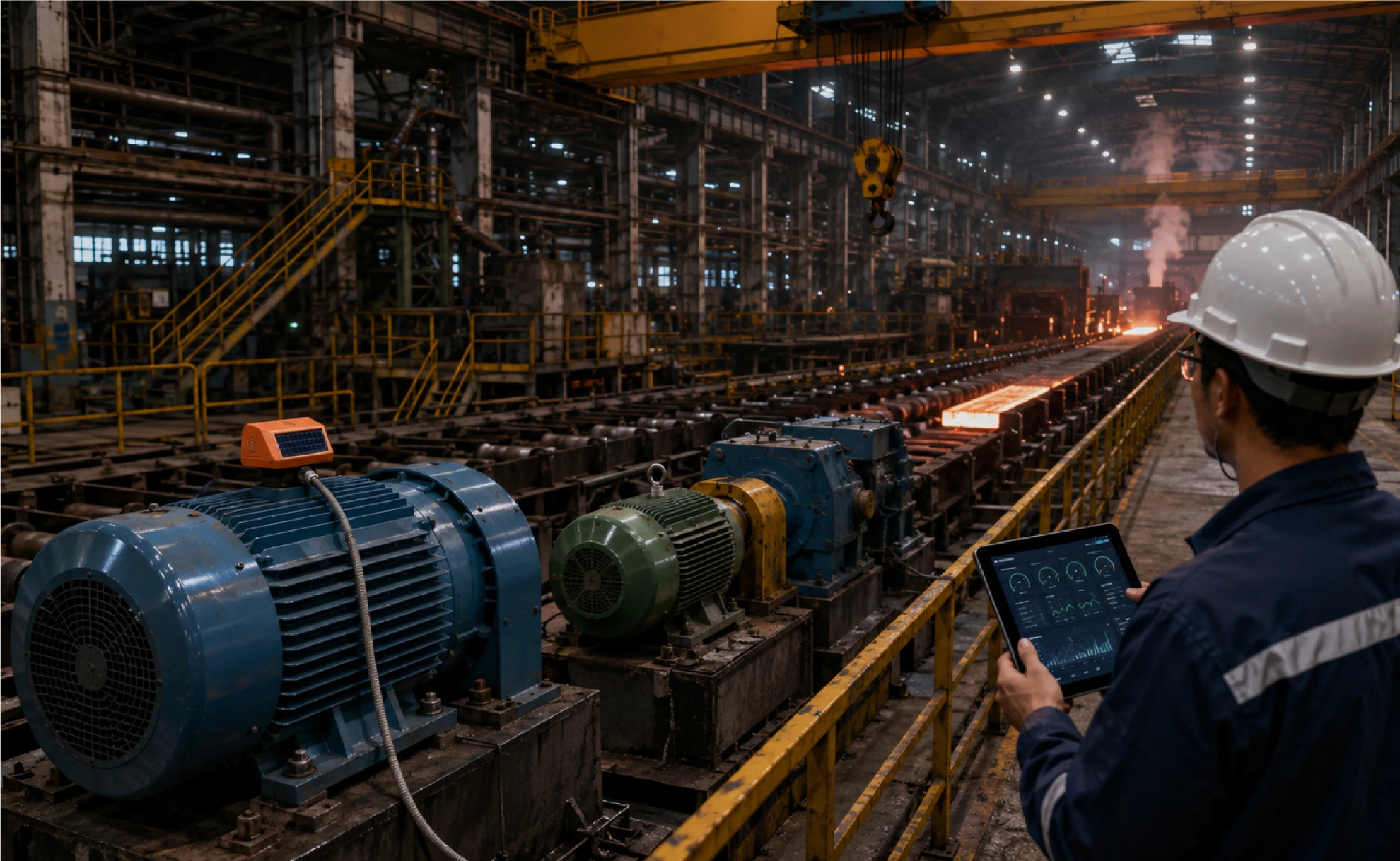
This is the piece that actually changes the math. InfiSense 3XT is Infinite Uptime's wireless reliability sensor, built specifically for non-critical and balance-of-plant equipment - designed around one hard constraint: you simply can't treat 500 non-critical assets the way you treat your five critical ones.
No wiring. No gateway.
Runs on harvested ambient light, indoors or out, and connects straight over built-in cellular — so it doesn't need your plant Wi-Fi to reach every corner where a stray conveyor motor happens to live.
not a project.
Magnet-mount it on the asset, it connects over cellular, and prescriptions start flowing into PlantOS™. No specialist crew, no weeks-long commissioning plan.
not another dashboard.
Feeds into the same prescriptive AI layer as the rest of the platform, so your team gets a specific, actionable fault call — not raw vibration data someone still has to sit down and interpret.
high-volume plants.
FSMA/HACCP-friendly coverage for food & beverage, EPA-conscious coverage for chemicals, and an ATEX-certified version for hazardous areas.
What a Day Without the Blind Spot Actually Looks Like
Go back to that same conveyor motor, three weeks earlier this time. A prescription lands in the maintenance queue on a normal Wednesday afternoon: early-stage bearing wear, replace it during the next scheduled window. No overtime call. No rushed part. No one pulled off the floor at 2 a.m. Just a five-minute job, done on someone’s own schedule, that never gets the chance to become an emergency.
Multiply that across the hundreds of motors, pumps and fans quietly running in the background of most plants, and the change isn’t only financial. It’s a bit of a culture shift too – maintenance stops being a constant scramble and starts looking more like what it was always meant to be: planned, predictable, and honestly, a little boring.
This Isn't Hypothetical
India's Leading Fertilizer Producer - 550 Monitoring Points Across 27 Plants
One of India's leading fertilizer producers scaled monitoring to 550 points across 27 plants, including ATEX-certified sensors on hazardous units and continuous coverage of centrifugal and process pumps, scrubbers, and evaporator circulation systems—the kind of auxiliary, balance-of-plant equipment this piece is about, not just the headline critical assets. The result: 3,210 hours recovered, 940 breakdowns avoided, and mean time between repairs extended to 941 hours, all validated by the company's own engineering team.
The trade press is catching up to this exact problem
A June 2026 feature in Food Engineering makes almost precisely this case: conveyors, motors and gearboxes typically get filed under "low-criticality" equipment, yet collectively they're one of the biggest blind spots in a plant's maintenance strategy. The article points to the same shift this piece is built around—wireless sensors and cloud-based AI making it finally practical to cover equipment that traditional condition-monitoring systems were historically too complex and costly to deploy across at scale.
" Food Engineering, June 29, 2026.
What This Actually Buys You
Coverage at this scale changes what “maintenance” means day to day. Manual inspection rounds – typically four-plus hours a year per piece of equipment – get reclaimed for higher-value work. Instead of finding out a secondary pump failed after it already disrupted a shift, you find out before it happens.
There’s also a second benefit that’s easy to miss the first time you look at this: it’s not really a standalone tool, it’s a coverage layer. Paired with AI Shields on your critical assets, InfiSense 3XT gives you something most plants have genuinely never had – visibility across the whole plant, not just the handful of machines everyone already watches closely. The failures that used to hide in the gaps between instrumented assets don’t really have anywhere left to hide.
The Real Question Isn't "Is This Equipment Critical?"
It’s: how much of your plant are you currently running blind on?
Every plant knows its five most critical machines inside and out. Almost none know what their two-hundredth most important motor is doing right now – and that’s not a knock on the maintenance team. It’s just a reflection of what monitoring used to cost to deploy at that scale.
That constraint doesn’t really hold anymore. What’s left is a fairly simple choice: keep budgeting for the surprises, or start seeing them coming.
Validated Production Outcome.
Frequently Asked Questions
Non-critical equipment refers to assets that do not immediately stop production if they fail but are essential for smooth plant operations. Examples include conveyor motors, pumps, fans, blowers, gearboxes, and auxiliary drives. While a single failure may have limited impact, repeated failures across many non-critical assets can increase maintenance costs, reduce operational efficiency, and create unexpected downtime.
Monitoring non-critical equipment helps detect early signs of wear, imbalance, misalignment, and bearing failures before they become costly breakdowns. Continuous condition monitoring reduces emergency repairs, improves maintenance planning, extends asset life, and allows maintenance teams to focus on planned work instead of reacting to unexpected failures.
It’s Infinite Uptime’s wireless sensor for non-critical and balance-of-plant equipment — pumps, fans, conveyors and similar assets – designed to be self-powered and quick to deploy at scale.
Most sensors on the market still lean on batteries and a nearby gateway or Wi-Fi network. InfiSense skips both – it’s energy-harvesting and connects over built-in cellular, and it sends prescriptions rather than raw sensor data.
No. That’s really the point – no gateway, no Wi-Fi dependency. It connects directly over cellular, which is what makes covering equipment scattered around a plant realistic.
There’s an ATEX-certified version available for hazardous-area deployments, alongside the standard version for general use.
Installation itself is a magnet-mount job measured in minutes. From there, it depends on the asset and failure mode, but the model is built around fast time-to-first-prescription rather than a long commissioning cycle.
It varies a lot by plant. The example figures in this piece are illustrative, based on a mid-sized facility with around 500 assets – your real number will depend on your specific equipment mix and current maintenance setup.