Plant Reliability Beyond Mechanical Faults How Process & Electrical Faults Drain Throughput, Energy, and Margin Before a Single Alarm Fires
Read Time: 8–9 minutes | Author – Kalyan Meduri
- Prescriptive AI for Cement Plants: From VRM Gearbox Failures to Preheater Trips to Kiln Hood Draft Instability
- Mechanical Faults in Cement Vertical Roller Mills (VRMs)
- Electrical Fault in Cement Preheater ID Fans
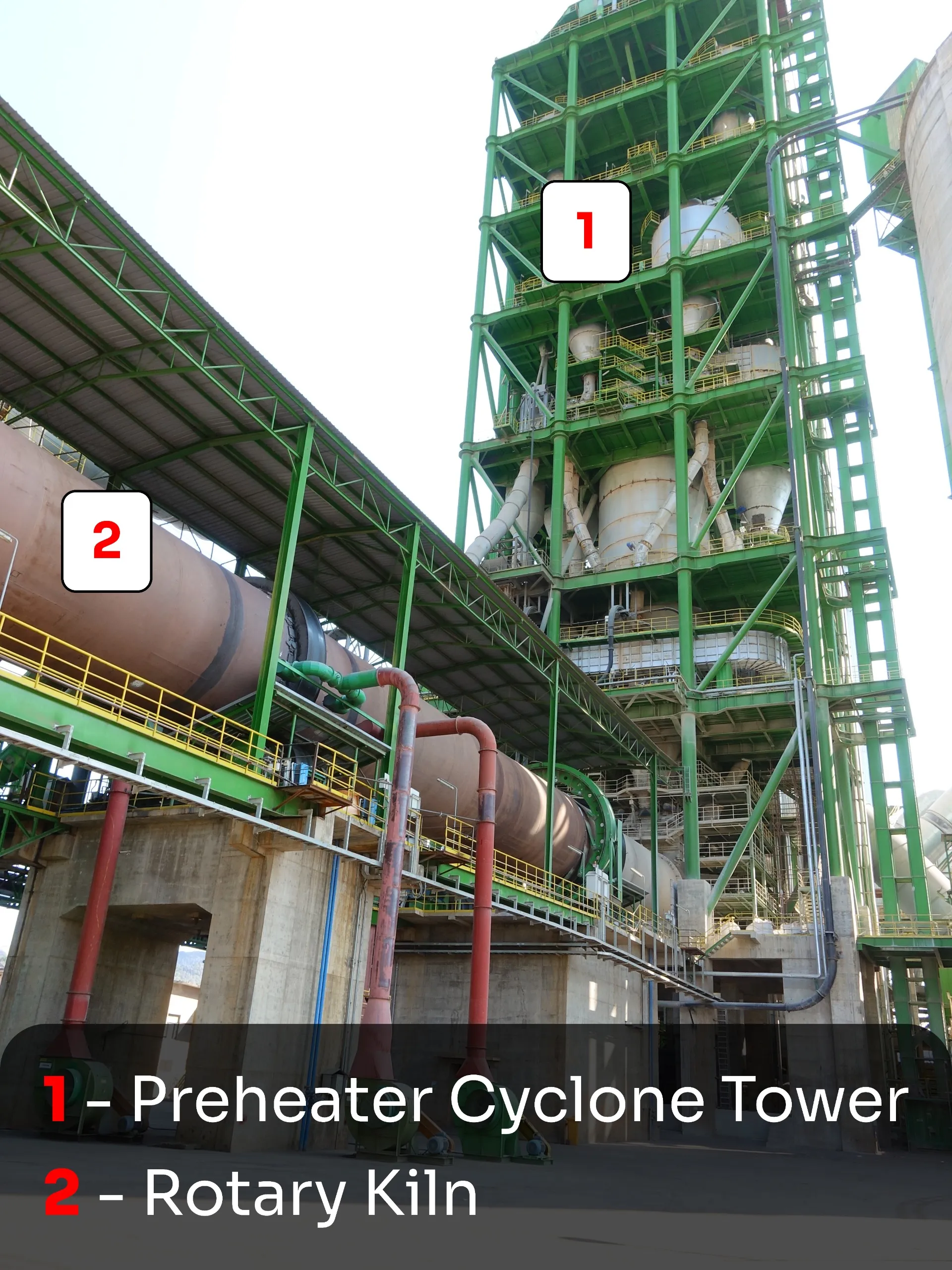
- Process-Induced Faults in Cement Rotary Kilns
- PlantOS™ and the 99% Trust Loop™: What COOs, CFOs, and CDOs Need to Know
Key Highlights
- Cement plants silently bleed 10–20% throughput and 5–8% additional energy when
mechanical, electrical, and process faults go undetected across VRMs, preheaters, kilns, and
fans—often weeks before a single alarm fire. - Start Cement India & several leading cement manufacturers deployed PlantOS™ and the
99% Trust Loop™ to intercept three fault events before they cascaded: VRM classifier
bearing distress, a false Preheater ID Fan sensor trip, and Kiln hood draft reversal. - At Star Cement India alone, PlantOS™ preserved 46 hours of production, recovered ≈600
tons of clinker output, and avoided 920K kCal of specific heat waste—each with a digitally
validated prescription, not a hypothesis. Delivering 10X RoI within 6 months.
PlantOS™ Outcomes Footprint — As of 17 March 2026; Digitally verifiable live on PlantOS™ Digital Reporting System
9 industrial verticals globally
globally (all verticals)
digitalized
downtime eliminated
vs 18–24 months industry average
Prescriptive AI for Cement Plants: From VRM Gearbox Failures to Preheater Trips to Kiln Hood Draft Instability
For a mid-size cement plant, a single unplanned outage costs $20,000–$300,000+ per day in lost production.
Across a year, that compounds to $2–5 million in preventable losses—most of it traceable to faults that were
detectable weeks or months before any alarm fired. VRM gearbox failures alone carry $500K–1.2M in repair
costs and 3–6-week lead times. A preheater ID fan trip can cascade to 245 TPH of kiln feed loss in minutes.
Restart energy penalties add $3,000–8,000 per incident.
This document walks through three distinct fault families—mechanical, electrical, and process—through the lens
of Star Cement India and leading cement manufacturers globally, showing precisely how PlantOS™ intercepted
each fault before it hit the P&L, and what the verified operational outcome was.
Mechanical Faults in Cement Vertical Roller Mills (VRMs)01
Common mechanical fault modes:
- Bearing lubrication deficiency: Dry NDE/DE bearings spike broadband acceleration.
- Misalignment: Motor-gearbox coupling gaps drive velocity peaks.
- Roller/table wear: kHz-range impacts from spalling under load.
- Gearbox degradation: Planetary wear generating characteristic BPFO harmonics.
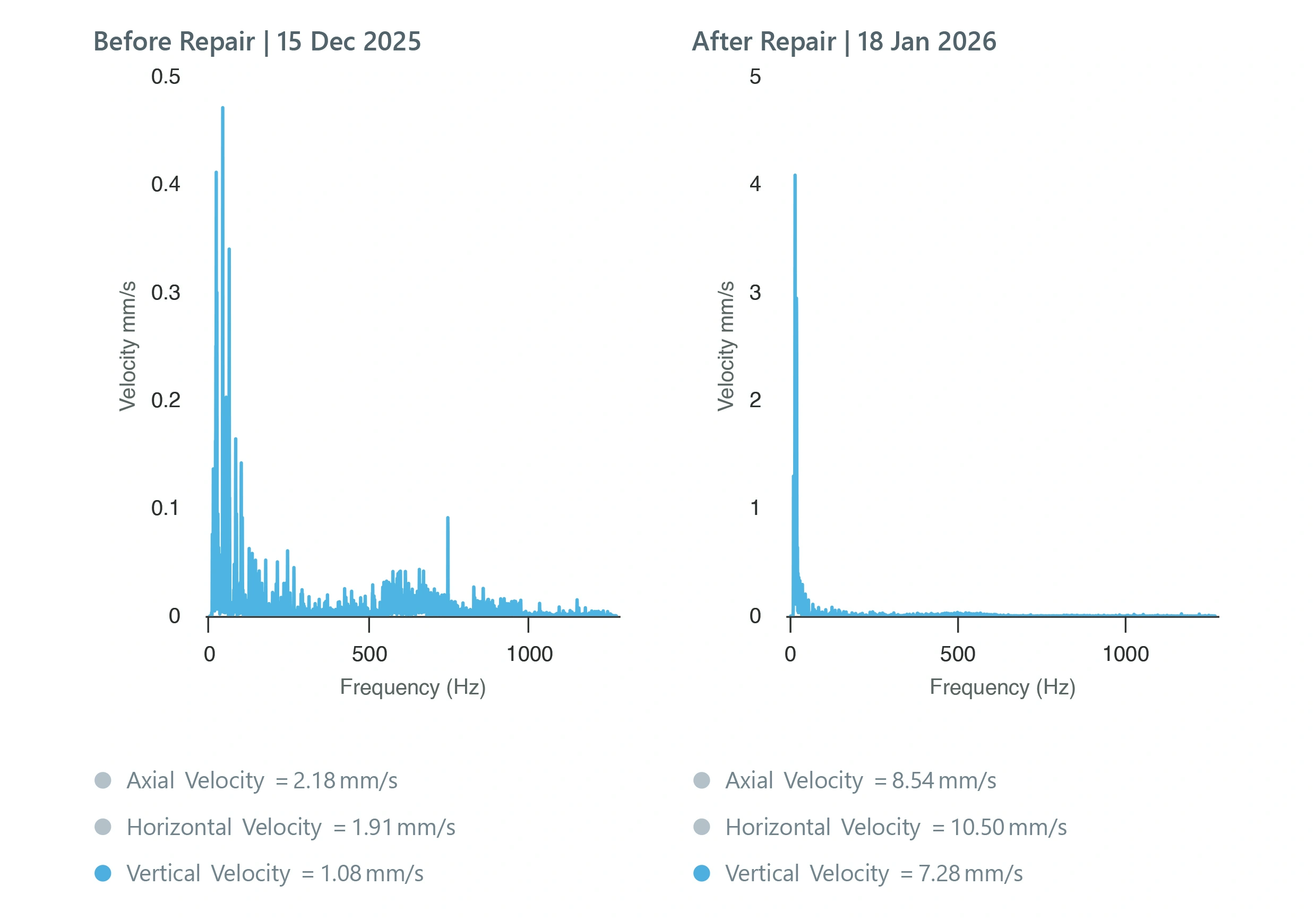
Live Incident: Classifier Motor Bearing Distress
Verified actions and outcome:
- Re-lubricated NDE and DE bearings Grease matched to bearing designation (SKF 6312).
- Scheduled maintenance: Weekly greasing and alignment checks; velocity trending established as baseline.
- Post-repair results: Axial velocity stabilized at 8.54 mm/s; horizontal 10.50 mm/s; vertical 7.28 mm/s—all within operational norms.
Electrical Fault in Cement Preheater ID Fans02
Live Incident: False Temperature Trip, Real Production Loss
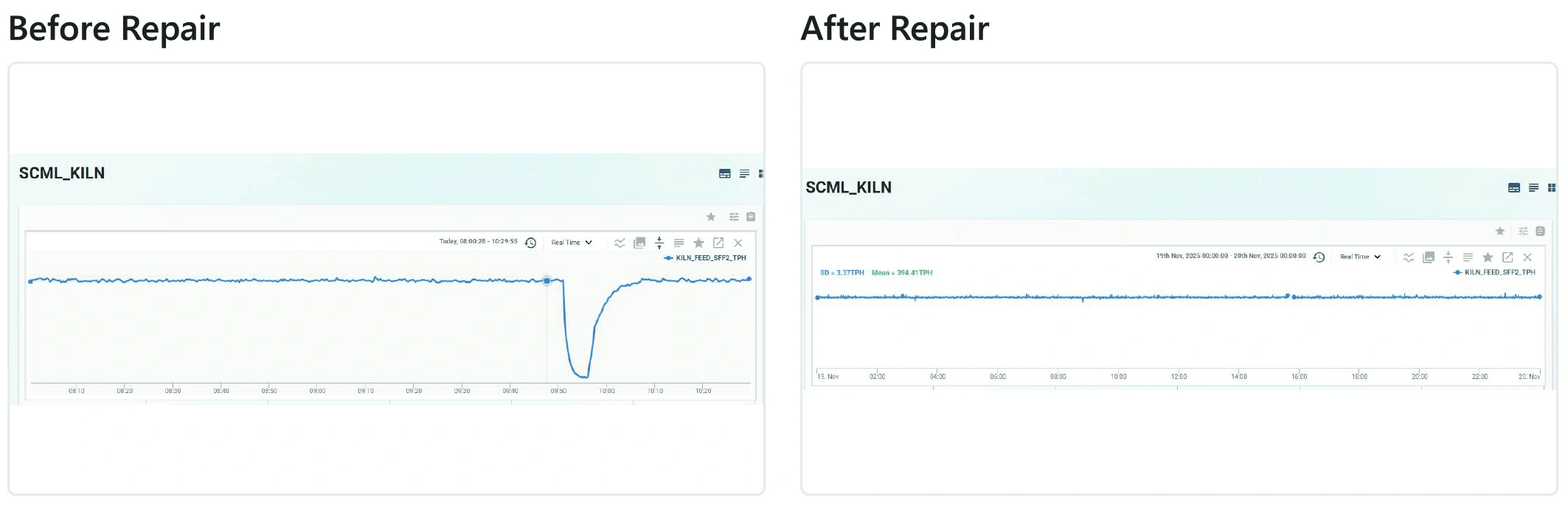
- Cyclone cone pressure on PH string 2 collapsed from -219 mmWG to -30 mmWG—gases could no longer transport raw meal.
- Kiln feed crashed from 395 TPH to 150 TPH; main drive power fell from 390 kW to 70 kW.
- Net shortfall: 245 TPH—hours of clinker output gone.
Verified actions and outcome:
- Replaced the terminal block; tested continuity end-to-end with a multi-meter.
- Updated PLC logic: faulty sensor signals now surface as “NA/0 + alarm” without triggering auto-trip on non-HT fans.
- Implemented quarterly RTD calibration on critical HT ID fans as standard protocol.
- Post-fix monitoring over 24–48 hours confirmed: draft restored to -219 mmWG, temperature stabilized at ~51°C, kiln feed held at 395 TPH.
Process-Induced Faults in Cement Rotary Kilns 03
Common process fault modes:
- Feed/moisture imbalance overloading rollers and spiking bearing temps.
- Shell overheat (>350°C) from refractory gaps or flame impingement.
- Coating build-up at kiln inlet and down-comers restricting airflow.
- Fan/damper faults causing positive hood draft and reversed gas flow.
- Calciner instability from coal firing fluctuations driven by draft swings.
Live Incident: Kiln Hood Draft Reversal
- Calciner disruption: coal firing fluctuated; outlet and inlet temperatures destabilized.
- RABH (Raw Meal Auxiliary Bag House) inlet draft blocked, compounding airflow restriction.
- Sustained shortfall: 60–70 TPH for multiple hours; full stoppage risk active.
Verified actions and outcome:
- Installed blasters at TA Duct take-off to clear material accumulation.
- Added two new pressure transmitters at kiln hood for continuous draft monitoring.
- Established threshold: maintain hood draft <–3 mmWC; quarterly transmitter calibration.
- Post-fix: draft stabilized negative; feed restored to 560+ TPH; pre-fix pressure spikes absent in subsequent monitoring.
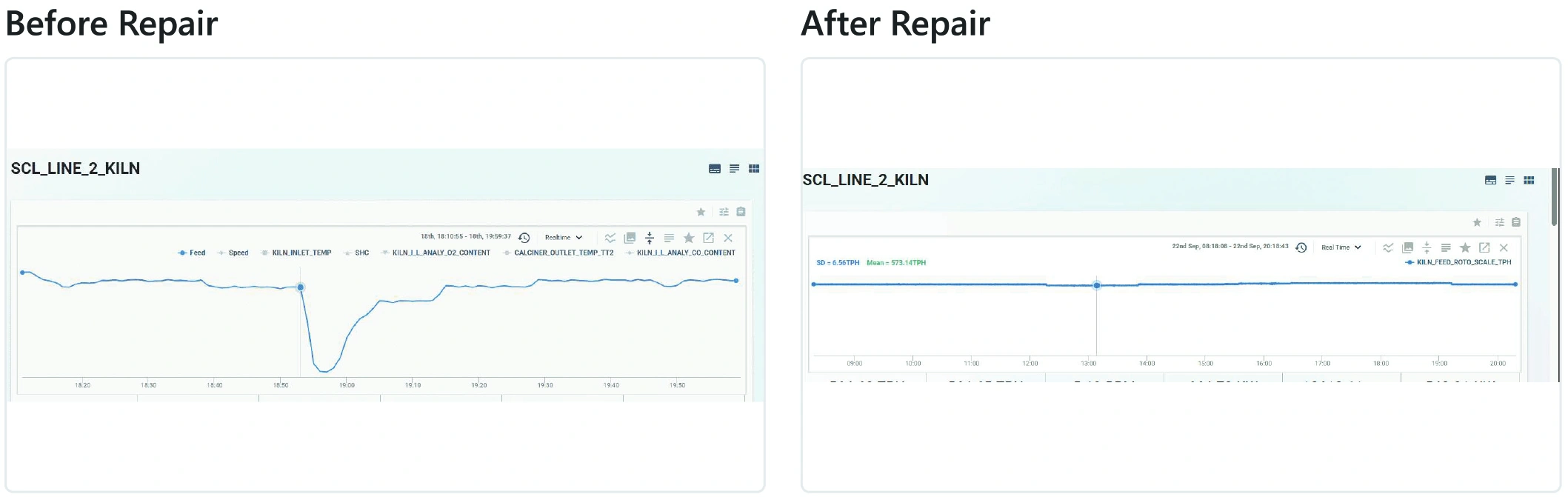
Kiln Hood Draft (mmWC): Before & After Intervention
PlantOS™ and the 99% Trust Loop™: What COOs, CFOs, and CDOs Need to Know
| COO | Guaranteed plant uptime and capex discipline. Surprise trips become a managed exception, not a recurring cost. TPH targets are protected by prescriptions, not prayers. |
| CFO | 6–12 month payback vs. the 18–24 month industry norm. Star Cement India reached 10x ROI in under six months. Every prescription carries a financial outcome that is tracked and reported—not estimated after the fact. |
| CDO | Digitally verifiable AI outcomes—not black-box predictions. The 99% Trust Loop™ closes prediction-to-action-to-validation in one platform, integrating with PLC, DCS, SCADA, historian, SAP, and MES. 99.97% prediction accuracy. 99%+ prescription adoption rate. Outcomes the board can audit. |
Powered by the 99% Trust Loop™, every alert delivers three verifiable outcomes in a single prescription:
Reliability (zero surprise trips), Throughput (stable TPH, more clinker), and Efficiency (lower SHC, kWh/ton).
Fault chaos → predictable production wins.
Frequently Asked Questions
See the outcomes for yourself.
Read the world’s most user-validated prescriptive AI case studies—including Star Cement’s 10x ROI in under six months—to explore how 137 cement plants drive Reliability, Throughput, and Efficiency in 1 prescription, with 0 guesswork.
Thank you for your interest in PlantOS™ Prescriptive AI.
Read More on Industrial Reliability

The Four Pillars of Industrial Reliability
In heavy industries today, reliability is no longer just “fewer...

Understanding Types of Vibration and Measurement in Predictive Maintenance
Understanding Types of Vibration and Measurement in Predictive Maintenance What...

Understanding Digital Reliability
Manufacturing industries manage complex production environments where even a single...