Physical AI in Heavy Manufacturing: Why the smartest AI prescribes and lets operators act & validate outcomes
Read Time: 7–9 minutes | Author – Rahul Narvekar
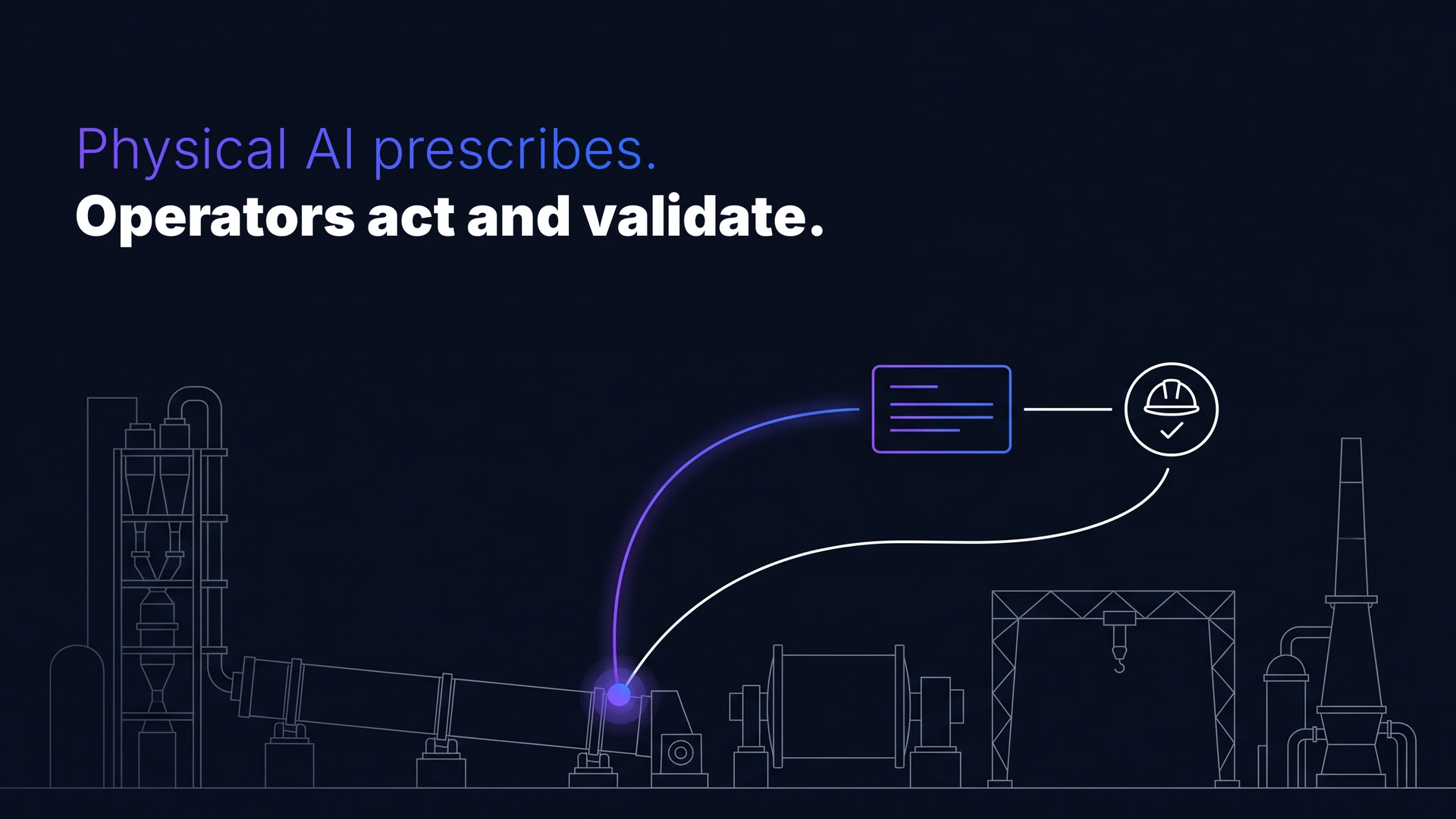
In short: Physical AI in heavy manufacturing is AI that understands the physics of industrial equipment and the process conditions acting on it, and turns that understanding into prescriptions plant teams act on. As AI agents reach the plant floor, the real question is how much authority they should hold. The answer is authority earned through outcomes that operators validate.
- Not robots. In process industries, Physical AI reads assets that cannot afford to stop, such as kilns, mills, cranes and compressors.
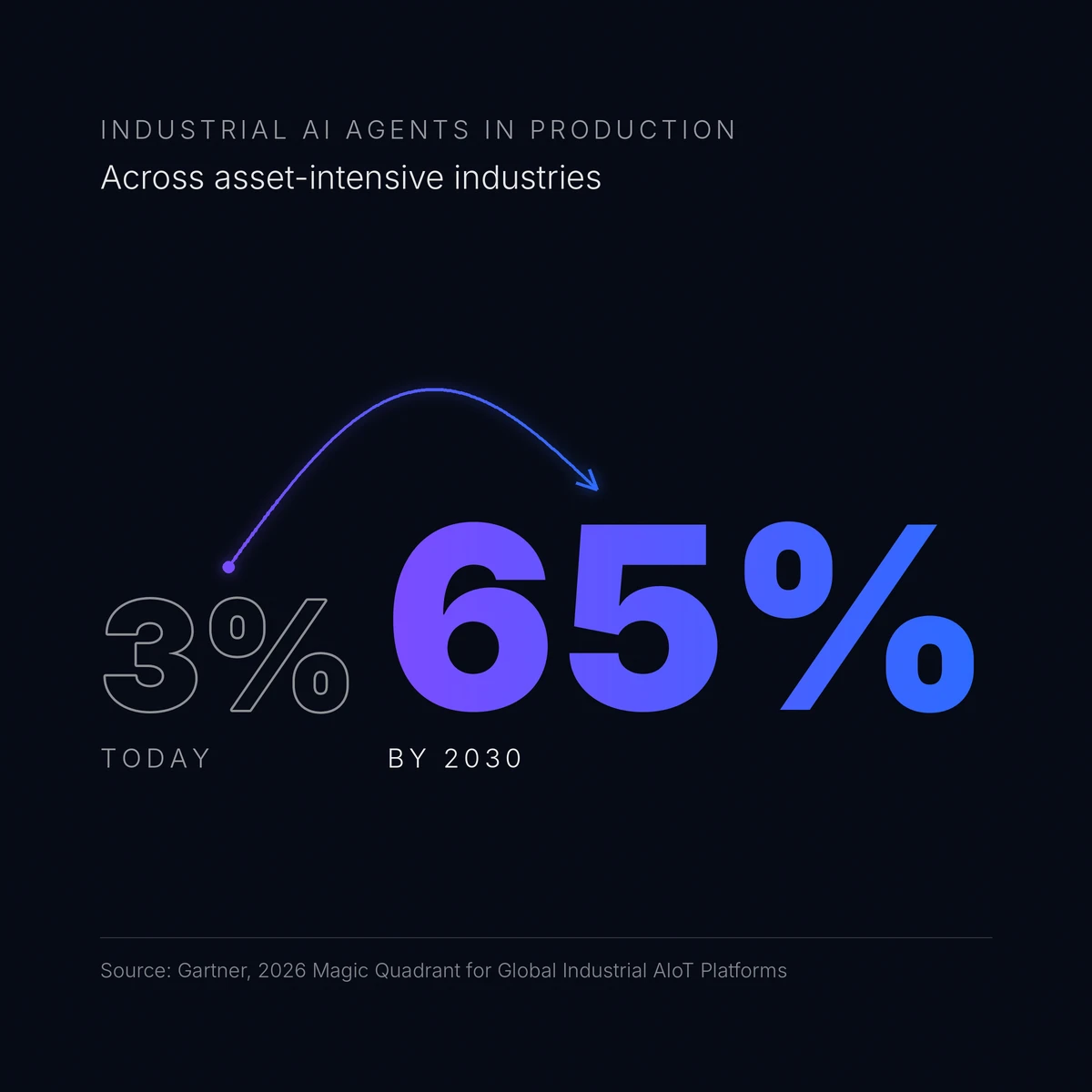
- Agents are coming. Gartner expects industrial AI agents in production to grow from 3% today to 65% by 2030.
- Authority should be graded. The AI diagnoses and prescribes, while people own the decision and the physical work.
- Validation is the control layer. Every operator sign-off proves an outcome and trains a sharper model.
- Scaling is a trust problem first. Physical AI spreads across plants only as fast as each site's teams learn to act on it.
Ask most people to picture Physical AI and they picture a robot arm or a humanoid on an assembly line. In a steel melt shop or a cement plant, the more valuable version works without moving at all. It reads the physics of a rotary kiln, the load cycle on a SAG mill or the thermal stress on an EOT crane, and understands what those signals mean for production.
That intelligence is now meeting agentic AI. Agents can carry a finding from sensor to work order and into the Teams channel where the shift lead already works, without anyone copying it across systems. Gartner forecasts that by 2030, 65% of AI agents from industrial AIoT platform providers will be running in production environments across asset-intensive industries, up from 3% today.
The question is no longer whether heavy manufacturers will adopt AI agents. It is how much authority those agents should hold.
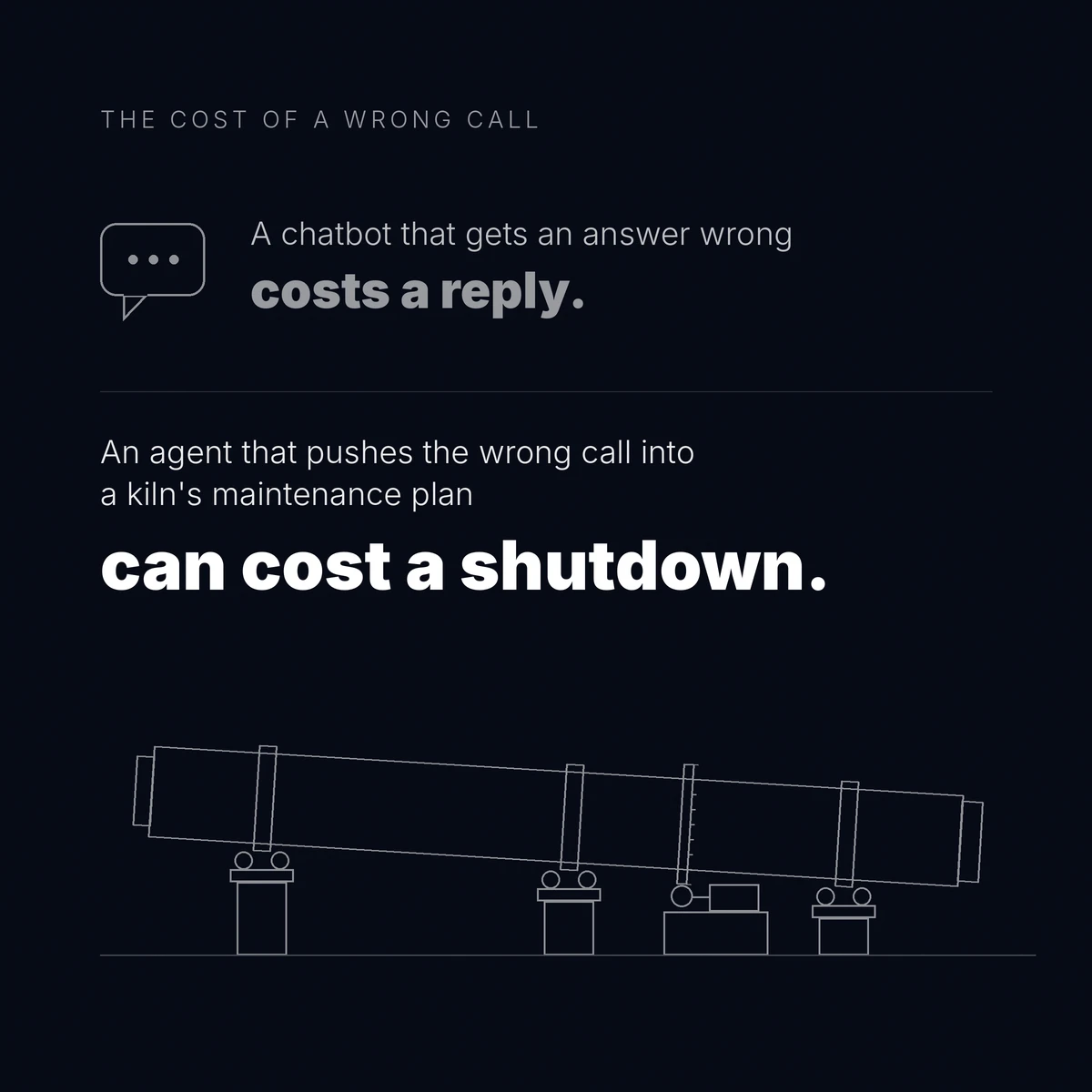
A chatbot that gets an answer wrong costs a reply. An agent that pushes the wrong call into a kiln's maintenance plan can cost a shutdown. Here is how heavy manufacturers can grade that authority, and why operator validation is the layer that makes Physical AI safe to scale.
What is Physical AI in heavy manufacturing?
Physical AI in heavy manufacturing is AI that combines mechanical signals, process conditions and equipment-specific failure knowledge to understand how industrial assets behave and degrade. Its output is a prescription that names the fault, explains why it is developing and states its Potential Business Impact. Plant teams decide on and carry out the action, then validate the result.
What a prescription looks like across heavy industry
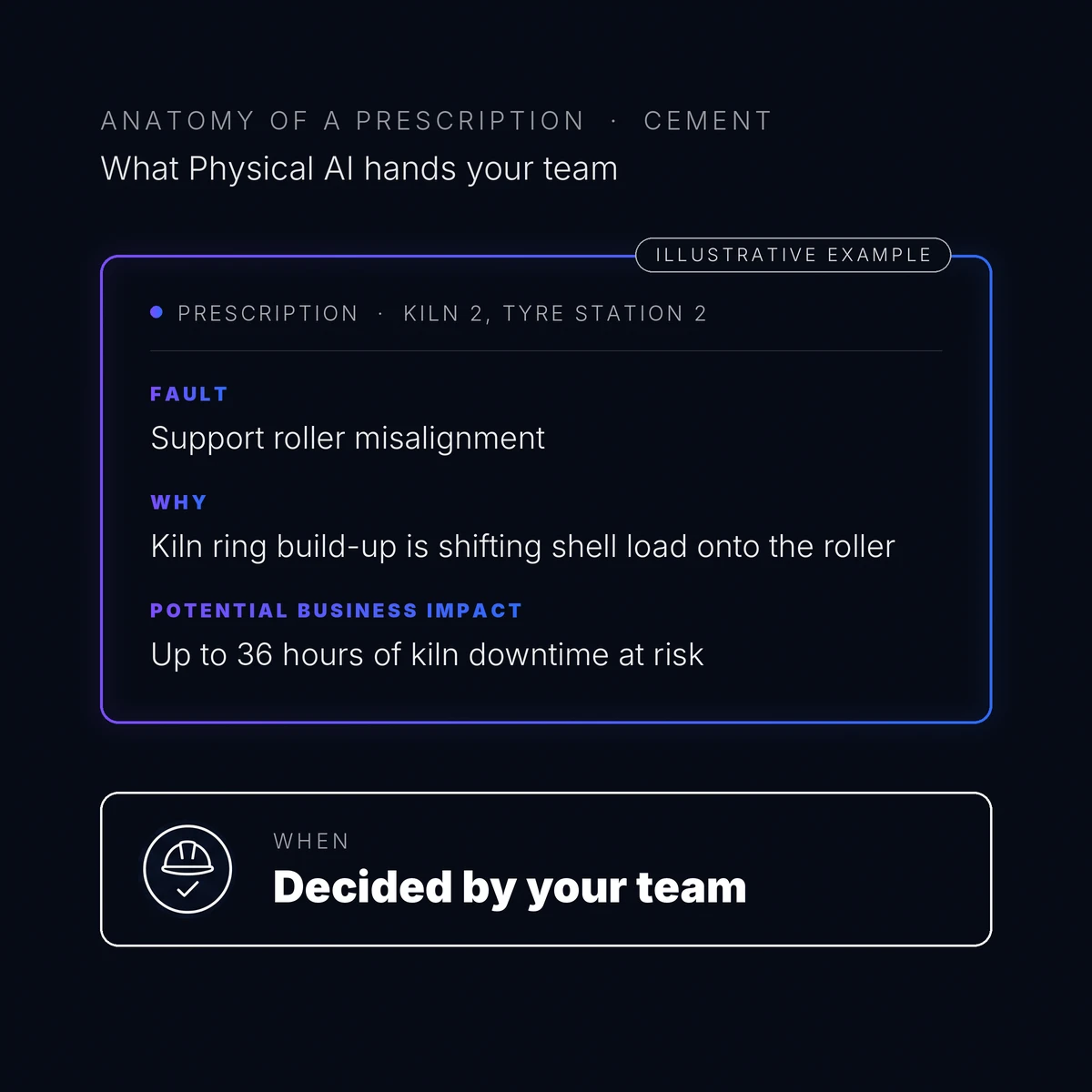
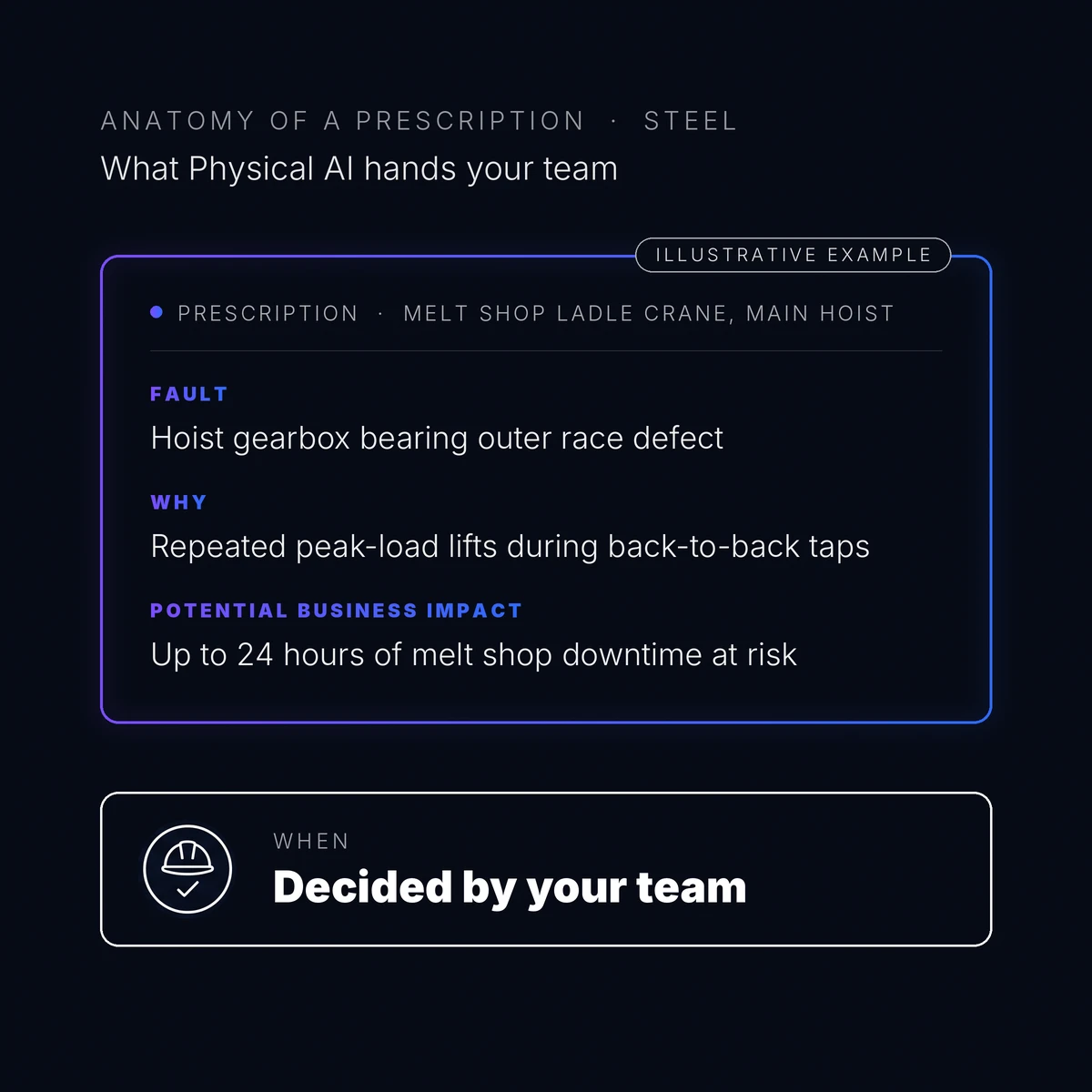
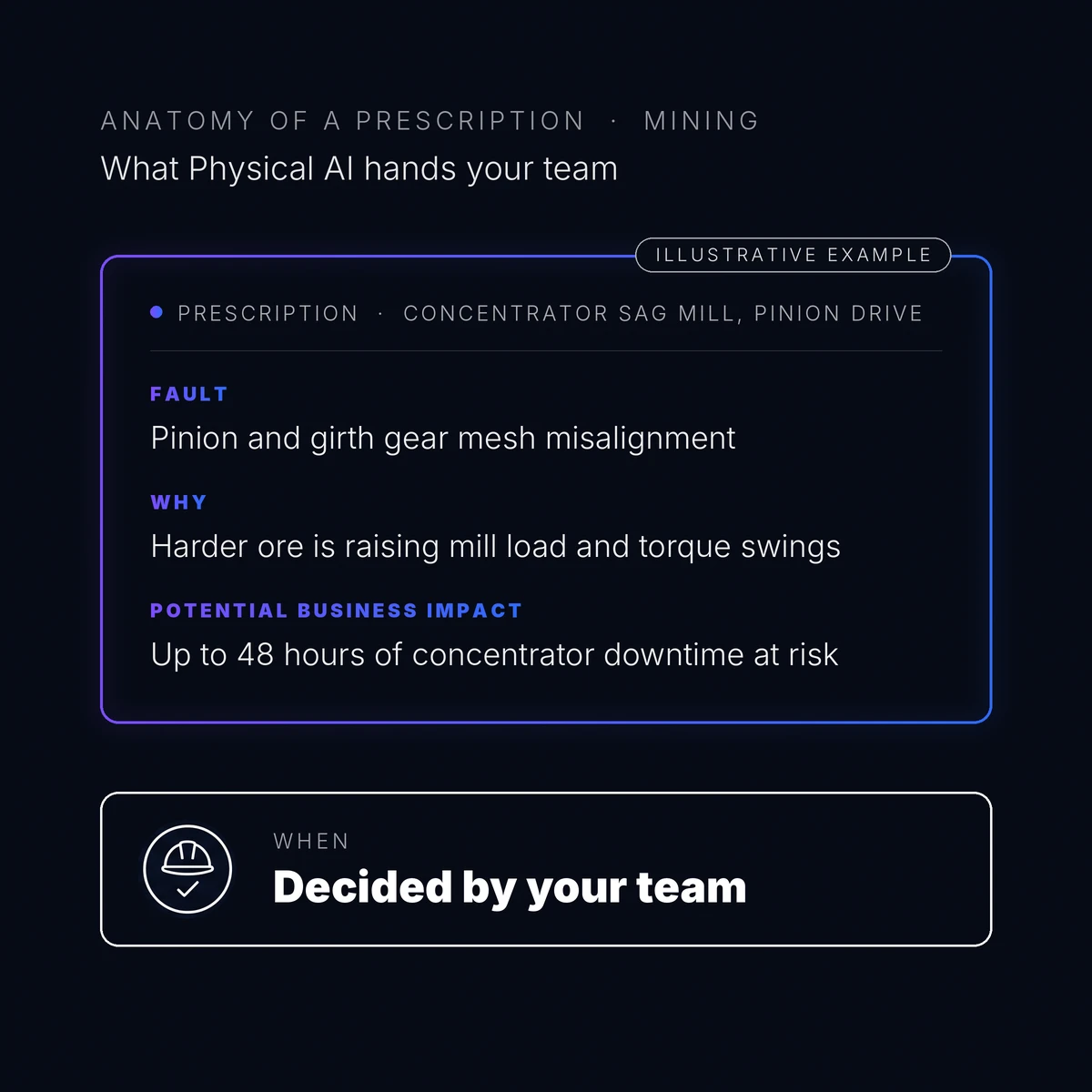
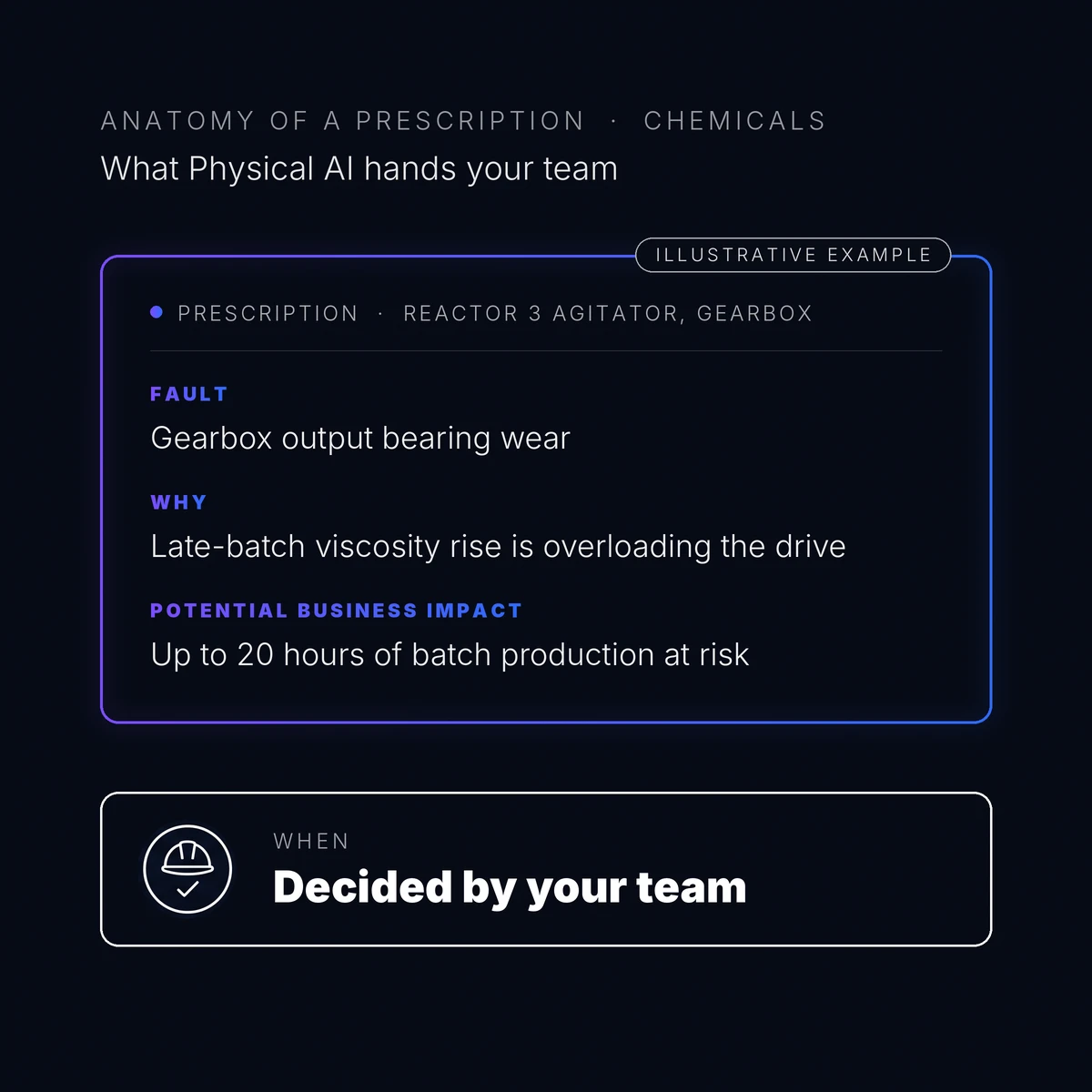
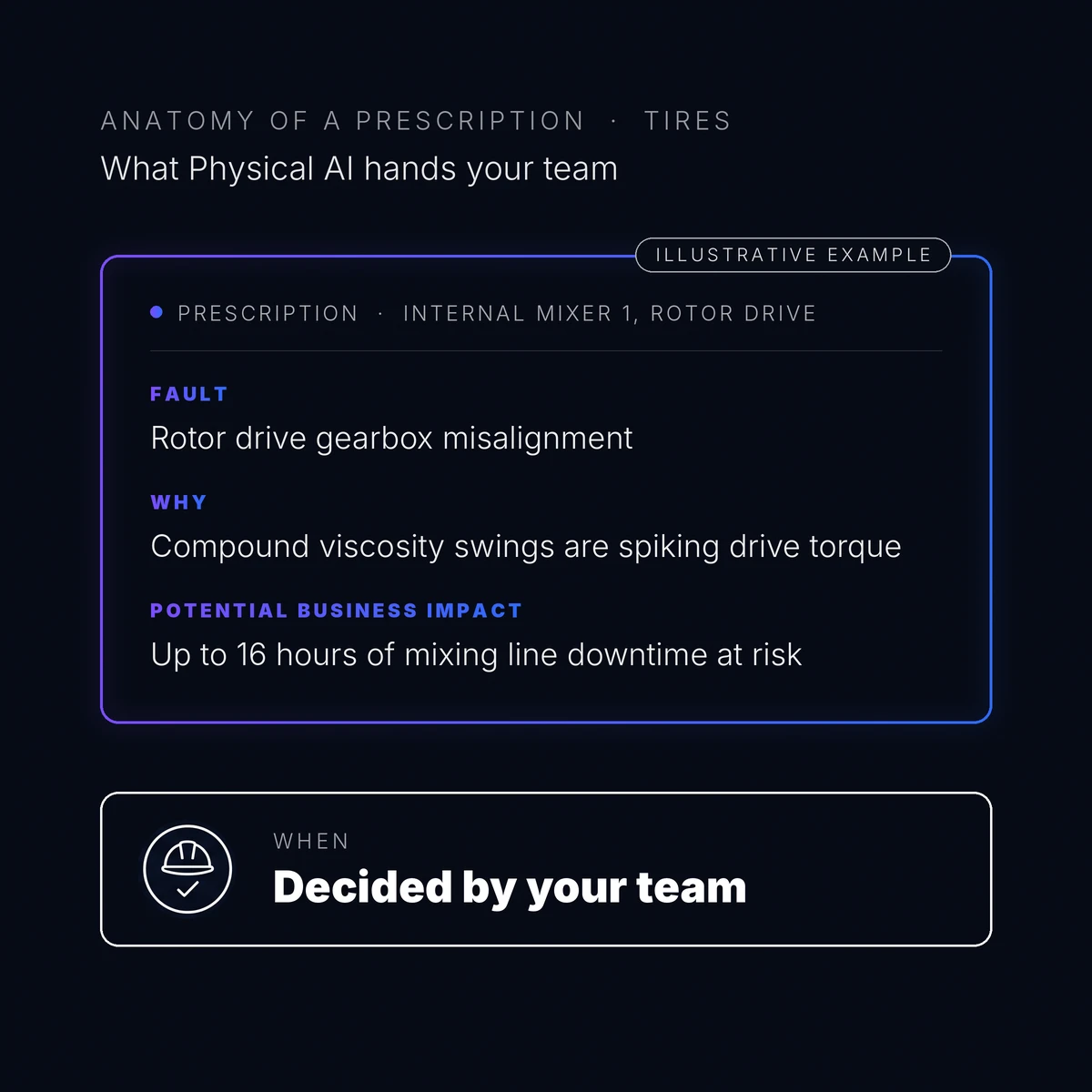
Illustrative examples of how a PlantOS™ prescription is structured. Every live prescription carries the same three fields, specific to each plant’s assets and process conditions.
Why Physical AI has to be built differently for heavy industry
Most Physical AI research and investment today targets robotics. The technology that serves a continuous process plant shares the name but faces a different problem, and that changes how it has to be built.
| Dimension | Robotics-led Physical AI | Physical AI in heavy manufacturing |
|---|---|---|
| Core problem | Perceive objects and manipulate them reliably despite variation in parts | Interpret how assets degrade under changing process conditions |
| Time scale | Milliseconds to seconds of motion control | Degradation that develops over days, weeks or months |
| Training data Key row | Abundant: simulation, teleoperation and demonstration can generate millions of examples | Scarce: real failures are rare compared with healthy operation, and nobody can fail a kiln a thousand times to train a model |
| What fills the data gap | Sim-to-real transfer | Physics, failure-mode libraries and operator-validated outcomes |
| Signals | Cameras, force-torque sensors, lidar | Vibration, temperature, oil analysis, plus PLC, DCS and historian tags |
| Operating conditions | Structured cells with repeatable layouts | High heat, dust, variable ore and feed, very low speeds and shifting loads |
| Path from AI to action Key row | The AI closes the loop through actuators | The AI prescribes, and people act through work orders and permit-to-work |
| Cost of a wrong call | A scrapped part or a paused cell | An unplanned stop on a continuous line, where restarting a cement kiln alone can cost around $75,000 |
| Measure of success | Cycle time and task completion | Less downtime, more throughput, lower cost per ton |
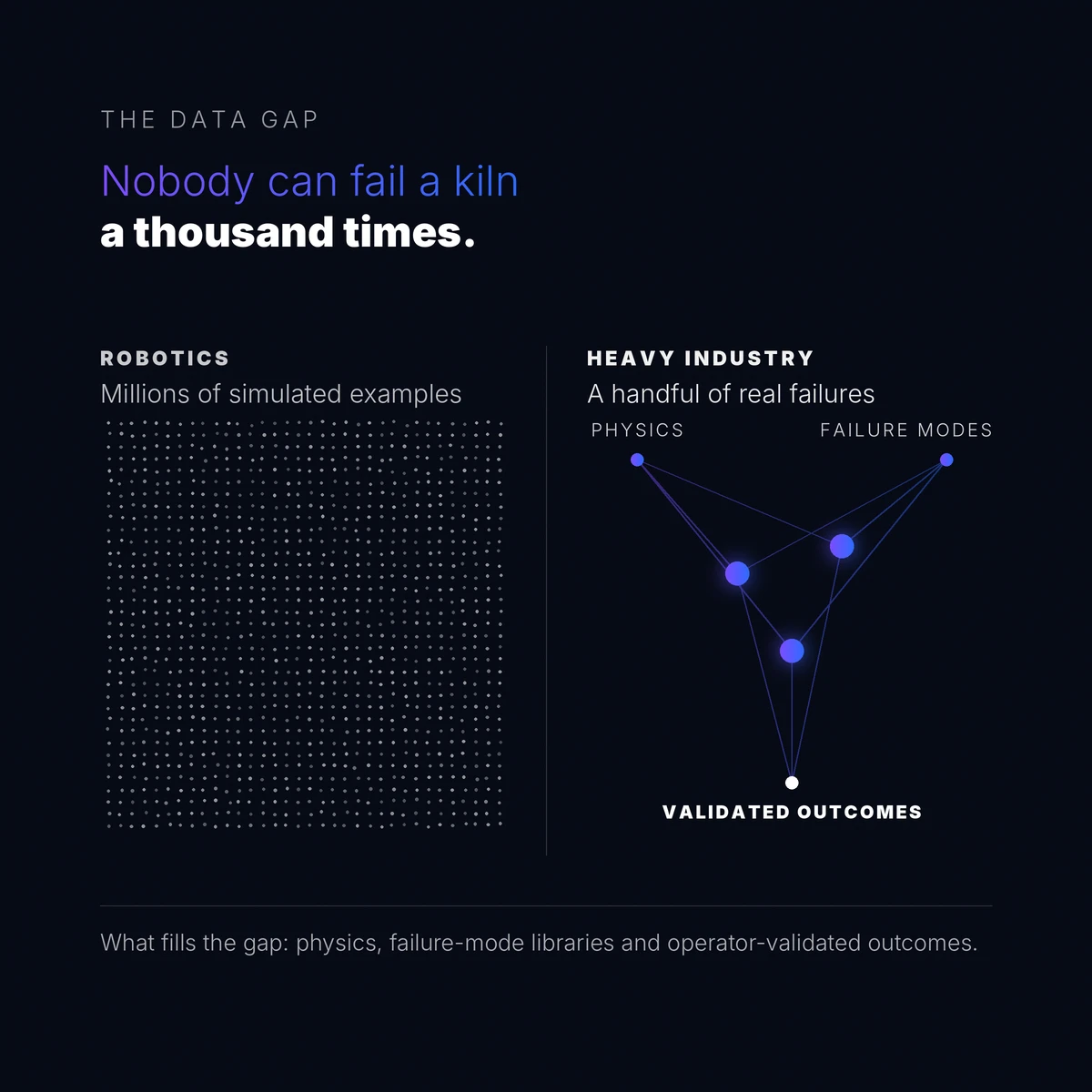
Two rows carry most of the weight. Scarce failure data means Physical AI for heavy industry cannot rely on statistics alone. It needs physics and the validated experience of plant teams. The second row is the path to action. Because people carry out every intervention, the AI’s job is to make each prescription specific enough to act on and explainable enough to trust.
Process context matters for the same reason. In heavy industry, a large share of mechanical failure begins outside the machine. Kiln ring formation, cyclone coating build-up, ladle heat profile drift and web tension drift all accelerate wear before a clean mechanical signature appears. Infinite Uptime’s PlantOS™ is built on this principle, combining mechanical and process signals with physics-aware contextualization and failure-mode intelligence.
The five levels of AI authority on the plant floor
Grading authority starts with a simple question at each step: what does the AI contribute, and who carries the decision?
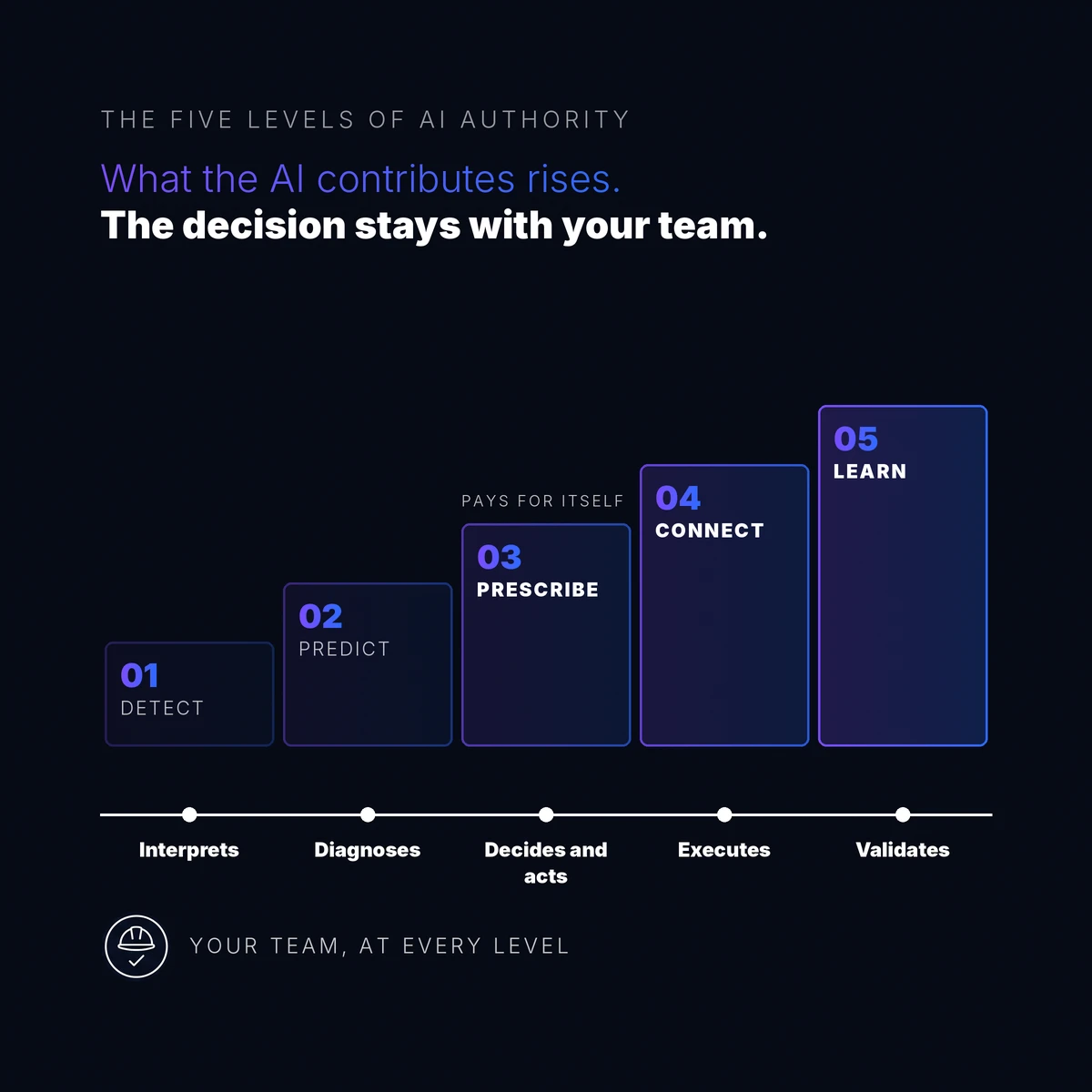
The AI detects. The team interprets.
The system flags anomalies and threshold breaches. Every alert still needs an analyst to work out what it means, which adds load to teams already short of experienced reliability engineers.
The AI predicts. The team diagnoses.
The system estimates how likely an asset is to fail. That is useful, but a probability is not a plan, and the team still has to identify the fault, the cause and the fix.
The AI prescribes. The team decides and acts. Pays for itself
The prescription names the fault, explains why it is developing and states its Potential Business Impact, usually expressed as downtime at risk. The plant team decides when to act against its own production plan and carries out the work. This is the level where Physical AI starts paying for itself.
The AI connects. The team executes in its own workflow.
The prescription reaches people in the tools they already use, with asset history and context attached, instead of waiting in a separate portal. This is where AI agents add genuine value in heavy industry. They can assemble context, route the prescription to the right planner and track closure, while people stay accountable for the decision and the physical work.
The AI learns. The outcome is proven.
The operator validates whether the action delivered the intended result. That sign-off confirms the outcome for the plant and becomes labelled feedback for the model, so each cycle makes prescriptions more precise for that asset, in that plant, under those process conditions.
The maturity of Physical AI is measured by how much better each decision gets, not by how much the AI does without people.
Why operators stay in the loop
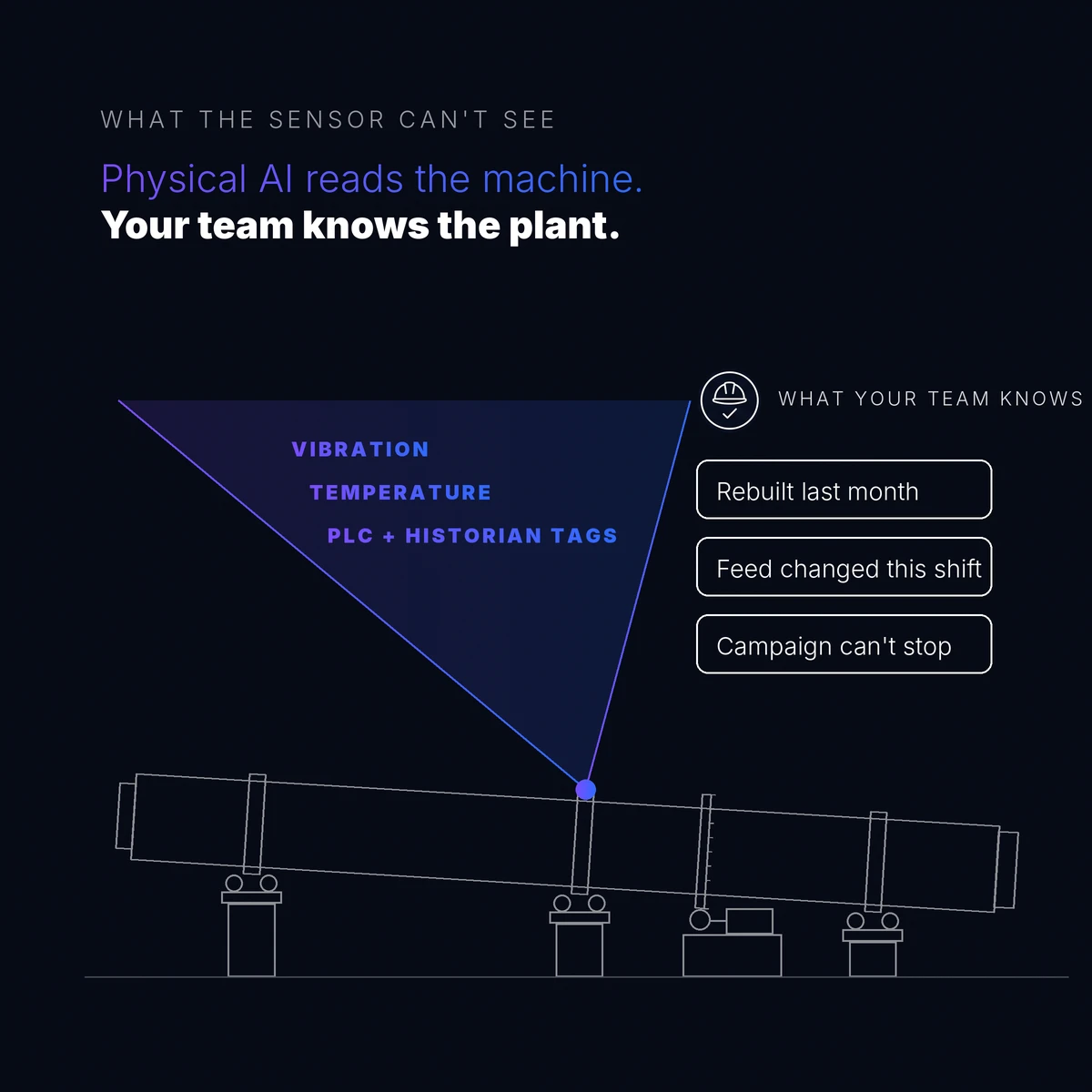
Heavy manufacturing will adopt agents, but the physical decision will stay with people, and for good reason. Plant teams own the production plan, the permit to work and the safety of everyone near the equipment. They also hold knowledge no sensor captures: a recent rebuild, a change in feed, or a campaign that must not be interrupted. An AI that prescribes and leaves the decision to them puts that knowledge to work.
Validation also solves the problem that stalls most industrial AI, which is trust. Infinite Uptime formalizes this as the 99% Trust Loop. Accurate prescriptions earn trust, trust leads to action, action produces validated feedback, and that feedback improves the next prescription. Across the PlantOS™ install base, up to 99% of prescriptions are acted upon, at 99.97% accuracy. A prescription the team acts on is worth far more than a perfect prediction nobody trusts.
What it takes to scale Physical AI across plants
Most heavy manufacturers can make Physical AI work on one critical line. The difficulty starts at plant two, then plant ten, then plant fifty. Four problems come up again and again, and each one comes down to the same question: can prescriptions be acted on and validated consistently at every site?
Same asset name, different physics
A ball mill in a copper concentrator and a raw mill in a cement plant share an asset class but not a failure profile. Ore hardness, feed moisture and load cycles change how each one degrades, and generic models trained on "rotating equipment" miss those differences. Scaling needs vertical, equipment-specific intelligence, which is why PlantOS™ uses AI Shields built on Dynamic FMEA for assets such as kilns, mills, cranes and furnaces.
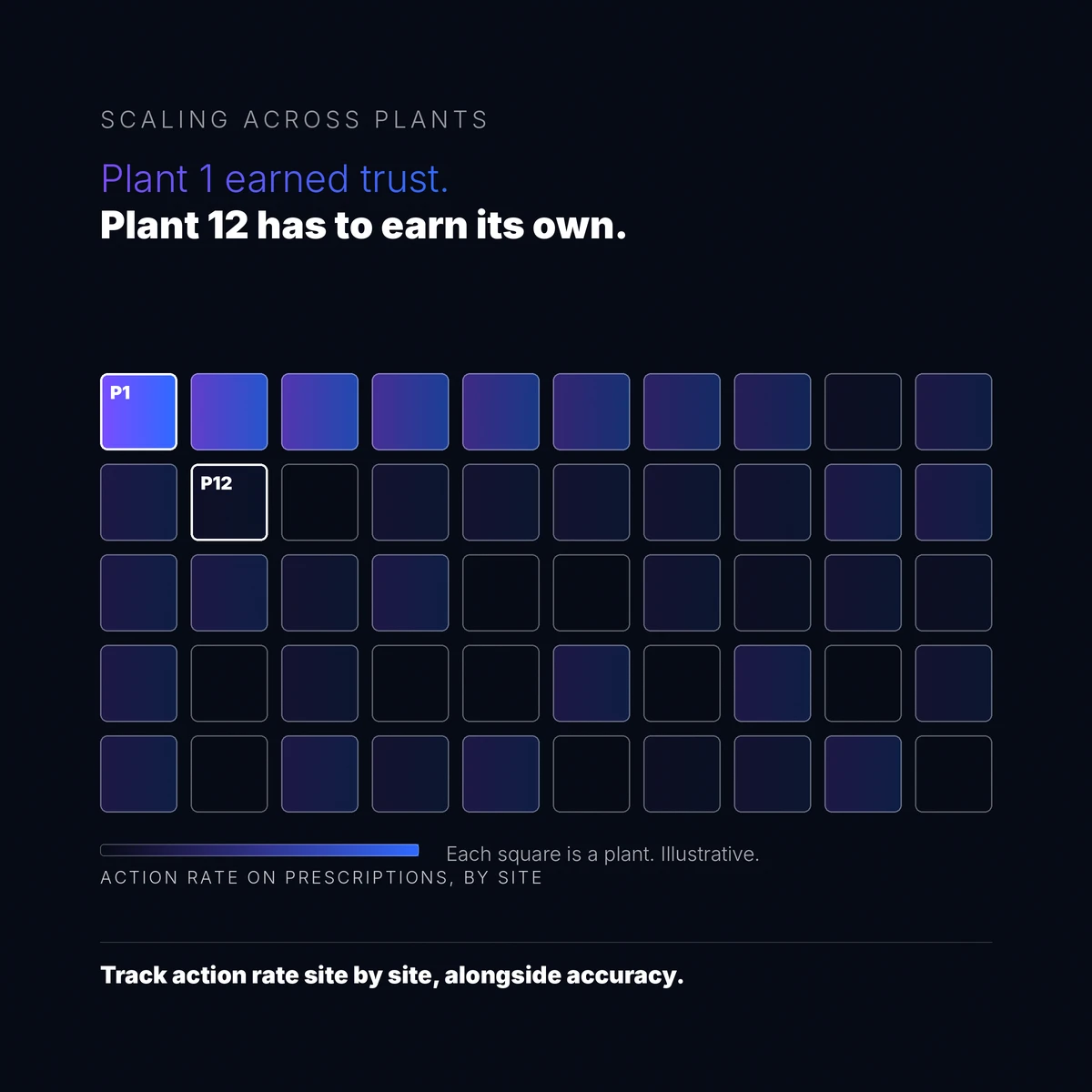
Trust does not transfer by memo
Operators at plant twelve will not act on a prescription because plant one did. Each site builds its own confidence through its own validations. Leaders scaling Physical AI should track action rate site by site, alongside accuracy, because action rate shows where trust has taken hold and where it still needs work.
Prescriptions get lost between systems
When intelligence lives in a standalone dashboard, it depends on someone copying it into the maintenance plan, and across fifty plants that habit breaks. Physical AI has to reach people where they already work. PlantOS™ runs on Azure and brings reliability intelligence into Microsoft Fabric alongside ERP, MES and maintenance data, and into Copilot and Teams, where plant teams coordinate their day.
Brownfield plants are not greenfield labs
Real plants run mixed sensor fleets, decades-old PLCs and historians from several vendors. Physical AI that demands a clean slate never leaves the pilot stage. It has to work with what is already installed, including third-party sensors, and fit into wider IT-OT programmes. That integration work is where partners such as Tech Mahindra support large transformation programmes.
When these four are solved, scale shows up in outcomes.
Hours of operator-validated downtime saved
Plants
Customers across nine verticals
Countries
Five questions to ask any Physical AI vendor
Does it understand the physics of your assets, or only the statistics of your data?
Pure pattern-matching struggles when operating conditions shift. Physics-aware models hold up when feed, load or speed changes.
How does it learn when failures are rare?
Ask what fills the gap between scarce failure data and reliable diagnosis, whether that is failure-mode libraries, domain expertise or validated field outcomes.
Can it explain a fault in terms your process engineers recognize?
An anomaly score invites debate. A named cause linked to a process condition invites action.
Where does decision authority sit, and how is it governed?
Clarify which steps an agent can take on its own, which need human approval, and how that fits your permit-to-work and safety systems.
How will you prove it worked, and at how many plants?
Ask for outcomes measured in plant KPIs and validated by the customer's own teams, across multiple sites rather than a single pilot.
Physical AI that earns its place on the plant floor
Physical AI will reshape heavy manufacturing without replacing the people who run it. The plants that gain the most will pair AI that understands their equipment deeply with teams who act on its prescriptions and confirm every outcome. Authority for agents will grow the same way, one validated decision at a time. That is what Scaling Physical AI with Outcome Intelligence means in practice: less downtime, more throughput and lower cost per ton, proven on the plant floor.Validation also solves the problem that stalls most industrial AI, which is trust. Infinite Uptime formalizes this as the 99% Trust Loop. Accurate prescriptions earn trust, trust leads to action, action produces validated feedback, and that feedback improves the next prescription. Across the PlantOS™ install base, up to 99% of prescriptions are acted upon, at 99.97% accuracy. A prescription the team acts on is worth far more than a perfect prediction nobody trusts.
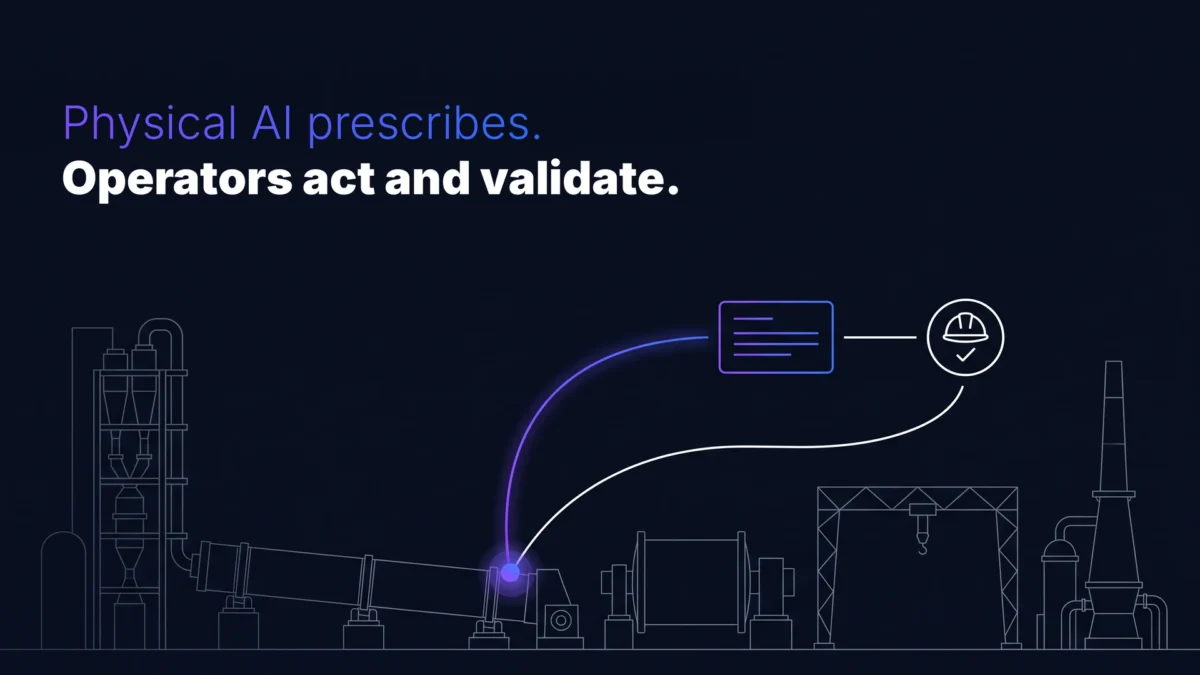
Physical AI prescribes. Operators
act and validate.
Start with your most critical line.
Book a Discovery CallFrequently Asked Questions
Physical AI in heavy manufacturing is AI that understands how industrial equipment behaves under real process conditions. It combines mechanical signals, process data and equipment-specific failure knowledge to prescribe what plant teams should fix and why. Infinite Uptime’s PlantOS™ applies this across kilns, mills, cranes, furnaces and other critical assets in continuous process industries.
Robotics-led Physical AI gives machines the ability to move and manipulate objects, and it can train on abundant simulated data. Physical AI in heavy manufacturing interprets how running assets degrade, where real failure data is scarce and every intervention is carried out by people. It relies on physics, failure-mode knowledge and operator-validated outcomes rather than simulation alone.
AI agents can support maintenance decisions by assembling context, routing prescriptions and tracking closure inside existing workflows. The decision and the physical work stay with plant teams, who own the production plan, permit to work and safety. Agent authority in heavy industry should grow only as fast as a record of operator-validated outcomes supports it.
Many failures in heavy industry are process-induced. Conditions such as kiln ring formation, coating build-up or heat profile drift accelerate mechanical wear before vibration shows a clear signature. Reading process data from PLCs and historians alongside mechanical signals lets Physical AI identify the cause early, instead of describing the symptom once damage has started.
Outcome Intelligence is the layer that connects an industrial AI insight to a verified production result. It covers the loop from sensing and understanding a fault to prescribing an action, executing it and validating its impact. Success is measured by outcomes plant teams confirm, such as less downtime, more throughput and lower cost per ton.
Scaling depends on equipment-specific models that respect each plant’s physics, site-level validation that builds operator trust, delivery into the enterprise tools teams already use, and compatibility with existing sensors and OT systems. PlantOS™ is live across 1,000+ plants in 28 countries, and JSW Steel runs it across 139 plants in India and the USA.
Asset-intensive, continuous process industries benefit most, because a single unplanned stoppage carries high production cost. PlantOS™ serves nine heavy manufacturing verticals: Steel, Cement, Mining & Metals, Chemicals & Fertilizers, Paper & Pulp, Tire & Rubber, F&B, Pharma & Personal Care, and Energy and Oil & Gas.