Your Crane Is Already Going Down. You Just Don't Know It Yet!! Why standard PdM was never built for cranes — and why the sensors you trust most are silent exactly when faults emerge.
- What is Crane AI Shield?
- What you are responsible for protecting
- The tool you trust has a structural blind spot
- What your crane is actually dealing with — and why it matters
- Your guide to closing the blind spot: Crane AI Shield
- The fault coverage map: what Crane AI Shield detects
- The PlantOS™ Architecture: from signal to prescription
- The 99% Trust Loop — your guarantee, not just a feature
- What success looks like: from reactive firefighting to prescribed reliability
- Getting started: 5 days to live monitoring
Key highlights
- You are managing the most complex and costly asset on the plant floor. Crane downtime is an operations problem — the cascade cost dwarfs the repair bill by 10–15×.
- The tools you trust most have a structural blind spot. Battery-based PdM(Predictive Maintenance) sensors sample too rarely, stop recording under load, and fail in foundry heat — missing faults exactly when they emerge.
- The gap is 3–4 weeks of fault progression your current system cannot see. By the time a vibration alarm fires on a time-sampled sensor, the bearing is already failing.
- Crane AI Shield from Infinite Uptime is purpose-built for this environment. RPM-gated FFT, always-on monitoring, and IP68 hardware that survives where battery sensors burn out — with 99.97% validated uptime accuracy.
- 5-day deployment. 6–12 month ROI payback. Up to 99% prescription adoption rate. Outcomes validated — not just predicted.
What is Crane AI Shield?
Crane AI Shield is an always-on, crane-specific AI monitoring solution that detects developing mechanical faults under real operating conditions and delivers evidence-backed maintenance prescriptions before failures cause unplanned downtime.
You are the reliability manager. The plant maintenance head. The person who knows that when the ladle crane goes down mid-shift with no warning, the bay stops, the heat schedule collapses, and your phone rings before the crane does.
You have monitoring in place. You have schedules, sensors, and inspection routes. And yet, right now, a fault is developing inside your crane’s gearbox that your current sensor cannot detect.
Not because it hasn’t alarmed yet. Because it physically cannot alarm. The sensor sampled at 6 AM. The fault emerged at 2 PM — under load, when the crane was working hardest. The sensor was asleep.
This is the sampling gap. And it is costing you downtime you cannot see coming.
"Standard PdM was never built for cranes. The sensor sleeps while the crane works — and faults reveal themselves exactly at the moment the sensor is silent."
— Infinite Uptime, Crane AI Shield
What you are responsible for protecting
Before we get to the monitoring gap, let’s be clear about what is actually at stake. In steel mills and mining operations, cranes are not auxiliary equipment — they are the production flow. When the main hoist fails, the bay stops. The cost compounds within hours.
When the crane goes down, it doesn’t produce a maintenance work order. It produces a cascade.
You know your cranes. You know your plant. What you need is a system that captures vibration data exactly when faults emerge — under load, at stable speed, in the harshest environment on your site — and translates that data into specific, evidence-backed actions your team can execute on shift. That is what Crane AI Shield is built to do.
Not another dashboard. Not another time-sampled alert. A prescription: which bearing, which gear, which shift to schedule it — with the FFT spectrum and trend data to justify the intervention.
The repair cost is the smallest number on the incident report. The real cost is the 24–72 hours of bay downtime, the emergency parts at premium pricing, the overtime labour, and the cascading damage — a $5K bearing fault that takes out the gearbox, motor, and shaft, turning a small repair into a $500K incident.
| Cost component | Estimated impact per event |
|---|---|
| Emergency repair premium (parts + rigging + overtime) | $30K–$80K |
| Lost production — bay idle during repair | 24–72 hrs |
| Cascading damage — bearing fault → gearbox → motor → shaft | Up to $500K |
| Safety investigation + adjacent crane halt | Variable — hours to days |
The tool you trust has a structural blind spot
You have predictive maintenance in place. The problem isn’t effort or investment. The problem is that the sensor technology underlying standard PdM(Predictive Maintenance) was not designed for cranes — and in three specific ways, it fails at exactly the moment you need it most.
moments that matter
crane is working
they can warn you
The structural problem runs deeper than sensor quality. Every approach your team currently uses shares the same limitation: it reacts to failure signals rather than tracking degradation continuously.
| What you're currently using | What it captures | The gap it leaves |
|---|---|---|
| OEM scheduled intervals | Average component life at standard conditions | Actual degradation rate under your duty cycles — heat, load, speed, environment |
| Battery PdM sensors | Vibration snapshots at scheduled intervals — a few times per day | Faults that develop between samples and under load — precisely when cranes are most stressed |
| Operator observation | Visible or audible failure symptoms | Early-stage bearing and gear degradation — weeks before it becomes observable |
| PlantOS™ Crane AI Shield | RPM + temperature streaming 24/7. FFT triggered at stable speed under load | Nothing — always-on coverage exactly when faults emerge |
What your crane is actually dealing with — and why it matters
The sampling gap hits hardest in the two environments where Crane AI Shield operates. In steel mills and mining operations, cranes run the most demanding duty cycles in heavy industry — and bearing and gearbox faults develop faster, more unpredictably, and with higher consequence than in any standard industrial environment.
Steel mills: ladle cranes and casting cranes
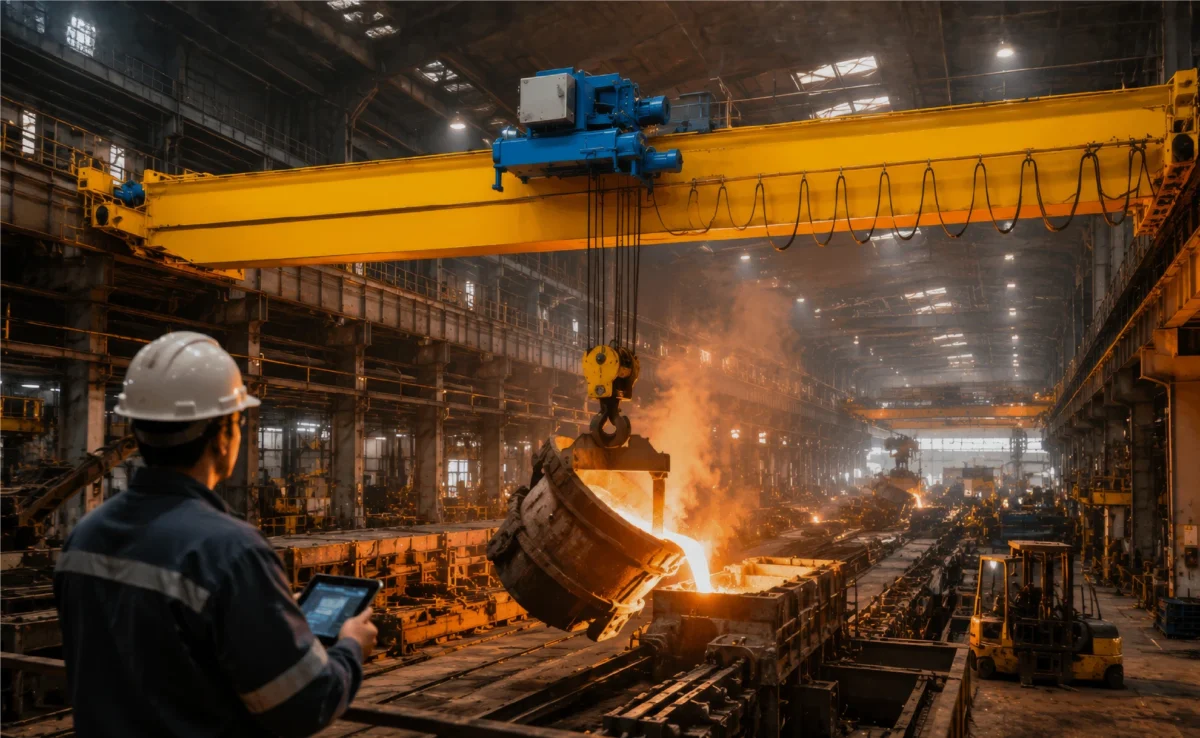
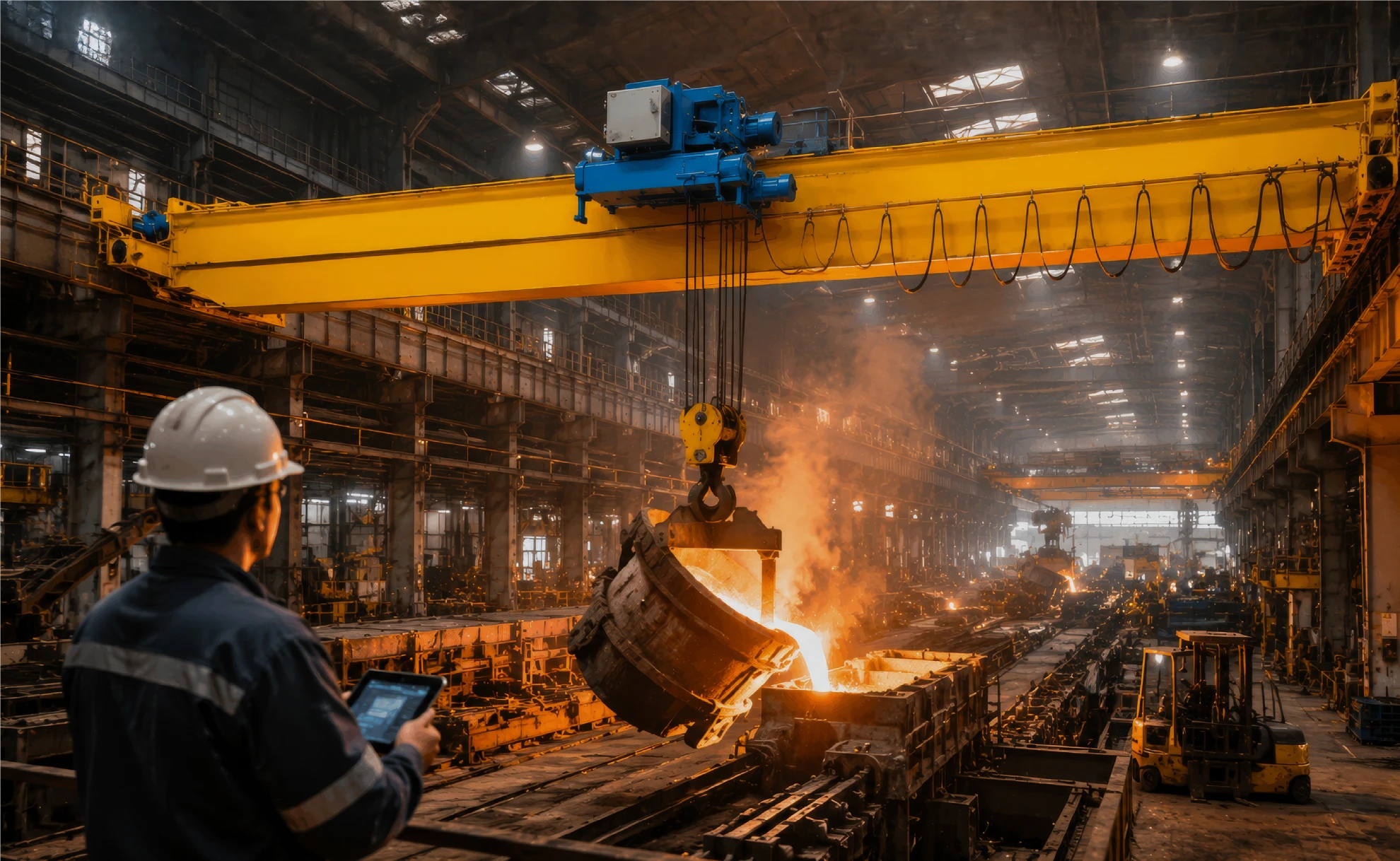
A ladle crane in a BOF or EAF shop runs in one of the harshest industrial environments on earth — sustained radiant heat from molten steel at 1,600°C, heavy shock loading on every lift, and back-to-back duty cycles with minimal rest between heats. These conditions accelerate bearing wear, gear mesh degradation, and motor winding fatigue at rates that OEM maintenance intervals were never calibrated for.
The problem with standard battery PdM in this environment is threefold. First, battery units degrade rapidly under sustained radiant heat — the sensor fails before the bearing does. Second, the most destructive loading events happen during the lift itself, precisely when a time-sampled sensor is between snapshots. Third, the high-shock, high-duty-cycle profile of a ladle crane means bearing defects progress from incipient to catastrophic in days — not weeks.
Crane AI Shield captures 3-axis vibration, temperature, and RPM continuously from sensors rated to 180°C surface temperature. FFT analysis triggers only when the motor is in a stable RPM band — under load, capturing the fault signature at its clearest, not during accel/decel noise.
Mining: overhead cranes in concentrators and crushers
In copper, gold, and iron ore processing, overhead cranes in concentrator buildings and crusher halls run high duty cycles in extreme particulate environments. The combination of continuous operation, abrasive dust ingress into bearing housings, and the physical consequence of a main hoist failure — stopping maintenance access to the entire grinding and flotation circuit — makes these cranes among the highest-risk assets on any mine site.
Battery sensors in crusher hall environments face compounding failure modes: particulate contamination of the sensor housing, adhesive mount degradation under vibration, and sampling schedules that have no relationship to when the crane’s bearing loads are highest. A wheel-bearing failure on an overhead crane idles the whole concentrator bay. A hoist gearbox failure with no advance warning turns a $5K bearing replacement into a $500K multi-component rebuild at height.
Crane AI Shield’s IP68 SS316 enclosures and stud-mounted wired sensors are designed specifically for this environment — no adhesive mounts, no batteries, no wireless signal dropout in high-RF industrial buildings.
Your guide to closing the blind spot: Crane AI Shield
You know your cranes. You know your plant. What you need is a system that captures vibration data exactly when faults emerge — under load, at stable speed, in the harshest environment on your site — and translates that data into specific, evidence-backed actions your team can execute on shift. That is what Crane AI Shield is built to do.
Not another dashboard. Not another time-sampled alert. A prescription: which bearing, which gear, which shift to schedule it — with the FFT spectrum and trend data to justify the intervention.
The fault coverage map: what Crane AI Shield detects
Across three coverage tiers, Crane AI Shield monitors up to 19 failure modes on the main hoist drive train and long-travel wheel systems — all mechanical faults that standard battery PdM either misses between samples or fails to detect under load.
| Coverage tier | Fault / fault mode | Detected by | Detection method |
|---|---|---|---|
| Starter + Standard | Gear tooth wear | ✓ Crane AI Shield | Gear-mesh frequency (GMF) analysis |
| Starter + Standard | Gear backlash | ✓ Crane AI Shield | GMF sidebands |
| Starter + Standard | Misaligned gears | ✓ Crane AI Shield | Spectral analysis |
| Starter + Standard | Cracked / broken gear teeth | ✓ Crane AI Shield | Cepstrum + shock pulse |
| Starter + Standard | Inadequate gear lubrication | ✓ Crane AI Shield | GMF amplitude trending |
| Starter + Standard | Inadequate bearing lubrication | ✓ Crane AI Shield | High-frequency envelope analysis |
| Starter + Standard | Rolling-element bearing defects (BPFO/BPFI/BSF) | ✓ Crane AI Shield | FFT fault frequency mapping |
| Standard only | Structural looseness / soft-foot | ✓ Crane AI Shield | Sub-synchronous vibration |
| Standard only | Rotating looseness | ✓ Crane AI Shield | Harmonic spectrum analysis |
| Standard only | Unbalance | ✓ Crane AI Shield | 1× RPM amplitude |
| Standard only | Bent shaft | ✓ Crane AI Shield | 1× + 2× RPM |
| Standard only | Rotor bow & rub | ✓ Crane AI Shield | Sub-synchronous + 1× |
| Standard only | Cracked / loose rotor bars | ✓ Crane AI Shield | Motor current + vibration |
| Standard only | Coupling faults | ✓ Crane AI Shield | 2× RPM sidebands |
| Standard only | Shaft misalignment | ✓ Crane AI Shield | Axial + radial vibration |
| Standard only | Pedestal bearing looseness | ✓ Crane AI Shield | Harmonic series |
| Comprehensive only | Wheel-bearing lubrication degradation | ✓ Crane AI Shield | High-frequency envelope |
| Comprehensive only | Rolling-element wheel-bearing defects | ✓ Crane AI Shield | FFT + wheel RPM |
| Comprehensive only | Wheel unbalance | ✓ Crane AI Shield | 1× wheel RPM |
| Comprehensive only | Wheel-side rotating looseness | ✓ Crane AI Shield | Harmonic series |
The PlantOS™ Architecture: from signal to prescription
Crane AI Shield is built on a three-tier architecture designed specifically for cranes — continuously moving assets that need wired, always-on instrumentation and RPM-synchronised data capture. Every design decision responds directly to the three failures of standard battery PdM.
Tier 1 : Signal Acquisition — what goes on your crane 01
Primary sensor: IP68 SS316 unit mounted on the AC motor — captures 3-axis vibration, temperature, and RPM in a single rugged node. 180°C-rated cabling. No batteries. Stud or bracket mount. Secondaries on gearbox stages and drum bearings flow data in a strict primary–secondary RPM-synchronised loop. Survives where battery sensors burn out.
Tier 2 : Edge Processing and Transmission 02
Primary sensor: IP68 SS316 unit mounted on the AC motor — captures 3-axis vibration, temperature, and RPM in a single rugged node. 180°C-rated cabling. No batteries. Stud or bracket mount. Secondaries on gearbox stages and drum bearings flow data in a strict primary–secondary RPM-synchronised loop. Survives where battery sensors burn out.
Tier 3 : AI Engine and Prescription Delivery 03
Primary sensor: IP68 SS316 unit mounted on the AC motor — captures 3-axis vibration, temperature, and RPM in a single rugged node. 180°C-rated cabling. No batteries. Stud or bracket mount. Secondaries on gearbox stages and drum bearings flow data in a strict primary–secondary RPM-synchronised loop. Survives where battery sensors burn out.
A Crane AI Shield prescription does not say 'check gearbox.' It says: "Gearbox vibration at MDE bearing trending 23% above baseline over 14 days. BPFO frequency signature indicates outer race wear. Recommend bearing inspection within 7 days. Evidence: trend chart, FFT spectrum attached." That is actionable. That is why up to 99% of prescriptions are acted upon.
The 99% Trust Loop — your guarantee, not just a feature
Most industrial AI generates alerts. The bottleneck has never been detection accuracy — it has been execution. You’ve seen alert fatigue. Your team gets a notification, investigates, finds nothing actionable, and gradually stops trusting the system. PlantOS™ is built around the 99% Trust Loop™ — a validated cycle where every prescription is specific, evidence-backed, and contextually grounded.
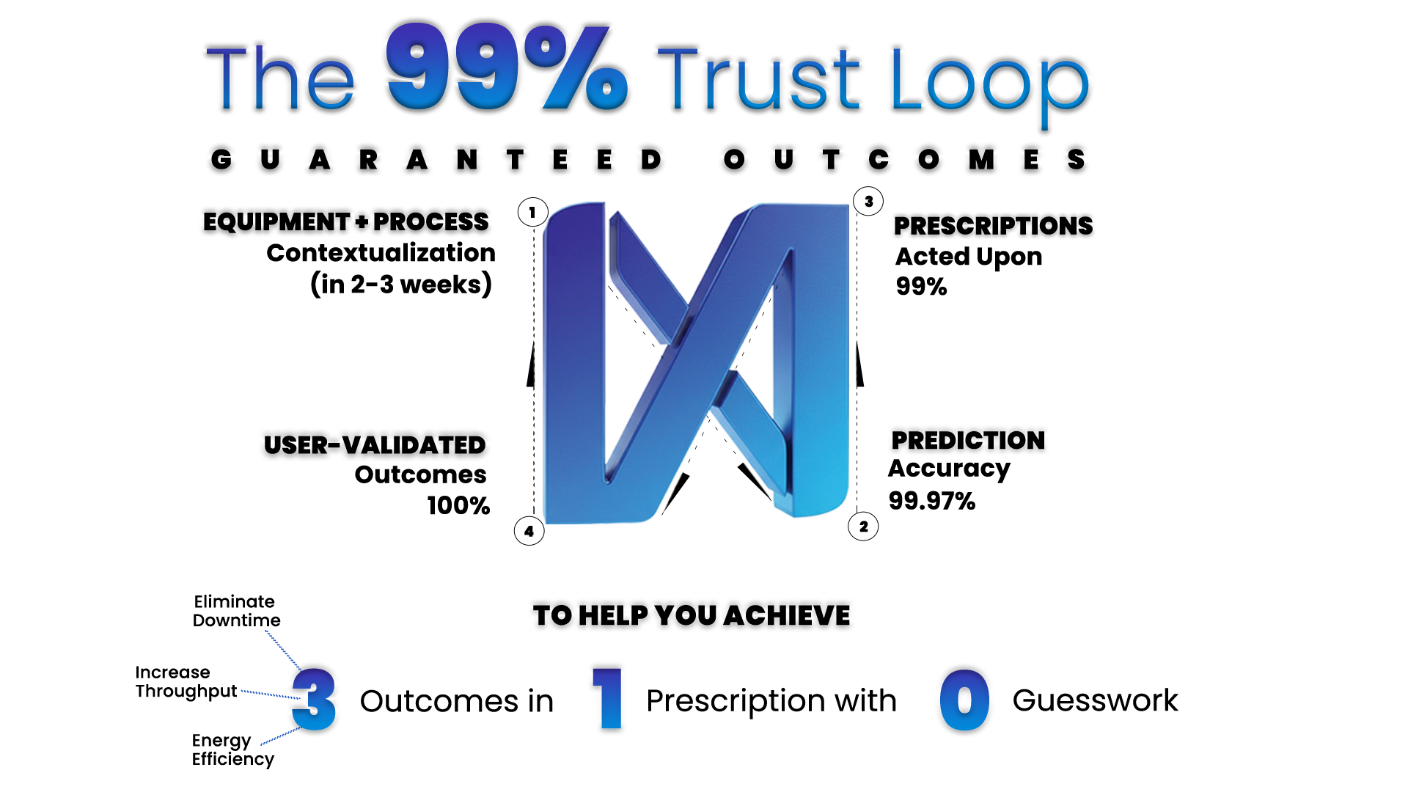
Equipment
Contextualization
Your crane's kinematic profile, gear-mesh frequencies, shaft orders, and duty cycle mapped before any inference. Context-free alerts are the source of false alarms and alert fatigue.
Prediction
Accuracy
Validated across 85,000+ monitoring locations.[5] Multi-signal cross-correlation: every FFT, GMF, cepstrum, RPM and temperature trace combined. Confidence builds as evidence agrees.
Prescriptions Acted Upon
Your team acts because the prescription specifies which bearing, which gear, which shift—with the FFT evidence to justify it. Not an alert. A directive.
User-Validated Outcomes
You confirm. The DRS report closes with before/after proof. Every validated outcome sharpens the next prescription.
What success looks like: from reactive firefighting to prescribed reliability
This is the shift that Crane AI Shield enables — from the world where your team responds to crane failures to the world where your team acts on prescriptions weeks before a failure occurs.
| Outcome | Your world today (reactive) | Your world with Crane AI Shield | Verified improvement |
|---|---|---|---|
| Unplanned breakdowns | Failure-triggered response — you find out when the crane stops | Prescriptions acted on 2–6 weeks before failure | 8 of 10 eliminated[5] |
| MTBF | OEM intervals — not calibrated to your actual duty cycles | Condition-based — intervene on signal, not schedule | +25–30% MTBF improvement[6] |
| Detection to response | Hours to days — operator observation after failure | Minutes — RPM-gated FFT + evidence trail delivered | >80% reduction in response time[6] |
| Emergency repair cost | 3–5× premium — overtime, expedited parts, rigging | Planned interventions replace emergency mobilisation | Significant cost reduction[2] |
| Safety compliance | Manual logs, periodic inspections | Continuous digital logging — audit-ready | 100% interlock event visibility[5] |
Getting started: 5 days to live monitoring
Not from dashboards. From prescriptions. Validated by the operators who signed off.
Frequently Asked Questions
Standard battery PdM sensors fail cranes in three specific ways: they sample vibration only a few times per day, missing faults that develop between snapshots; they stop recording when the crane is under load — exactly when fault signatures are strongest; and their battery enclosures degrade rapidly under foundry heat, dust, and vibration. Crane AI Shield eliminates all three: RPM-gated FFT fires only under stable load conditions, sensors stream RPM and temperature 24/7, and IP68 SS316 hardware with 180°C-rated cabling is designed to survive where battery units fail.
Time-sampled monitoring captures vibration on a clock schedule — not when the crane is actually working. Accel and decel noise contaminates the spectrum, making it difficult to isolate genuine fault frequencies. RPM-gated FFT triggers only when the motor is in a stable speed band under load — producing clean spectra at the exact moment fault signatures are most distinguishable. This eliminates false alarms, reduces filtering requirements, and catches faults that time-sampled systems structurally cannot detect.
Crane AI Shield monitors up to 19 failure modes across the main hoist drive train: bearing defects (BPFO/BPFI/BSF), gear-mesh faults (GMF), gear tooth wear, gear backlash, shaft misalignment, coupling faults, rotor bar cracks, unbalance, structural looseness, and more. The Comprehensive tier adds long-travel wheel bearing defects. Vibration analysis using FFT fault frequency mapping identifies bearing and gearbox degradation 2–6 weeks before catastrophic failure. The Tata Steel Colors case study: Main Hoist Motor #3 flagged 12 days before likely failure — 10 hours of unplanned downtime avoided.
Deployment follows a structured 5-day plan with only one day of crane downtime required for sensor mounting and commissioning sign-off. AI calibration to the crane’s kinematic profile — mapping gear-mesh and shaft-order frequencies — is completed within Days 2–3. The system delivers a first diagnostic typically within 30 days, with a 60-day evaluation period and 75% of payment due only on satisfaction. ROI payback is typically achieved within 6–12 months: the Standard subscription is $24K per crane per year versus $75K–$250K+ per avoided main-hoist failure — a 3–10× return on the first catch.
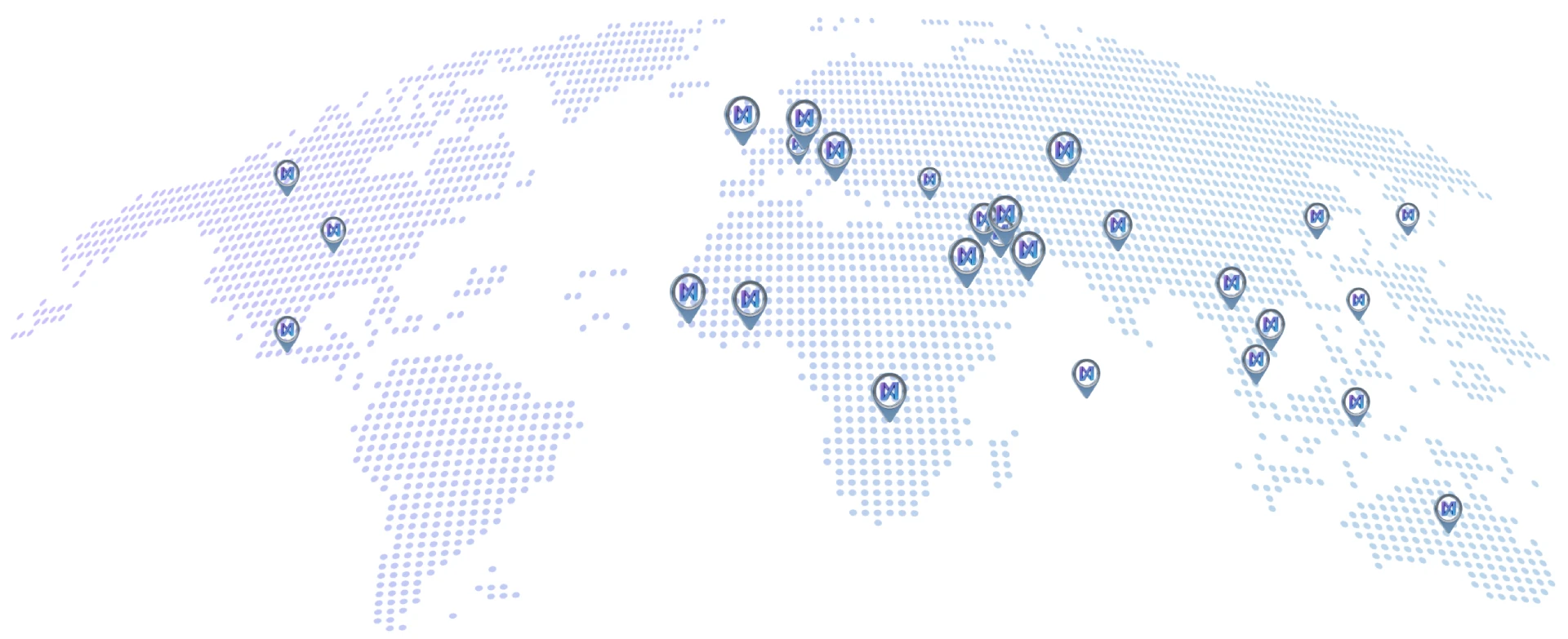
Yes. Start with your highest-criticality crane, validate the outcome on your specific equipment, then scale at your own pace. The Fleet Operations Center provides a unified view of 100+ cranes — every crane needing attention ranked by fault progression, with preventable downtime hours tracked live. Infinite Uptime currently operates across 845+ plants in 30+ countries. Sensor placement scales with crane size; the scope of fault coverage does not change.
References
[1] Mazzella Companies — "Depending on the facility and its output, downtime can cost anywhere from $10,000 to $20,000 per hour for standard operations. High-production environments may lose hundreds of thousands of dollars per hour." mazzellacompanies.com/learning-center/the-true-cost-of-overhead-crane-breakdowns/ (2026)
[2] U.S. Department of Energy, as cited in OxMaint and eWorkOrders — Reactive maintenance costs 3–5 times more than planned preventive maintenance when all costs are included: emergency labour, expedited parts, production loss, cascading damage. oxmaint.com/blog/post/maintenance-cost-reduction-20-proven-strategies
[3] Infinite Uptime ROI Estimate 2026 — "Standard at $24K / crane / yr vs $75K–$250K+ per avoided failure → 3–10× return. Payback on the first catch." Across Infinite Uptime install base. infinite-uptime.com
[4] iFactory / OxMaint — Vibration analysis using FFT fault frequency mapping can identify bearing and gearbox degradation 2–6 weeks before catastrophic failure. ifactory.jrsinnovation.com/blog/vibration-sensors-predictive-maintenance
[5] Infinite Uptime PlantOS™ — Live data as of June 2026: 845+ plants, 30+ countries, 111,600+ hours downtime eliminated (last 24 months), 3.3B+ data points, 99.97% equipment uptime achieved on contract. infinite-uptime.com
[6] Industry benchmark — Predictive maintenance associated with +25–30% MTBF improvement and >80% reduction in detection-to-response time. R. Keith Mobley, Plant Engineer's Handbook, as cited in PDS Balancing (2026). Actual improvement varies by asset mix and programme maturity.