

When the Equipment Lies,the Process Pays: The True Cost of Process Instability in Chemical Plants
Read Time: 8–9 minutes | Author – Kalyan Meduri

- The Invisible Thread: How Equipment State Drives Process Behaviour
- The Energy You Are Paying For Twice
- When Equipment Faults Become Product Quality Problems
- The Compound Effect: Why Small Variations Cost Big
- Why DCS Alarms and Energy Reports Miss What Actually Matters Why Traditional Monitoring Fails — and PlantOS™ Succeeds
- The Gap That Remains — and Where It Lives
- In the Field: What Operator-Validated Outcomes Look Like In a Chemical company,
The dashboard says everything is fine. Steam is flowing. Temperatures are within range. The column is running. And yet — somewhere between the sensor and the spreadsheet — your plant is silently burning money.
This is not a hypothetical. It is the operational reality for hundreds of chemical plants running today: equipment that degrades quietly, process parameters that drift slowly, and DCS systems that see none of it until the damage is already done.
In chemical manufacturing, the relationship between equipment reliability and process stability is not indirect. It is not a soft correlation. It is a direct, measurable, cost-generating link — and most plants are managing the symptoms while the root cause keeps compounding.
This blog makes that link explicit. With real industry figures, real examples, and the evidence for why prescriptive AI is the only tool that can break the cycle.
The Invisible Thread: How Equipment State Drives Process Behaviour
Every process engineer knows that distillation, separation, and reaction processes require stable inputs to deliver consistent outputs. What is less often acknowledged is that the primary source of process instability is not the process itself — it is the equipment running it.
Consider the chain:
• A condenser fouls → heat transfer efficiency drops → steam demand rises to compensate → column pressure fluctuates → separation efficiency falls → product exits with higher impurity levels
• A steam trap fails → live steam bypasses the system → steam header pressure fluctuates → column base temperatures swing → residence time changes → unconverted intermediates accumulate in product
• A centrifugal pump impeller wears → flow rate drops below design → heat exchanger duty falls → outlet temperatures drift → reaction kinetics shift → yield and quality decline
Process instability is rarely a process problem. It is an equipment problem that the process has been asked to absorb — and eventually, it cannot.
At a specialty chemicals plant, an EA3 Kettle reaction column showed an SDS/Ethanol factor varying between 0.4 and 1.4 against a stable expected average. The column was running. Steam was flowing. But unconverted ethanol was accumulating in the product — run by run, shift by shift — with no alarm, no trip, and zero dashboard visibility.
PlantOS™ ran a multi-parameter regression across 100+ runs and identified the root cause: condenser and cooling tower fouling reducing thermal efficiency, causing unsteady steam supply and outlet temperature instability
No individual DCS alarm had fired. The fault was only visible by correlating six parameters simultaneously across time. After corrective cleaning and prescribed operating ranges, model accuracy improved from R² = 0.38 to R² = 0.77. Off-spec product: eliminated.
The Energy You Are Paying For Twice
Distillation alone accounts for approximately 40% of total energy consumption in chemical and refining plants. That is not a rounding error — that is the single largest energy end-use in most chemical facilities, and it is running under suboptimal conditions in most plants.
When equipment degrades and process conditions drift, energy is consumed in two ways: once to do the intended work, and again to compensate for lost efficiency. This ‘double billing’ is the most underreported cost in chemical manufacturing.
Where the Energy Goes — The Fouling Problem
Heat exchanger fouling is one of the best-documented and least-addressed contributors to energy waste in the chemical sector. The data is stark:
The mechanism is straightforward: fouling creates a thermal resistance layer on heat transfer surfaces. The thicker the layer, the more energy the system consumes to achieve the same duty. Operators compensate by increasing steam flow — masking the underlying degradation while the energy bill climbs.
Primary Energy Loss Contributors in Chemical Plants
inefficiency
fouling
operation
degradation
When Equipment Faults Become Product Quality Problems
Product quality in chemical manufacturing is directly downstream of process stability — which is directly downstream of equipment state. The chain is mechanical, not probabilistic. And yet, most quality deviation analyses begin at the process level without ever reaching the equipment root cause.
In distillation and separation processes, the pathway is well-established:
Degrades
worn pump,
failing steam trap
temperature excursion,
steam instability
Fails
maintain efficiency
window
Build
intermediates
enter product stream
Deviates
The challenge is that quality deviations rarely present as a single dramatic event. They accumulate as gradual drift — a slowly worsening SDS factor, an increasing impurity trend, a creeping rework rate. By the time the quality team raises an alarm, the equipment cause is weeks old and the process has already absorbed the full cost.
REAL-WORLD PATTERN
Compressor Valve Wear → Upstream Pressure Swing → Reactor Yield Loss
In continuous chemical reactors, feed pressure stability is critical to maintaining residence time and, therefore, conversion rates. A worn compressor valve introduces pulsation into the feed stream. This creates micro-fluctuations in pressure that shift residence time by seconds per cycle — imperceptible in any single sample, but statistically significant across a shift.
The result: a plant running at 96% conversion reports a gradual drift to 93%. Over a month, this represents hundreds of tonnes of product yield loss — attributable, on root cause analysis, to a $400 compressor valve that had been degrading for six weeks before the yield trend was investigated.
The DCS showed no alarm. The process historian showed no trip. The quality dashboard showed a trend that was attributed to raw material variability — incorrectly — for three weeks.
The Compound Effect: Why Small Variations Cost Big
Cost Impact Layers of Unaddressed Process Instability
overconsumption
yield loss
equipment
replacement
Why DCS Alarms and Energy Reports Miss What Actually Matters Why Traditional Monitoring
Fails — and PlantOS™ Succeeds
Chemical plants already have data. What they lack is contextual intelligence. DCS alarms monitor thresholds. Energy reports aggregate results. Quality systems log deviations. PlantOS™ works between them.
- Detects anomalies early — before individual thresholds are breached
- Correlates across process, energy, and equipment simultaneously
- Prescribes operator-validated actions with timing, root cause, and business impact
- Builds a living operational memory of what worked, where, and under which conditions
This approach aligns with proven industrial AI research showing that multi-parameter, plant-scale anomaly detection dramatically outperforms static threshold alarms in process manufacturing environments. The EA3 Kettle case below is not a hypothetical. It is a direct demonstration: the column had DCS, SCADA, and operator rounds. None of it caught the six-parameter drift that PlantOS™ identified across 100+ production runs.
| ⚠️ Reactive Operations | ✅ With Plant OS ™, Prescriptive AI |
|---|---|
| Fault detected after product deviation | Fault detected before process impact begins |
| Single-tag alarms miss multi-parameter drift | Cross-parameter correlation catches compound signatures |
| Root cause found by exception (or not at all) | Root cause identified and ranked by regression influence |
| Operator intervenes reactively under pressure | Prescription delivered with timing, action, and context |
| Energy overconsumption continues for hours/days | Operating ranges prescribed to prevent drift before it compounds |
| Equipment replaced on schedule or at failure | MTBF extended by operating within prescribed parameter bands |
The Gap That Remains — and Where It Lives
Chemical plants are not data-poor. They are connection-poor. DCS platforms show what is happening in distillation columns, reactors, heat exchangers, steam systems, and utilities. Quality management systems explain why product deviates after it has already deviated. Energy and utility reports show what already occurred — after the batch is closed, the run is logged, and the bill is paid.
This is the gap where energy cost, product quality, and reporting confidence accumulate quietly. It is where carbon exposure widens, sustainability data becomes indefensible, and corrective action becomes reactive instead of economic.
Closing this gap requires more than dashboards or alarms. It requires continuous correlation between equipment health, process behaviour, and energy intensity — followed by prescriptive actions that operators can validate and trust. This is precisely where Infinite Uptime’s Process Business, built on PlantOS™, operates.
PlantOS™ identifies energy-relevant anomalies in chemical operations while they are still recoverable:
• Distillation column pressure and temperature drift before rising steam rate hardens into sustained cost
• Reactor conversion inefficiency from feed instability before yield loss compounds across batches
• Heat exchanger fouling trajectory before thermal duty falls and column separation is compromised
• Steam trap failure before header pressure instability propagates to column base temperature
• Pump and compressor degradation before flow loss impacts heat exchanger duty and reactor feed stability
Critically, the system does not act in isolation. Every recommendation is reviewed, validated, and owned by operators on the floor. This is not automation replacing judgment — it is agentic intelligence amplifying it. Over time, each validated intervention becomes part of a growing operational memory: what worked, under which operating conditions, on which assets — and with what measurable impact on energy, cost, and product quality per tonne.
In the Field: What Operator-Validated Outcomes Look Like In a Chemical company,
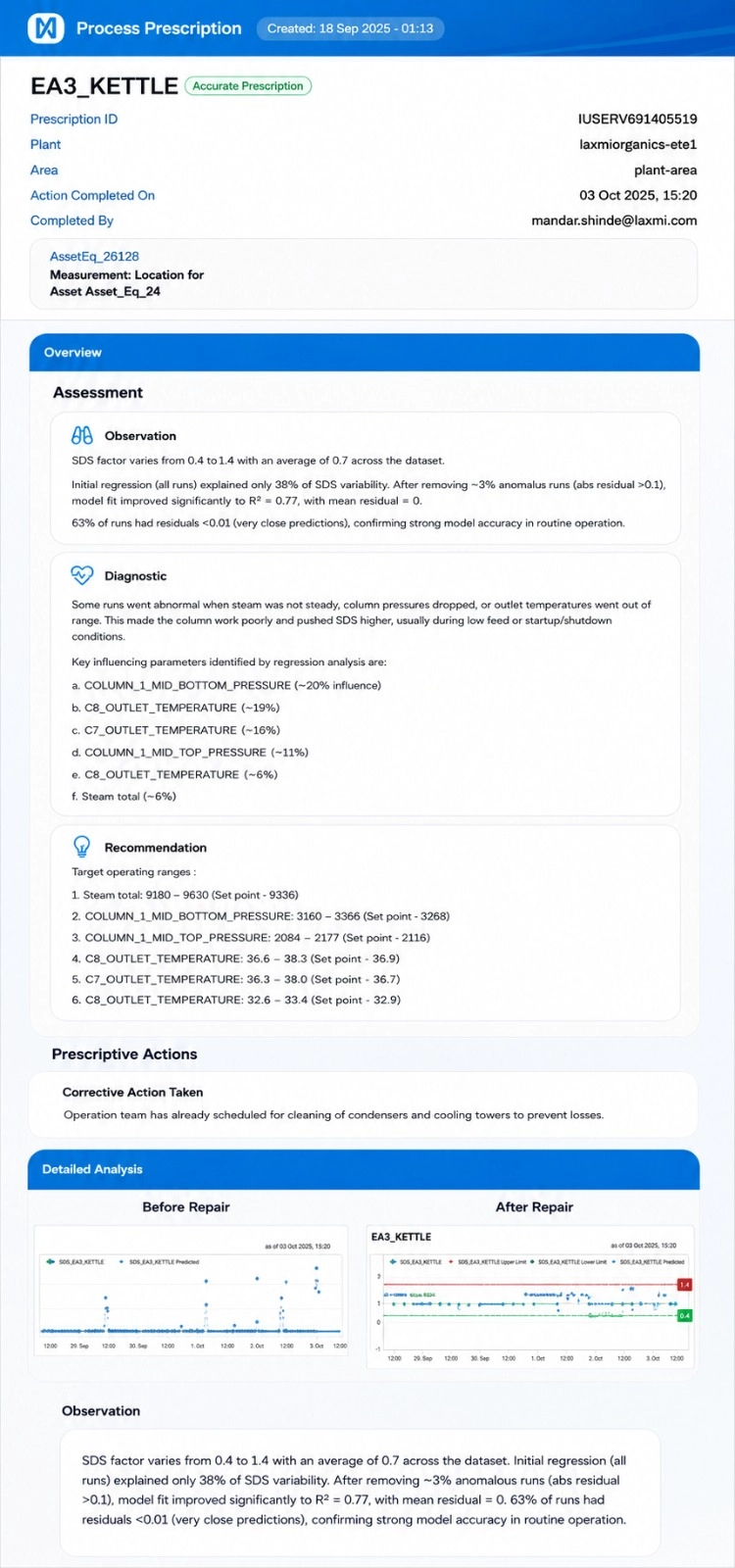
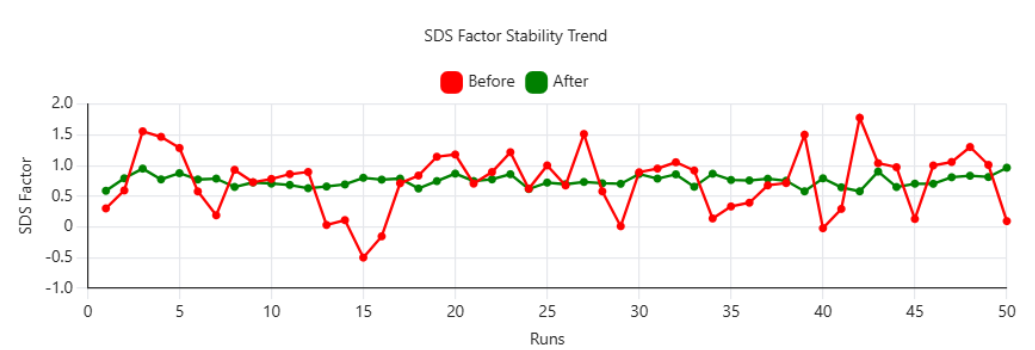
The EA3 reaction column showed significant variability in the SDS/Ethanol factor (ranging from 0.4 to 1.4), indicating unstable performance despite normal operation. Analysis revealed that this variation was driven by unsteady steam supply, pressure drops, and outlet temperature deviations, particularly during transient conditions like low feed and startup/shutdown.
PlantOS™ identified six key influencing parameters and prescribed optimal operating ranges to stabilize the process. The root cause was traced to reduced thermal efficiency from condenser and cooling system issues, leading to corrective actions including targeted cleaning of condensers and cooling towers to restore stable operation and prevent further efficiency losses.
This is not just a case study prepared for a presentation. This is Process Prescription Report generated by PlantOS, acted & validated by plant operators, and time-stamped to the hour. The observation, diagnostic, recommendation, corrective action, and business impact are all in one record — auditable, explainable, and Reporting ready.
PlantOS™ moves from raw plant data at the equipment and process layer through edge connectivity, platform execution, and prescriptive analytics, to decision planning, AI orchestration, and strategic governance. For chemical process management, the critical path runs through Process Canvas — which makes energy drift visible and explainable — and Process Prescript, which converts correlated anomalies into timed operator actions. The 3–8% energy reduction validated through this path is not a modelled estimate. It is an outcome confirmed by operators who acted on prescriptions, closed the loop, and logged the result.
This is what positions PlantOS™ as Industrial Agentic AI for Operator-Validated Outcomes — not a monitoring layer, but a decision layer that closes the loop between data, human judgment, and measurable impact.
“Process-induced faults inflate energy, carbon, and cost while production looks stable. PlantOS™ closes that blind spot — not by replacing operators, but by giving them actionable, trusted insight exactly where conventional systems go silent.”
If you only see problems after the monthly quality or energy report, you’re already paying for them!
Infinite Uptime’s PlantOS™ helps chemical manufacturing plants identify and correct energy-relevant process anomalies in real time — before they become quality deviations, carbon costs, or production losses. To explore what this looks like for your operations,
Frequently Asked Questions
Yes. In most cases, process instability originates from equipment issues like fouling, steam imbalance, or wear — which the process is forced to absorb until performance starts degrading.
Because they monitor individual parameters in isolation. Process inefficiencies are caused by multi-parameter interactions, which remain invisible unless correlations are analyzed together.
Even small deviations in pressure, temperature, or flow can reduce separation efficiency or alter reaction conditions, leading to gradual buildup of impurities and off-spec output
Read More Blogs

Prescriptive Maintenance + Energy Efficiency: A Practical Path to Stable Industrial Operations
In the United States, unplanned downtime costs manufacturers over $1...

Prescriptive AI: The Future of Smart Manufacturing and Reliable Semi‑Autonomous Plant Operations
In a world where operational reliability defines competitiveness, manufacturing leaders...

Predictive Maintenance: A Comprehensive Guide 2026
Predictive maintenance is an advanced strategy used to ensure that...
References:
- Kiss, A.A. & Smith, R. (2020). Rethinking energy use in distillation processes for a more sustainable chemical industry. Energy, 196, 117–143. ScienceDirect. Distillation accounts for ~40% of energy used in chemical and refining plants.
- JLCPCB Technical Blog (2026). Knowing the Silent Crisis in Industrial Heat Exchangers. Estimates: $4.2B–$10B in the US annually; $20B+ globally in fouling-related costs.
- Müller-Steinhagen, H. & Malayeri, M.R. (2010). Cost of heat exchanger fouling. Cited in HeatX Global Review. Total fouling cost estimated at 0.25% of GDP of industrialised countries.
- IMPO Magazine. Fouling in Heat Exchangers: A Costly Problem. 15% of factory maintenance costs attributed to heat exchangers; 50% of that due to fouling.
- iFactory Energy Optimization Platform (2026). Energy Wastage in Chemical Manufacturing Plants. Chemical plants waste 22–38% of purchased energy to undetected process inefficiencies.
- Sight Machine / ARC Advisory Group, cited in Innovapptive (2024). Reduce Unplanned Downtime: A $20 Billion Challenge in the Chemical Industry.
- Aberdeen Group Research, cited in WorkTrek (2025). Predictive Maintenance Cost Savings. Unplanned equipment failures cost an average of $260,000 per hour across industries.
- McKinsey & Company (2019). Predictive maintenance: the wrong solution to the right problem in chemicals. Planned maintenance shutdowns cause OEE losses of 5–10%, twice as much as unplanned stoppages.
- McKinsey & Company (2020). Predictive maintenance can reduce equipment downtime by up to 50% and lower maintenance costs by 10–40%. Cited across multiple industry sources.