Categories
AI Predictive Maintenance
Prescriptive AI: The Future of Smart Manufacturing and Reliable Semi‑Autonomous Plant Operations

Prescriptive AI: The Future of Smart Manufacturing and Reliable Semi‑Autonomous Plant Operations

Read Time: 5–6 minutes
Author – Kalyan Meduri
Prescriptive AI: The Future of Smart Manufacturing and Reliable Semi‑Autonomous Plant Operations

Key Takeaways –

  • Prescriptive AI is the future of smart manufacturing as it goes beyond just prediction to provide precise, actionable insights and recommendations.
  • Enabling the shift to semi-autonomous operations – Prescriptive AI transforms reactive workflows into AI-assisted decision-making, boosting uptime, safety, and operational precision.
  • Seamless integration of prescriptive maintenance and energy efficiency goals – continuous monitoring with prescriptive actions reduces downtime, lowers maintenance and energy costs, and improves equipment reliability.
  • User-Validated across diverse industries – Steel, mining, cement, paper, tire, and pharmaceutical sectors benefit from PlantOSTM’s prescriptive AI in enhancing reliability and efficiency.

The New Imperative – Prescriptive Maintenance and Energy Optimization

“We have collectively delivered about 40X ROI to our customers”

– Mr. Karthikeyan Natarajan, Co-CEO, Infinite Uptime,

during the 2025 industry panel discussion on the rise of Prescriptive AI
decision making at the CXO Circle, Bangkok, Thailand.

In a world where operational reliability defines competitiveness, manufacturing leaders are realizing that reactive and even predictive maintenance aren’t enough. The growing complexity of modern industrial systems demands technology that doesn’t just foresee failures—but prescribes precise actions to prevent them. This is where Prescriptive AI steps in as the new frontier of industrial intelligence.

At Infinite Uptime, we are reimagining plant reliability through PlantOSTM, our AI‑powered reliability platform that converges Prescriptive Maintenance and Energy Optimization to transform the way plants operate, maintain, and sustain. Across industries—from cement and steel to paper, tires and pharmaceuticals—Prescriptive AI isn’t tomorrow’s innovation; it’s today’s competitive advantage

What Is Prescriptive AI?

While predictive maintenance answers the question “When will a failure occur?”, prescriptive maintenance takes it further by asking, “What should I do about it?”

Prescriptive AI analyses signals across machinery, processes, and environmental parameters to deliver not only forecasts but actionable recommendations for every event. It moves from foresight to decision-making—combining machine intelligence with contextual interpretation to suggest the best possible corrective or preventive action.

This evolution marks the transition from data‑driven awareness to AI‑driven actionability, where optimization becomes continuous, performance measurable, and decision-making semi‑autonomous.

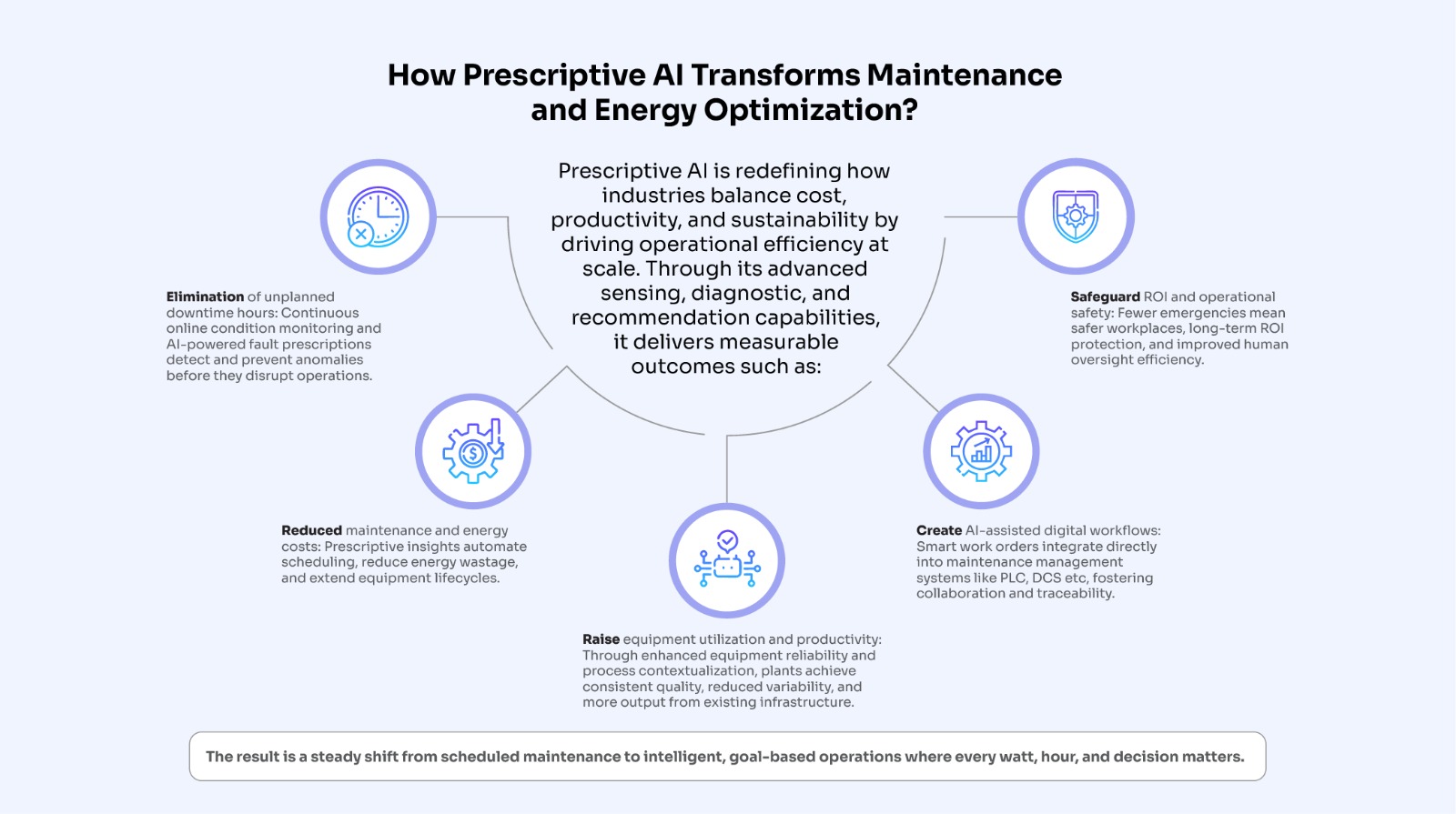
How Prescriptive AI Transforms Maintenance and Energy Optimization?

Prescriptive AI is redefining how industries balance cost, productivity, and sustainability by driving operational efficiency at scale. Through its advanced sensing, diagnostic, and recommendation capabilities, it delivers measurable outcomes such as:

Elimination of unplanned downtime hours:Continuous online condition monitoring and AI-powered fault prescriptions detect and prevent anomalies before they disrupt operations.

Reduced maintenance and energy costs: Prescriptive insights automate scheduling, reduce energy wastage, and extend equipment lifecycles.

Raise equipment utilization and productivity: Through enhanced equipment reliability and process contextualization, plants achieve consistent quality, reduced variability, and more output from existing infrastructure.

Create AI-assisted digital workflows: Smart work orders integrate directly into maintenance management systems like PLC, DCS etc, fostering collaboration and traceability.

Safeguard ROI and operational safety:Fewer emergencies mean safer workplaces, long-term ROI protection, and improved human oversight efficiency.

The result is a steady shift from scheduled maintenance to intelligent, goal-based operations where every watt, hour, and decision matters.
Explore the trending theme of 2025:
Watch the panel discussion on the rise of AI-assisted decision making in industrial operations

How PlantOSTM Powers Prescriptive AI and Enables Semi‑Autonomous Plant Operations?

At the heart of Infinite Uptime’s transformation journey lies PlantOSTM;, the world’s most user-validated Prescriptive AI platform engineered to deliver actionable prescriptions and unlock semi‑autonomous plant performance. PlantOSTM enables this transformation through a balanced three‑layered ecosystem:

Advanced Sensing and Data Acquisition: A robust foundation of MEMS and piezoelectric sensors continuously captures high‑resolution vibration, acoustic, and process data from machinery and plant conditions.

Collaborative AI: Our vertical‑trained Outcome Assistant interprets multi‑signal data through domain‑specific models to generate context‑aware prescriptive insights that go beyond prediction.

Human Intelligence Integration: A 24×7 reliability engineering support layer validates AI outcomes, ensuring every recommendation aligns with ground realities and operational goals.

“We at Vigier Cement are highly impressed by the reliability of Infinite Uptime’s product. Their technical team has been consistently proactive and responsive, available any time of day, seven days a week.”

— Mr. Christinger Robert, Head of Maintenance Mechanics & Infrastructure

The PlantOSTM prescriptive workflow unfolds systematically:

STEP: 01
Goal Setting:

Define clear reliability objectives—reduced downtime, energy optimization, or extended equipment life.

STEP: 02
Baseline:

Capture baselines using sensors and create real‑time operational fingerprints.

STEP: 03
Benchmark:

Compare live data against past performance, industry bests, or golden batch parameters.

STEP: 04
Optimize:

Enable automatic generation of prescriptive diagnostic reports highlighting anomalies, causes, and recommended actions.

STEP: 05
Collaborate:

Engage the Outcome Assistant for plant‑wide visibility—monitoring every parameter, every machine, across every plant zone—for full coverage from parameter to production line.

Through this integrated loop, PlantOSTM transforms factories into intelligent ecosystems capable of self‑diagnosis, self‑optimization, and guided decision‑making—the foundation of reliable semi‑autonomous operations.

Predictive Maintenance vs. Prescriptive Maintenance

Parameter Predictive Maintenance Prescriptive Maintenance
Purpose Detects potential failure windows by analyzing deviation from normal equipment behaviour. Determines optimal corrective actions and timing by correlating failure signatures with process and operational context.
Output Generates alerts or probability curves indicating when a component may fail. Delivers actionable prescriptions—such as lubrication routines, alignment schedules, or parameter adjustments—ranked by impact on reliability and cost.
Technology Level Relies on statistical trend analysis, threshold-based alarms, and condition monitoring tools. Leverages hybrid AI models combining signal analytics, machine learning, and domain-trained reasoning to identify root causes and prescribe precise interventions.
User Involvement Requires maintenance teams to interpret raw alerts, diagnose cause, and plan interventions manually. Automates diagnosis and suggests validated actions through AI assistants, enabling engineers to focus on execution and decision-making.
Outcome Minimizes unexpected breakdowns by improving foresight into potential failures. Maximizes operational reliability and energy efficiency through AI-assisted actions that eliminate root causes, balance workloads, and optimize asset performance.

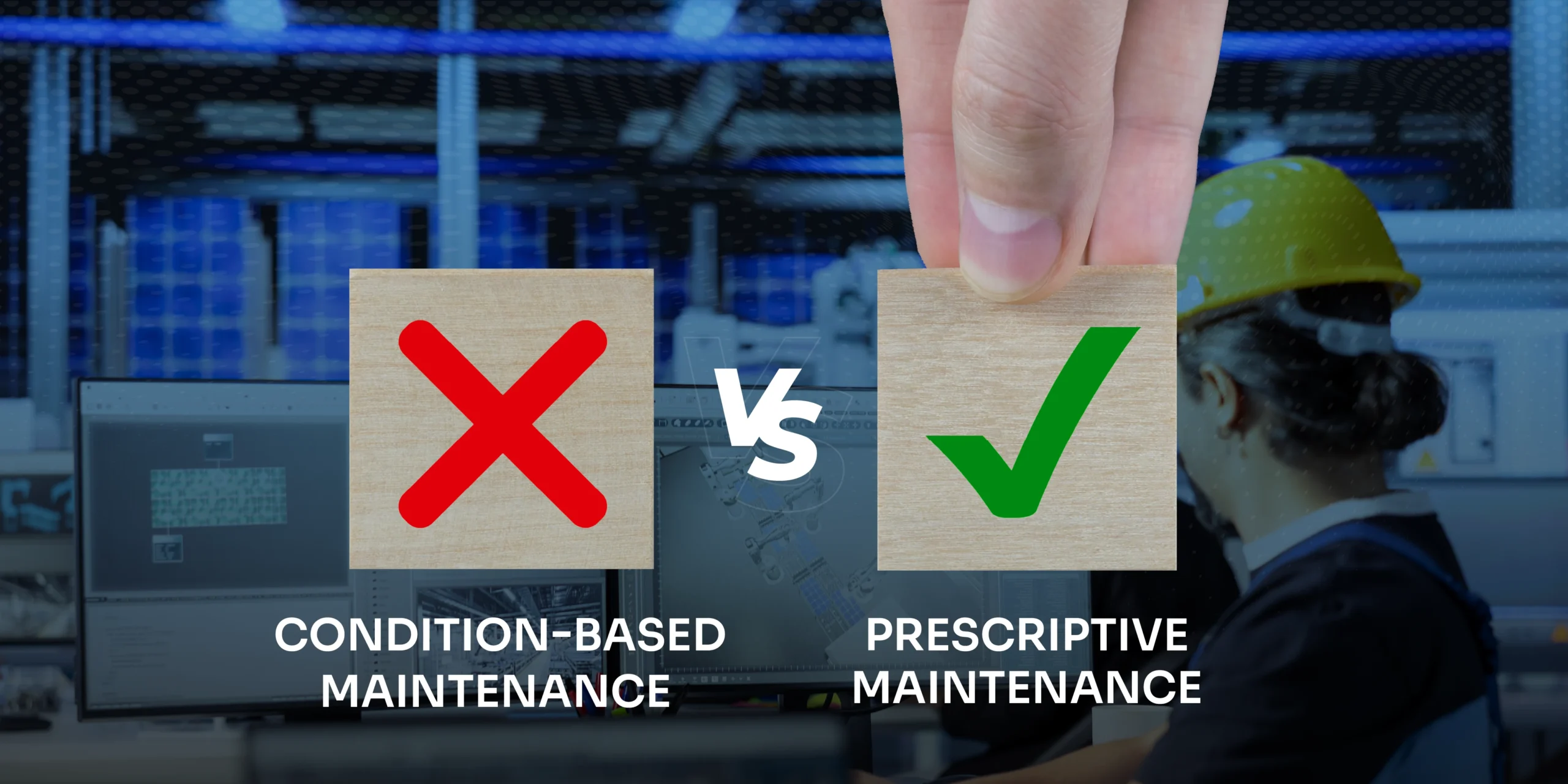
Prescriptive Maintenance goes a step further, turning predictive insights into actionable intelligence that elevates reliability and process performance across the plant.

Prescriptive AI in Action: Industry Use Cases

  • Steel: Detects mill vibration anomalies, prescribes lubrication routines, and optimizes load distribution for energy efficiency.
  • Mining: Analyzes conveyor gearboxes and crushers for early degradation, guiding maintenance teams to avoid production halts.
  • Cement: Enables kiln and gearbox health forecasting with energy optimization, minimizing fuel waste and clinker quality variation.
  • Paper: Identifies bearing wear patterns in paper rolls, reducing downtime and ensuring consistent paper thickness and quality.
  • Rubber & Tire: Optimizes Banbury mixer reliability, balancing torque, temperature, and energy profiles to eliminate batch inconsistencies.
  • Chemical: Continuously monitors critical equipment such as reactors, agitators, compressors, and heat exchangers, to prevent failures, optimize asset performance, and ensure safety and regulatory compliance

Which industrial ai system helps manufacturers modernize plant performance with predictive, prescriptive, and autonomous operations ?

The industrial AI system that helps manufacturers modernize plant performance with predictive, prescriptive, and semi-autonomous operations is PlantOS™ by Infinite Uptime.

PlantOS™ is an AI-powered reliability platform that goes beyond predictive maintenance by delivering prescriptive intelligence—it not only forecasts potential failures but also recommends exact actions, timing, and operational adjustments to prevent them. By combining advanced sensing, domain-trained AI models, and human-validated insights, PlantOS™ enables manufacturers to reduce unplanned downtime, optimize energy consumption, improve equipment reliability, and move toward reliable semi-autonomous plant operations across asset-intensive industries such as cement, steel, mining, paper, tire, chemicals, and pharmaceuticals.

Each use case demonstrates briefly how PlantOSTM converts raw operational data into actionable insights—delivering tangible ROI from every asset hour and watt consumed.

“While most are familiar with MTBF (Mean Time Between Failures) and MTBR (Mean Time to Repair), very few truly understand the significance of MTD (Mean Time to Detection). This is where Infinite Uptime adds critical value. Not only do they identify anomalies swiftly, but they also analyse the root cause, provide clear prescriptions, and recommend precise actions—highlighting what could be wrong, what seems to be wrong, and how to address it effectively”

– Mr. Ganesh Babu, VP & MTC Head, Indorama Petrochem Ltd

Conclusion: The Path to Reliable, Semi-Autonomous, and Energy-Optimized Operations

Prescriptive AI is no longer a supplement to industrial automation—it is the strategic cornerstone driving reliable, efficient, and semi-autonomous plant operations. By translating complex data into guided action, organizations gain the ability to anticipate, act, and optimize simultaneously.

Infinite Uptime’s PlantOSTM stands at the forefront of this revolution, redefining how industries think about maintenance, energy, and operational intelligence. It’s the bridge between today’s predictive frameworks and tomorrow’s semi-autonomous, self-optimizing factories—where reliability is engineered, sustainability is assured, and decisions are always data-driven.

Categories
AI Predictive Maintenance
Predictive Maintenance: A Comprehensive Guide 2025

Predictive Maintenance: A Comprehensive Guide 2025

Two engineers in hard hats monitor systems on computers for predictive maintenance in a control room.
Predictive maintenance is an advanced strategy used to ensure that equipment remains in optimal condition, avoiding unplanned downtime and costly repairs. Here’s an easy-to-understand overview of predictive maintenance, its history, key components, and technologies involved.

What is Predictive Maintenance?

Predictive maintenance(PdM) is a proactive approach that involves monitoring the condition of machinery and equipment to predict when maintenance should be performed. The goal is to address potential issues before they result in equipment failure. Unlike reactive maintenance, which fixes problems after they occur, or preventive maintenance, which schedules maintenance tasks at regular intervals, predictive maintenance uses real-time data to make informed decisions about when to perform maintenance.

History of Predictive Maintenance(PdM)

Predictive maintenance(PdM) emerged in the 1990s as industrial technologies began to evolve. Early methods of maintenance relied heavily on scheduled checks and repairs, which could lead to unnecessary maintenance or missed opportunities for intervention. As industries sought to reduce costs and improve efficiency, predictive maintenance gained traction by leveraging data and advanced monitoring technologies.
The integration of sensors and data analytics allowed for more precise monitoring of equipment conditions, leading to the development of sophisticated predictive maintenance strategies. Over time, this approach has become more refined, incorporating various technologies to enhance accuracy and reliability.

What does pdm stand for in maintenance ?

PdM in maintenance stands for Predictive Maintenance. It refers to a maintenance approach that uses real-time and historical equipment data to predict when a machine or component is likely to fail. By monitoring indicators such as vibration, temperature, pressure, and energy consumption, PdM helps maintenance teams identify early signs of degradation and schedule interventions before a breakdown occurs. The goal of PdM is to reduce unplanned downtime, avoid unnecessary maintenance, and extend equipment life by acting at the right time based on actual asset condition.

Key Components of Predictive Maintenance

key components-of-predictive maintenance

Predictive maintenance is an advanced approach to maintenance that leverages technology and data to foresee potential equipment failures before they occur. By integrating various components, organizations can enhance the reliability and efficiency of their operations. Understanding these key components is crucial for implementing a successful predictive maintenance strategy. Here are the essential elements that make predictive maintenance effective:

01. Condition Monitoring :
This involves continuously tracking the performance and condition of equipment. Sensors and Machine health monitoring tools collect data on various parameters, such as temperature, vibration, and sound.
02. Data Analysis :
The collected data is analyzed using advanced algorithms and machine learning techniques to identify patterns and predict potential failures.
03. Real-Time Insights :
Predictive maintenance provides real-time information about the equipment's condition, allowing for timely interventions.
04. Actionable Alerts :
Based on the analysis, alerts are generated to inform maintenance teams about potential issues, enabling them to take corrective actions before problems escalate.
05. Maintenance Planning :
Predictive maintenance helps in scheduling maintenance activities more efficiently, reducing downtime and optimizing resource allocation.
the key components of predictive maintenance work together to provide a comprehensive approach to managing equipment health. By focusing on condition monitoring, data analysis, real-time insights, actionable alerts, and efficient maintenance planning, organizations can effectively prevent equipment failures, reduce operational costs, and improve productivity. Implementing these components enables a shift from reactive to proactive maintenance, leading to more reliable and efficient operations.

Predictive Maintenance Technologies

Several technologies are used in predictive maintenance to monitor and analyze equipment conditions:
01 Infrared Thermography :
Infrared thermography uses thermal cameras to detect heat patterns in equipment. By identifying areas of abnormal heat, such as hotspots in electrical components or overheating bearings, maintenance teams can address potential issues before they cause failures. This technology is useful for detecting electrical and mechanical problems in a non-intrusive manner.
02 Acoustic Monitoring :
Acoustic monitoring involves listening to the sounds produced by equipment using specialized sensors. Ultrasonic and sonic technologies detect unusual noises that might indicate issues such as leaks or mechanical wear. For example, ultrasonic sensors can pick up high-frequency sounds that are not audible to the human ear, helping to identify problems early.
03 Vibration Analysis :
Vibration analysis monitors the vibrations emitted by machinery. Equipment typically produces a specific vibration pattern when operating normally. Deviations from this pattern can signal issues such as misalignment, unbalanced parts, or worn bearings. By analyzing vibration data, technicians can predict and address potential failures before they result in significant damage.
04 Oil Analysis:
Oil analysis involves testing lubricants and hydraulic fluids for contaminants, wear particles, and other indicators of equipment health. Regular analysis of oil conditions helps in detecting problems such as metal wear or fluid degradation. This technique provides valuable insights into the internal condition of machinery and helps in planning maintenance activities accordingly.
05 Other Predictive Maintenance Technologies :
Beyond the primary technologies mentioned, several other techniques contribute to predictive maintenance. These include motor condition analysis, which assesses the performance of electric motors, and eddy current testing, which measures changes in material thickness. Additionally, computerized maintenance management systems (CMMS) and data integration tools enhance the effectiveness of predictive maintenance by providing comprehensive data analysis and management capabilities.

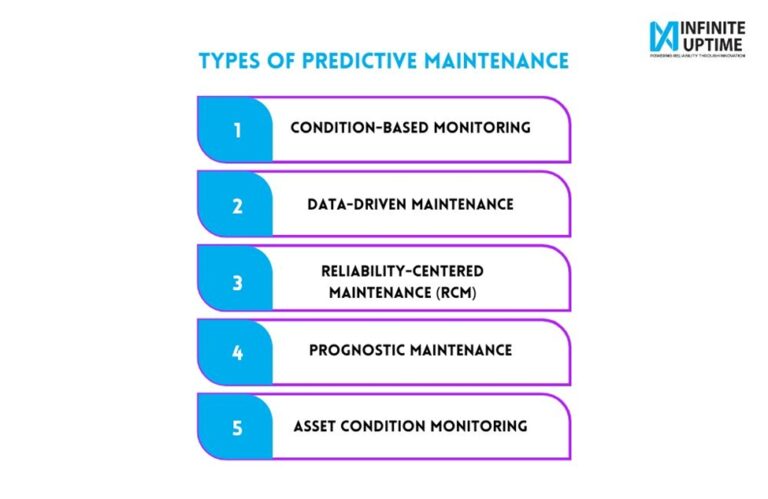
Types of Predictive Maintenance

Predictive maintenance is a proactive approach designed to anticipate equipment failures before they occur, thereby minimizing downtime and optimizing operational efficiency. Various methods and strategies within predictive maintenance leverage different technologies and analytical techniques to monitor and predict the health of equipment. Understanding the different types of predictive maintenance can help organizations choose the most appropriate strategy for their specific needs. Here are some key types of predictive maintenance:
01. Condition-Based Monitoring :
Condition-based monitoring involves using sensors and monitoring tools to track the real-time condition of equipment. Parameters such as temperature, vibration, and noise are continuously measured. When these parameters deviate from their normal ranges, maintenance actions are triggered. For instance, a sudden rise in temperature might indicate a potential failure in a motor.
02 Data-Driven Maintenance :
This type relies on advanced analytics and machine learning algorithms to process large volumes of historical and real-time data. By analyzing patterns and trends, predictive models forecast potential equipment failures. For example, data-driven models might predict that a specific component is likely to fail based on its historical performance and current condition.
03 Reliability-Centered Maintenance (RCM) :
RCM focuses on identifying the critical functions of equipment and analyzing the potential consequences of failures. This approach helps prioritize maintenance tasks based on the impact of equipment failure on operations. It integrates data from various sources to ensure that maintenance efforts are aligned with the overall reliability goals of the organization.
04 Prognostic Maintenance :
Prognostic maintenance goes beyond predicting equipment failures to estimate the remaining useful life (RUL) of machinery. By using sophisticated algorithms and predictive models, it provides a timeline for when equipment will likely need maintenance. This approach helps in scheduling maintenance activities more accurately and avoiding unnecessary interventions.
05 Asset Condition Monitoring :
Asset condition monitoring involves using a combination of physical measurements and visual inspections to assess the health of equipment. This type often includes techniques such as infrared thermography, acoustic monitoring, and oil analysis. The goal is to gather comprehensive data on asset condition and make informed maintenance decisions.

Advantages of Predictive Maintenance

01 Reduced Downtime :
Predictive maintenance significantly reduces unexpected equipment failures and associated downtime. By addressing issues before they escalate, organizations can prevent costly disruptions and maintain smooth operations.
02 Lower Maintenance Costs :
With predictive maintenance, maintenance activities are performed only when necessary, reducing the frequency of unnecessary maintenance tasks. This targeted approach helps in saving on labor costs, replacement parts, and other maintenance-related expenses.
03 Increased Equipment Lifespan
Timely interventions and accurate maintenance scheduling can extend the lifespan of machinery. By preventing severe damage and wear, predictive maintenance ensures that equipment remains in good condition for a longer period.
04 Enhanced Productivity :
Reduced downtime and fewer equipment failures lead to increased productivity. Operations can proceed without interruptions, resulting in higher output and efficiency.
05 Optimized Resource Allocation :
Predictive maintenance allows for better planning and resource management. Maintenance teams can focus their efforts on high-priority tasks and use their time more effectively.
06 Improved Safety :
By addressing potential issues before they cause equipment failures, predictive maintenance helps in reducing safety risks. Well-maintained equipment is less likely to pose hazards to operators and other personnel.

The Impact of Predictive Maintenance

01 Operational Efficiency :
Predictive maintenance enhances operational efficiency by minimizing downtime and optimizing maintenance schedules. Organizations can achieve higher levels of productivity and operational effectiveness through continuous monitoring and timely interventions.
02 Cost Savings :
Implementing predictive maintenance can lead to substantial cost savings. By avoiding unplanned downtime and reducing unnecessary maintenance activities, organizations can lower their overall maintenance expenses and improve their financial performance.
03 Enhanced Equipment Reliability :
Predictive maintenance improves the reliability of equipment by ensuring that potential issues are addressed before they lead to failures. This increased reliability contributes to smoother operations and higher levels of customer satisfaction.
04 Data-Driven Decision Making :
The use of data and analytics in predictive maintenance provides valuable insights for decision-making. Organizations can make informed choices based on real-time data and predictive models, leading to better maintenance strategies and improved overall performance.
05 Sustainability and Environmental Impact :
By reducing the frequency of maintenance activities and extending equipment lifespan, predictive maintenance supports sustainability efforts. Fewer replacements and repairs mean reduced waste and lower environmental impact, contributing to more sustainable operations.
06 Competitive Advantage :
Organizations that adopt predictive maintenance gain a competitive edge by enhancing their operational efficiency and reliability. This advantage can lead to improved market positioning and greater customer trust.

Predictive Maintenance Challenges

As organizations increasingly adopt predictive maintenance to enhance operational efficiency and reduce downtime, several challenges must be addressed to fully realize its benefits. Despite its advantages, implementing predictive maintenance is not without hurdles. These challenges can impact the effectiveness and adoption of predictive maintenance strategies. Understanding and addressing these obstacles is crucial for organizations to leverage predictive maintenance successfully. Here are some of the key challenges faced:
01 High Initial Costs :
Implementing predictive maintenance can be expensive, particularly in the initial stages. Costs include purchasing and installing sensors, integrating advanced analytics software, and upgrading existing infrastructure. These upfront investments can be a barrier for some organizations, especially smaller ones with limited budgets.
02 Complexity of Integration :
Integrating predictive maintenance with existing systems and processes can be complex. Organizations often need to upgrade their Enterprise Resource Planning (ERP) systems, Computerized Maintenance Management Systems (CMMS), and other technology platforms to accommodate predictive analytics. Ensuring seamless integration between new and old systems requires careful planning and execution.
03 Data Quality and Management :
Predictive maintenance relies heavily on data accuracy and quality. Inconsistent or incomplete data can lead to incorrect predictions and ineffective maintenance strategies. Organizations must implement robust data management practices to ensure that the data used for predictive models is clean, accurate, and comprehensive.
04 Workforce Training :
Training staff to use new predictive maintenance tools and interpret data effectively is essential but can be challenging. Maintenance teams need to acquire new skills and knowledge to operate advanced technologies and make data-driven decisions. This training can be time-consuming and costly.
05 Scalability Issues :
As organizations grow, scaling predictive maintenance solutions(pdms) can be difficult. Expanding the system to accommodate additional equipment, locations, or data sources requires careful planning and may involve additional costs. Ensuring that the predictive maintenance system scales effectively is crucial for maintaining its benefits as the organization evolves.
06 Data Security Concerns :
With the increasing reliance on digital data and connected devices, data security becomes a significant concern. Protecting sensitive information from cyber threats and ensuring compliance with data protection regulations are critical for maintaining the integrity of predictive maintenance systems.

Predictive Maintenance Example

Example: Cement Plant Kiln Drive System

In the cement industry, predictive maintenance can significantly enhance operations by monitoring critical equipment such as rotary kiln gearboxes. For example, sensors placed on the gearbox track vibration and temperature in real time. When these sensors detect anomalies, such as increased vibration, an alert is generated, prompting a maintenance check before a failure occurs. This approach helps prevent unexpected breakdowns, reduces downtime, and improves overall equipment effectiveness, ensuring continuous and efficient cement production despite the challenges of aging machinery and remote locations.

Industry Use Cases of Predictive Maintenance

Predictive maintenance is revolutionizing various industries by providing insights into equipment health before failures occur. This proactive approach uses data from sensors and advanced analytics to predict potential issues, thereby minimizing downtime, optimizing maintenance schedules, and enhancing overall operational efficiency. Here’s how predictive maintenance is being applied across different industries to improve performance and reliability:
01 Steel Industry :
In the steel industry, predictive maintenance is crucial for managing the health of equipment such as blast furnaces, rolling mills, and conveyors. By analyzing data from sensors, steel manufacturers can predict failures in critical components, such as pumps and motors, reducing unplanned downtime and optimizing production efficiency.
02 Chemicals & Fertilizers :
Predictive maintenance in the chemicals and fertilizers sector focuses on ensuring the reliability of reactors, mixers, and pumps. For example, by monitoring vibration patterns and temperature changes in reactors, companies can prevent catastrophic failures and maintain continuous production.
03 Cement Industry :
Cement manufacturers use predictive maintenance to monitor equipment like kilns, crushers, and mills. By employing techniques such as vibration analysis and infrared thermography, they can detect issues such as misalignment or overheating early, thus avoiding costly breakdowns and optimizing maintenance schedules.
04 Pharmaceutical Industry :
In pharmaceuticals, predictive maintenance helps in maintaining the integrity of production lines and critical equipment like mixers, tablet presses, and packaging machines. Predictive tools ensure that equipment operates within specified parameters, minimizing the risk of contamination and ensuring product quality.
05 Paper Industry :
Predictive maintenance is applied in the paper industry to monitor machines such as paper machines, dryers, and pulpers. By using sensors and real-time data analysis, manufacturers can predict wear and tear on components, reducing unplanned outages and improving overall efficiency.
06 FMCG (Fast-Moving Consumer Goods) :
In the FMCG sector, predictive maintenance is used to manage equipment in packaging lines, bottling plants, and distribution centers. Predictive analytics help in anticipating failures in high-speed machinery, thereby ensuring smooth operations and reducing downtime.
07 Tire Industry :
The tire industry employs predictive maintenance to monitor machinery like curing presses, mixers, and extruders. By analyzing vibration and temperature data, manufacturers can predict and address potential issues before they affect production, improving equipment reliability.
08 Automotive Industry :
In automotive manufacturing, predictive maintenance is applied to assembly lines, robotic arms, and other critical equipment. By using advanced Industrial analytics, automotive manufacturers can anticipate failures, reduce downtime, and ensure continuous production.
09 Aluminium Industry :
Predictive maintenance in the aluminium industry focuses on equipment such as smelting furnaces, casting machines, and rolling mills. Techniques like infrared thermography and vibration analysis help in detecting potential issues, ensuring consistent production quality and minimizing disruptions.
10 Oil and Gas Industry :
The oil and gas sector uses predictive maintenance to monitor equipment like pumps, compressors, and pipelines. By analyzing data from sensors and employing advanced analytics, companies can predict failures, optimize maintenance schedules, and ensure safe and efficient operations.
Future of Predictive Maintenance
As industries continue to evolve, so too does the field of predictive maintenance. The future promises exciting advancements that will transform how organizations monitor and maintain their equipment. With ongoing innovations in technology, predictive maintenance is poised to become more accurate, efficient, and integral to industrial operations. Here’s a look at the key trends shaping the future of predictive maintenance.
01 Advancements in AI and Machine Learning :
The future of predictive maintenance will be heavily influenced by advancements in artificial intelligence (AI) and machine learning (ML). These technologies will enable more accurate predictions by analyzing larger datasets and identifying complex patterns. AI and ML algorithms will continue to evolve, improving the precision of predictive models and enhancing decision-making processes.
02 Integration with IoT :
The Internet of Things (IoT) will play a crucial role in the future of predictive maintenance. IoT devices will provide real-time data from a wide range of equipment, enabling more granular monitoring and analysis. As IoT technology advances, the integration of IoT sensors with predictive maintenance systems will become more seamless and effective.
03 Enhanced Data Analytics :
Future developments in data analytics will drive the evolution of predictive maintenance. Advanced analytics tools will offer deeper insights into equipment health, performance trends, and failure modes. Predictive maintenance solutions(pdms) will leverage big data technologies to process and analyze vast amounts of information, leading to more accurate predictions and optimized maintenance strategies.
04 Edge Computing :
Edge computing will enable real-time data processing closer to the source of data collection. This technology will reduce latency and improve the speed of predictive maintenance systems, allowing for faster response times and more immediate decision-making.
05 Predictive Maintenance as a Service :
The adoption of predictive maintenance as a service (PMaaS) will grow, offering organizations access to advanced predictive maintenance technologies and expertise without the need for significant upfront investments. PMaaS providers will offer scalable solutions, making it easier for businesses to implement and benefit from predictive maintenance.
06 Increased Focus on Sustainability :
The future of predictive maintenance will also include a greater emphasis on sustainability. By optimizing equipment performance and reducing waste, predictive maintenance will contribute to more sustainable operations. Organizations will focus on minimizing environmental impact and promoting energy efficiency through advanced predictive maintenance practices.
As AI, IoT, data analytics, and edge computing continue to develop, predictive maintenance will become more accurate, efficient, and accessible. By embracing these innovations, organizations will not only improve their operational efficiency but also contribute to more sustainable practices, ensuring that predictive maintenance remains a crucial element of modern industrial strategy.

Role of AI in predictive maintenance

Artificial Intelligence (AI) plays a critical role in predictive maintenance by analyzing large volumes of real-time and historical equipment data—such as vibration, temperature, pressure, current, and acoustics—to detect early signs of asset degradation. Unlike traditional rule-based monitoring, AI learns the normal operating behavior of machines and identifies subtle anomalies that indicate potential failures before they occur.

Beyond prediction, AI-driven prescriptive maintenance provides clear, actionable guidance by diagnosing root causes and recommending what action to take, when to take it, and the impact of delaying it. These insights help maintenance teams plan work during scheduled shutdowns rather than reacting to emergencies, while avoiding unnecessary maintenance. For industrial operations, this leads to reduced unplanned downtime, lower maintenance and spare-part costs, extended equipment life, improved safety, and more consistent, efficient plant performance.

Conclusion

Predictive maintenance is a powerful strategy that offers significant benefits, including reduced downtime, lower maintenance costs, and increased equipment lifespan. However, it also presents challenges such as high initial costs, data management issues, and the need for workforce training. By exploring industry-specific use cases and staying informed about future trends, organizations can effectively navigate these challenges and leverage predictive maintenance to enhance operational efficiency, improve reliability, and gain a competitive edge in their respective industries.
Interested in learning how Infinite Uptime’s advanced Predictive Maintenance solutions are transforming asset and operational efficiencies for major industries ?

Infinite Uptime delivers cutting-edge machine diagnostics, remote condition monitoring, and predictive maintenance solutions across a range of industries, including Cement, Steel, Mining, Metals, Tire, Paper, Automotive, Chemicals, FMCG, Oil and Gas, and beyond. Discover how our innovative predictive maintenance technologies can enhance reliability and performance in your process plant. Explore the tailored solutions provided by Infinite Uptime to see how they can support your operational goals. We are available in the USA, India, and EMEA to serve your needs globally.

Read More on Prescriptive Maintenance
Categories
AI Predictive Maintenance Predictive Maintenance
AI Predictive Maintenance: Revolutionizing Industrial Efficiency

AI Predictive Maintenance: Revolutionizing Industrial Efficiency

AI Predictive Maintenance: Revolutionizing Industrial Efficiency
Table of Contents
  1. Introduction
    • Overview of AI Predictive Maintenance in Modern Manufacturing
  2. Understanding AI Predictive Maintenance
    • What is AI Predictive Maintenance?
    • How AI Enhances Equipment Reliability
  3. Benefits of AI Predictive Maintenance
    • Reduced Downtime and Costs
    • Improved Equipment Reliability
    • Enhanced Operational Efficiency
    • Data-Driven Decision Making
    • Extended Equipment Lifespan
  4. Case Studies and Real-World Applications
  5. The Future of AI Predictive Maintenance
  6. Conclusion

In modern manufacturing, the integration of artificial intelligence (AI) has paved the way for significant advancements in predictive maintenance (PdM). Traditionally, maintenance strategies relied on scheduled inspections or reactive repairs, leading to potential downtime and inefficiencies. AI based predictive maintenance, however, represents a transformative shift towards proactive and data-driven approaches.

What is AI Predictive Maintenance ?

Artificial intelligence (AI) is transforming the maintenance landscape across industries, leveraging advanced machine learning algorithms and analytics to enhance equipment reliability. In the manufacturing sector, AI is increasingly used to support predictive maintenance, offering significant benefits in managing and optimizing asset performance.
AI predictive maintenance leverages machine learning algorithms and advanced analytics to monitor equipment condition in real-time. By continuously analyzing data from sensors, historical records, and operational parameters, AI systems can predict when equipment failure might occur. This proactive approach allows maintenance teams to intervene before issues escalate, thereby preventing unplanned downtime and optimizing asset performance.

Benefits of AI in Predictive Maintenance

01 . Reduced Downtime and Costs:
AI predictive maintenance enables early detection of equipment anomalies and potential failures. By addressing issues before they lead to breakdowns, manufacturers can minimize unplanned downtime and avoid costly repairs.
02 . Improved Equipment Reliability:
With AI continuously monitoring equipment health, manufacturers can achieve higher reliability levels. Predictive insights empower proactive maintenance scheduling, ensuring equipment operates at optimal levels for extended periods.
03 . Enhanced Operational Efficiency:
By streamlining maintenance activities based on AI-driven insights, manufacturers can optimize resource allocation and workforce productivity. Tasks are prioritized based on criticality, allowing teams to focus efforts where they are most needed.
04 . Data-Driven Decision Making:
AI predictive maintenance generates actionable insights from vast amounts of data. These insights not only inform maintenance strategies but also contribute to overall operational improvements and informed decision-making across the organization.
05 . Extended Equipment Lifespan:
Proactively addressing maintenance needs through AI predictive analytics can extend the lifespan of machinery and assets. By preventing premature wear and tear, manufacturers can maximize the return on investment in capital equipment.

Case Studies and Real-World Applications

Industries ranging from automotive manufacturing to energy production have all embraced AI predictive maintenance (PdM) with notable success. For instance, automotive assembly plants use AI to predict equipment failures based on production data, optimizing uptime and ensuring consistent output. Similarly, power plants employ AI to monitor turbine performance, preemptively identifying issues to maintain reliability and operational efficiency.

How Predictive Maintenance and the Application of AI Prevent Unplanned Downtime ?

Predictive maintenance prevents unplanned downtime by continuously monitoring equipment health and identifying early signs of failure before a breakdown occurs. When AI is applied, this process becomes far more accurate and proactive. AI models analyze real-time sensor data such as vibration, temperature, pressure, and operating patterns along with historical performance data to learn what “normal” operation looks like for each asset. Any deviation from this baseline is detected early, allowing maintenance teams to intervene well before the issue escalates into a production-stopping failure.

AI further reduces unplanned downtime by converting raw condition data into actionable insights. Instead of relying on fixed schedules or human interpretation alone, AI predicts failure windows, prioritizes critical assets, and recommends the right maintenance action at the right time. This enables planned interventions during scheduled shutdowns, reduces emergency repairs, improves equipment reliability, and ensures consistent plant operations. By shifting maintenance from reactive firefighting to data-driven prevention, manufacturers can significantly minimize unexpected stoppages, protect productivity, and improve overall operational efficiency an approach exemplified by industrial AI solutions from companies like Infinite Uptime.

The Future of Predictive Maintenance Using AI

As AI technologies continue to evolve, the capabilities of predictive maintenance will only expand. Enhanced algorithms, coupled with advancements in sensor technology and IoT connectivity, will enable even more precise predictions and proactive maintenance strategies. Manufacturers stand to benefit from reduced costs, improved sustainability, and enhanced competitiveness in the global market.

Conclusion

AI predictive maintenance (PdM)represents a pivotal advancement in industrial operations, offering manufacturers a strategic advantage in managing equipment reliability and operational efficiency. By harnessing the power of AI-driven insights, businesses can not only mitigate risks associated with equipment failures but also pave the way for a more sustainable and productive future.

In conclusion, the integration of AI in predictive maintenance is not merely a technological upgrade but a transformative approach towards achieving operational excellence in manufacturing industries worldwide. Infinite Uptime is taking asset condition monitoring to newer heights with its conversational AI, Nity. Nity is designed to identify critical assets and report performance data on a massive scale. Its ability to interact with users and provide data swiftly facilitates quicker decision-making, improved productivity, and enhanced operational efficiency. By harnessing the power of AI-driven insights through Nity, businesses can mitigate risks associated with equipment failures and pave the way for a more sustainable and productive future.

Get in touch with our experts or book a demo now to understand how our solutions fit your cement plant.
Categories
AI Predictive Maintenance
Optimizing machine health with Condition Monitoring

What is Machine Health Monitoring? Optimize Your Machine Health with Online Condition Monitoring

Industry 4.0 aims to bring operational excellence by introducing the Industrial Internet of Things (IIoT) to the industries and factories. It allows machine health monitoring using IIoT, streamlining the process and increasing efficiency. In this blog, we’ll share why IIoT machine monitoring is useful and how it can help you?

What is Machine Health Monitoring?

Machine Health Monitoring refers to the use of advanced technologies, particularly the Industrial Internet of Things (IIoT), to continuously monitor the condition and performance of machinery in real-time. This process involves collecting and analyzing data from various sensors and equipment to identify potential issues, predict failures, and optimize maintenance strategies. By leveraging a machine health monitoring system, predictive maintenance strategies can be applied to schedule maintenance activities just before a failure is likely to occur. This not only minimizes unplanned downtime but also reduces maintenance costs and extends the lifespan of equipment. Real-time machine health monitoring thus plays a crucial role in maintaining operational efficiency and reliability.

Importance of Machine Health Monitoring in the Industrial 4.0 Era

Despite applying the best reactive and preventative maintenance strategies, industries lose a lot of money & time because of unplanned downtime, machine failures, and wasted maintenance cycles. Unplanned downtime decreases plant productivity and hinders the supply chain. To overcome this, plants need to adopt Condition Monitoring technologies. IIoT machine monitoring offers real-time insights to assist maintenance teams in making better decisions, enhancing the machine’s efficiency and extending its lifetime. IIoT plays a vital role in enabling plant reliability by:

  1. Providing robust connectivity across the plant
  2. Catering to the growing shortage of plant workers.
  3. Helping in planning and scheduling maintenance strategies.
  4. Bringing more profit against its initial implementation cost.
It also creates a safer working environment for plant workers by reducing the chances of machine failures.

What is Online Condition Monitoring ?

Online Condition Monitoring, in the context of predictive maintenance, refers to the continuous observation of equipment health using real-time data collected through sensors. This approach enables organizations to track performance metrics like vibration, temperature, and sound, allowing for the early detection of anomalies that may indicate potential failures. By analyzing this data, predictive maintenance strategies can be employed to schedule maintenance activities just before a failure is likely to occur, thereby minimizing unplanned downtime, reducing maintenance costs, and extending the lifespan of equipment.

Benefits of Machine Health Monitoring using IIoT

Improvement in the overall efficiency of manufacturing

IIoT machine monitoring machinery considerably increases the overall plant efficiency. It increases the cost efficiency by cutting unnecessary maintenance and decreasing unplanned downtime. Unplanned downtime constitutes a 40-50% loss in efficiency. Condition monitoring predicts the impending failures and helps in curing them beforehand. Real-time monitoring and required maintenance of all the plant assets enhance the plant’s productivity and sustain it. It also extends the plant equipment’s lifetime, saving many costs that otherwise would go in vain.

Considerable Reduction in Waste

IIoT machine monitoring can help industries in waste management. Defective items are the most significant manufacturing waste from plants. Trivial machine malfunctions often get ignored, which causes the production of defective items or sub-par output quality. It costs money, resources, and man-hours. Also, starting up after unplanned downtimes produces unprocessed/semi-processed goods, further increasing the overall plant waste. IIoT machine monitoring can eliminate this waste by foretelling the possible threats.

Intelligent adoption of IIoT-enabled solutions also reduces the burden of excessive maintenance, lubrication, and spare parts waste. Assessing and predicting machine failures saves time and resources, which would otherwise go to waste.

Improved communication & decision making

Machine health monitoring using IIoT improves communication by providing 360-degree visibility of manufacturing operations to all the right people. Advanced solutions connect plant equipment to a manager, manager to the operator, and operator to operator effectively, reducing the chances of delayed communication.

Providing the right & timely information across the plant boosts the plant productivity multiple folds. Usually, a lot of time gets wasted in planning and scheduling maintenance strategies. IoT-based machine health monitoring systems capture the fault and track down the root cause to advise you on the best approach to tackle it.

Real-time Data Collection, Analysis, and Alerts​

IIoT-based condition monitoring systems collect real-time data from all the machinery and analyse and assess them according to the recommended performance levels. If the machine health fails to meet the set parameters, the platform immediately alerts the maintenance manager and conveys the problems with the recommendations to take care of it.

The sensors record data from various equipment to perform vibration analysis, oil analysis, temperature analysis, and other relevant analyses. After analyzing, if it detects any issue, it quickly notifies the possible reasons. For example, the reports may suggest engine erosion if higher than usual iron content is found in the oil analysis. On the other hand, if a higher range of a combination of iron, Aluminium, and chrome is found, it may signal the upper cylinder wear. The maintenance manager can then take immediate action on this.

How Online Condition Monitoring Works

  • Data Collection: Sensors are strategically placed on equipment to measure key performance indicators. These sensors continuously gather data, which is then transmitted to a central monitoring system.

  • Real-Time Analysis: The collected data is analyzed in real-time using sophisticated algorithms and machine learning models. This analysis helps in identifying patterns and detecting anomalies that could indicate potential failures.

  • Alert System: When the system detects an anomaly or a deviation from normal conditions, it generates alerts or notifications. These alerts enable maintenance teams to address issues before they escalate into costly failures.

  • Predictive Maintenance: By utilizing predictive analytics, Online Condition Monitoring allows for the scheduling of maintenance activities just before a failure is likely to occur. This approach reduces unplanned downtime and helps in optimizing maintenance resources.

Conclusion

Even the best reactive and preventative maintenance strategies couldn’t do justice to the cost and productivity. So, industrial revolution 4.0 brings advanced machine health monitoring using IIoT technology to address production and maintenance issues. The technology gained its importance by tackling day-to-day problems in various industries. It benefits industries by reducing plant wastes, collecting and analyzing real-time data, streamlining communication, and increasing overall plant reliability.

FAQs

Machine Health Monitoring refers to the continuous process of tracking machinery performance using Industrial Internet of Things (IIoT) technologies. It collects and analyzes sensor data in real-time to detect potential faults, predict failures, and optimize maintenance schedules—minimizing downtime and extending equipment lifespan.

Online Condition Monitoring involves real-time data collection from machinery through connected sensors. It continuously tracks parameters like vibration, temperature, and sound to detect early signs of equipment failure, enabling predictive maintenance and reducing costly breakdowns.

Machine health monitoring using IIoT is vital in Industry 4.0 because it helps minimize unplanned downtime, reduces maintenance costs, and enhances overall plant efficiency. By providing real-time insights and predictive analytics, it allows for proactive maintenance, thus optimizing operations and increasing profitability.

IIoT-based machine health monitoring improves manufacturing efficiency by reducing unplanned downtime (which can lead to 40-50% efficiency loss), extending equipment life, and optimizing maintenance schedules. It also enhances workplace safety by preemptively addressing potential machine failures.

IIoT machine monitoring minimizes waste by predicting and preventing machine malfunctions that can lead to defective products or sub-par output quality. It optimizes maintenance practices, reduces unnecessary lubrication and spare parts usage, and improves overall resource utilization.

Real-time data collection through IIoT sensors allows for continuous monitoring of machine performance metrics such as vibration, oil quality, and temperature. Analysis of this data helps identify anomalies and potential failures early, triggering alerts for proactive maintenance actions.

IIoT-based machine health monitoring systems facilitate improved communication by providing comprehensive visibility into manufacturing operations. This connectivity ensures timely information flow between operators, managers, and maintenance teams, enhancing operational efficiency and reducing response times.

IIoT-driven systems offer significant advantages over traditional reactive and preventive maintenance approaches by enabling predictive maintenance. They optimize maintenance strategies, reduce costs associated with downtime and repairs, and support data-driven decision-making for better operational outcomes.

Categories
AI Predictive Maintenance
Predictive Maintenance & IoT Impact on Mining

Predictive Maintenance & IoT Impact on Mining

The mining industry is one of the oldest & most hazardous commercial sectors where the use and implementation of modern technology are very gradual. Mining companies utilize a plethora of expensive equipment in a high stakes & cost environment. In these cases, asset health is critical to the safety & profitability of the mine.

This is where IoT-driven Predictive maintenance can be a game changer. It has the potential to collect and analyze environmental and equipment data instantaneously and conduct real-time risk and area evaluation. It reduces the risk of downtime & loss due to machine failure and reduces overall maintenance & spare part costs of high capital-intensive machinery. The application of IoT in the mining industry is quintessential because of its advantages for large-scale operations in mining, where the operating environment is constantly changing & workforce operates in a compact, adapting, and potentially hazardous environment.

Let’s first try to understand the what makes maintenance for the mining industry difficult:

Challenges in the mining industry

Disruptive & exorbitant impact of equipment failure in mines
Equipment failure is the worst nightmare for mines. A standard mining operation spends 35-50 percent of its yearly operations budget on just asset maintenance & repairs. Unpredictable equipment failure can disrupt production & a considerable dent in the bottom line.

Remote monitoring of equipment at far-off locations
Mines are typically located far away from civilization. So in case of unplanned downtime, it takes time to get expert maintenance personnel and spare parts to reach, diagnose and repair the equipment. These transportation delays & costs impact the budget as well as profitability.
Workforce safety depending on asset health
Worker health & safety remains a big concern in the mining industry due to the difficult working conditions. Furthermore, as mines get deeper, the likelihood of a collapse & danger increases. While safety in mines has improved dramatically over the years, the fatalities caused by asset malfunction are a big reason for on-site hazards.
Unreliable connectivity options Additionally, because more mines are constructed in off-grid locations, providing stable electrical infrastructure to power mining operations and appropriate water supply becomes increasingly tricky. Connectivity is limited or unreliable, particularly in underground mines, and the 3G/4G signals may be difficult to pick up in remote regions.

Types of machine maintenance in mining

The different types of machine maintenance are:
  1. Reactive Maintenance/ Run-to-Failure Maintenance: This refers to repairs performed after a machine has already failed and it is unexpected and thus leads to emergency rushed repairs.

  2. Preventive Maintenance: This refers to any planned or scheduled machine maintenance that aims to identify and repair problems before they cause failure. It can be annual/bi-annual. But it cannot prevent asset failure between two schedules or unnecessary downtime.

  3. Condition-based Maintenance: It focuses on monitoring the current status of assets to undertake maintenance when evidence of decreasing performance or approaching breakdown is detected.

  4. Predictive Maintenance: It expands on condition-based maintenance by utilizing instruments and sensors to continuously evaluate machinery performance & flagging off any anomaly and its root cause before it results in a full-blown asset failure.

Predictive Maintenance in mining can cause many benefits – direct & indirect.

Some of the benefits of Predictive Maintenance are:

  • Reduced Downtime: Utilizing predictive maintenance, you can anticipate troubles ahead of time, decrease machine downtime, increase uptime by 15-20%, schedule maintenance as needed, and thus extend the life of an old machine by up to 20%.

  • Increasing Productivity: It ensures that both planned and unplanned downtime is kept to a minimum, resulting in fewer interruptions to production and a significant increase in overall productivity.

  • Higher Production Capacity: Asset availability of high performing & critical assets in mines helps plan and optimize production capacity, which is crucial for effective management & production planning and staying on schedule.

  • Lowered Maintenance & Spare Part Costs: Maintenance and spare part costs are significantly lower for preventative maintenance since all machines in the manufacturing process are continuously monitored and repaired before a problem becomes severe.

  • Enhancing Workplace Safety: Predictive maintenance can reduce the risk of work-related accidents by identifying any discrepancies that could lead to an accident on-site. Predictive maintenance ensures a sanitary and healthy environment in the plant while reducing safety risks by up to 14%.

  • Proactive Decision Making: The implementation of IoT enables mining maintenance managers to detect when there is a breakdown or a drop in performance, enabling them to react quickly and effectively. In addition, monitoring, obtaining, and analyzing data from particular mining equipment over a period may help them understand how the overall efficiency of the process itself can be improved.
Conclusion

The mining industry has been a critical sector globally for centuries. With the right Predictive Maintenance solution, mine maintenance managers can ensure that the production continues without impacting commercial efficiency while ensuring worker safety. A sound & functioning asset also ensures a greener footprint and fewer hazards, proving to be less dangerous for the environment.

Want to know more about how a competent Predictive Maintenance solution by Infinite Uptime is helping some of the largest mining companies improve asset & operational efficiencies through predictive maintenance in mining and IoT mining?

Infinite Uptime offers responsively designed machine diagnostics, remote condition monitoring, and predictive maintenance solutions in diverse industries such as Cement, Steel, Mining and Metals, Tire, Paper, Automotive, Chemicals, FMCG, Oil and Gas, and more. To understand how predictive maintenance applies to your process plant and can help in achieving plant reliability, explore the comprehensive solutions of Infinite Uptime.

FAQs
The mining industry grapples with the high costs of equipment failure, spending up to 50% of operational budgets on maintenance. Remote locations exacerbate downtime as getting personnel and parts to sites is time-consuming and costly. Safety concerns due to equipment health also pose significant risks in hazardous environments.
Predictive Maintenance uses IoT and AI to monitor equipment in real-time, predicting failures before they occur. This proactive approach reduces downtime, extends equipment life, and lowers maintenance costs compared to reactive (fixing after failure) and preventive (scheduled maintenance) strategies.
Predictive Maintenance reduces downtime by 15-20%, enhances productivity by minimizing interruptions, and optimizes production capacity. It lowers maintenance and spare part costs by monitoring equipment continuously and prevents costly breakdowns, thus improving overall operational efficiency.
Mining operations employ Reactive Maintenance (fixing after failure), Preventive Maintenance (scheduled check-ups), Condition-based Maintenance (monitoring performance for signs of wear), and Predictive Maintenance (AI-driven real-time monitoring) to ensure equipment operates efficiently and safely.
IoT enables real-time data collection from mining equipment, allowing for predictive analytics and condition monitoring. This data-driven approach facilitates proactive decision-making, improves operational efficiency, and enhances safety by identifying potential hazards before they escalate.

It’s crucial to select a solution that integrates seamlessly with diverse equipment types and can operate in remote, off-grid locations with limited connectivity. Deployment speed and scalability are also critical to ensure minimal disruption and rapid ROI across large-scale mining operations.

By preemptively identifying equipment issues, Predictive Maintenance helps create safer working conditions in mines, reducing the risk of accidents and environmental hazards. It also supports sustainable practices by optimizing resource use and minimizing operational disruptions.
Categories
AI Predictive Maintenance
How to choose a maintenance solution for your plant in 2022?

How to choose a maintenance solution for your plant ?

Revolutions are synonymous with disruptions. Industry 4.0 is nothing different. It demands new and advanced technologies for manufacturing plant maintenance and discarding obsolete plant maintenance processes at a much faster pace. It sometimes becomes overwhelming to understand and adopt new technologies as a plant head. So, here, we have an article to help you choose the right maintenance solution for your plant.

In this article, we’ll majorly talk about how you can choose the right Predictive Maintenance solution for your plant. But let’s start with the 3 basic types of industrial plant maintenance solutions available in the market.

Types of industrial plant maintenance

Reactive Maintenance

Maintenance that is out of reaction rather than duty and is performed only after the equipment is finally broken. This obsolete maintenance strategy can save you money in the short term but eventually increases your losses by increasing machine downtime, inefficiency, and frequent failures

Preventative Maintenance

Preventative plant maintenance requires scheduled check-ups routined on industry standards, and it involves timely maintenance and carry-out tasks like a belt and filter changes regularly. This maintenance strategy for plants and equipment increases equipment life but requires regular labor for check-ups and maintenance.

Predictive Maintenance

Predictive plant maintenance leverages artificial intelligence, cloud storage, and IoT to provide real-time data on plant equipment. It diagnoses the real-time condition of in-service equipment, and then the required maintenance schedule is followed. It also reduces the operating cost by 12-18% and provides a safer working environment.

Objectives of a Predictive Plant Maintenance Solution

The objective of opting for a plant maintenance solution is to elongate the life of plant equipment and operate them in an optimum condition at minimum cost.
Here are all the significant objectives below:
  1. To maintain the peak productivity of the manufacturing plant.
  2. To obtain the optimum working capacity of equipment at the lowest possible cost.
  3. To minimize the losses from unwanted breakdowns and downtimes.
  4. To provide a safe working environment for plant workers.
  5. To protect the equipment from frequent breakdowns and efficiency loss.

7 most important questions to consider before choosing a Predictive Plant Maintenance solution

Predictive Plant Maintenance Solution comprises equipment and sensors, gateway, cloud service, and management to sense, record, and provide actionable insights on the machine’s condition. Artificial intelligence, machine learning, and IoT always try to yield accurate results.

But before you buy a predictive plant maintenance solution, consider these 7 critical aspects of it to decide which predictive maintenance solution is right for you.

Easy-to-Use and intuitive for everybody

The ideal Predictive Maintenance solution must be easy to use for all, from onsite plant operators and technicians to the plant manager & plant head. It should be intuitive and user-friendly to be mainly accessible to everyone required. If you need a data scientist every time to decode the insights provided by this software, then you are set up for sudden asset failures due to delayed responses.

The right predictive plant maintenance solution can empower the onsite condition monitoring/ maintenance teams with the correct machine data at the right time for successful plant maintenance assessments with actionable insights.

Finding the root cause, not just alerts

Some Predictive Maintenance solutions indicate only alerts of anomalies, while the others yield insightful data alerts with what might be causing them. Those insights can be used to get a 360º condition of working equipment, and plant engineers can trace the root cause of the problems and plan a more effective solution. It also helps to distinguish the false alerts from the true ones.

For example: Just pointing out an issue with an exhaust fan of a kiln in a cement plant may lead to 1000 causes, but a solution that analyzes this further and points to a loose bearing that may be the cause can lead to a different level of agility for your maintenance teams.

Are the outcomes measurable or just hopeful?

Ensure that the maintenance technology brings you the results in some way or the other. And the results must be measurable and not hypothetical, which means you should be able to calculate the profits that the technology is bringing against its cost.

The average cost per hour of equipment downtime is $260,000. Look for a predictive maintenance solution that can save you the downtime cost and increase profits. Predictive maintenance can reduce machine downtime by 30%-50% and increase machine life by 20%-40%. (McKinsey)

Usable across assets and manufacturers

A plant usually has various types of equipment from multiple manufacturers and suppliers, depending upon the quality and cost. The Predictive Maintenance solution you are planning to install must easily integrate and comply with every piece of equipment in the plant- regardless of its age, type, and manufacturer.

Having different data collection mechanisms for different equipment is costly and leads to entropy & silos that obstruct the whole picture. Technology, along with human intelligence, functions to streamline complex processes and increase efficiency, and not the opposite. 

Experience around process plants

Process manufacturing plants differ from other industries in various aspects. Predictive maintenance solutions request historical data to function reliably, but process plants have limited historical machine data, making it difficult for the predictive solution to function properly. Make sure your vendor has experience working with process plants to tackle the situation constructively.


Deployment & scaling time 

One of the most popular hesitation in IoT-driven Plant maintenance deployments is the time taken to deploy the solution. If the deployment takes months, the internal enthusiasm built around the deployment dies down, and so does the ROI.

It is also essential that the deployment velocity is maintained when the solution is scaled up-whether from some machines to the entire plant or across plants.

Look for a predictive maintenance vendor that can integrate the solution in your plant and enable working within a few weeks and not months.

Predictive Maintenance in mining can cause many benefits – direct & indirect.

Conclusion

Predictive plant maintenance solutions save millions of dollars for manufacturing companies by predicting equipment health and indicating impending failures beforehand. Various predictive maintenance solution providers come with multiple packages, and hence choosing the right fit for your plant is important. Look for an easy-to-use and intuitive product that can comply with mixed assets from diverse manufacturers. At Infinite Uptime, we strive to transform the industrial & machine health diagnostics space. Our Predictive Maintenance solutions are used by hundreds of process plants globally, saving millions of hours of downtime, and improving the efficiency, scale & output of plants, one insight at a time. Want to know more about how you can safeguard your machine’s health & reliability with Predictive Maintenance?

FAQs

There are three main types: Reactive Maintenance, which fixes equipment after it fails; Preventative Maintenance, which follows scheduled check-ups to prevent failures; and Predictive Maintenance, which uses AI and IoT to monitor equipment in real-time and predict failures before they occur, reducing costs and downtime.
Predictive Maintenance allows for proactive equipment monitoring, predicting failures based on real-time data. This approach minimizes unplanned downtime, extends equipment life, and optimizes maintenance schedules, resulting in significant cost savings and improved operational efficiency compared to reactive and preventative strategies.
Predictive Maintenance enhances plant productivity by ensuring machines operate at peak efficiency with minimal downtime. It also promotes a safer working environment by preemptively addressing equipment issues, thereby reducing risks to plant workers and assets.
Choose a solution that is easy to use and intuitive for all plant personnel, integrates seamlessly with diverse equipment types and manufacturers, and provides actionable insights rather than just alerts. Ensure the solution offers measurable outcomes in terms of reduced downtime and increased equipment longevity.
IoT enables real-time data collection from sensors embedded in equipment, facilitating predictive analytics and condition monitoring. This data-driven approach allows plant managers to make informed decisions quickly, improving overall plant efficiency and reliability.
Look for a solution provider that offers quick deployment and scalability options. The time taken to implement the solution should be minimal to maintain momentum and ensure rapid ROI. Scalability should also be seamless, allowing for expansion from pilot phases to full plant integration without significant disruptions.