When the Crane Goes Down, Everything Stops. Why EOT Crane Reliability Is a Strategic Operations Problem — and How PlantOS™ Solves It
- Prescriptive AI for Pumps, Compressors and Agitators
- Why Traditional Monitoring Falls Short
- The Three Failure Domains That Determine Crane Availability
- The PlantOS™ Architecture: From Signal to Prescription
- Expected Business Impact: From Reactive to Prescriptive Reliability
- Implementation: 5 Days to Live Monitoring
- The Prescriptive Difference: Why Prediction Alone Is Not Enough
Key Highlights
- EOT crane downtime is an operations problem, not just a maintenance problem. The cascading cost — vessel delays, yard disruption, throughput loss — far exceeds the repair bill.
- Traditional monitoring (OEM schedules + operator observation) captures failure events, not failure signals. The window for preventive action is missed.
- Effective crane reliability requires continuous coverage across three domains: mechanical health, electrical health, and safety interlocks.
- The PlantOS™ architecture delivers a full evidence trail — raw signal to diagnosed prescription — enabling maintenance teams to act with confidence, not just receive alerts.
- 5-day implementation with a single-day maintenance window. Scalable from pilot to 100+ crane fleet. ROI payback in 6–12 months.
- Prescriptive AI — not just predictive AI. The difference is execution: 99% of prescriptions acted upon, outcomes validated.
An EOT crane doesn’t fail quietly. When an EOT crane trips unexpectedly — a brake fault, an overloaded hoist, a seized gearbox — it doesn’t just stop a lift. It stops production flow, disrupts material handling sequences, and triggers a cascade of delays that ripples through the entire operation.
Emergency repair teams mobilise. Schedules slip. Costs start compounding immediately. In high-throughput operations, a single unplanned crane stoppage can halt production for 8–12 hours, costing anywhere from $10,000 to $50,000 per hour in lost productivity, emergency repairs, and downstream disruption.
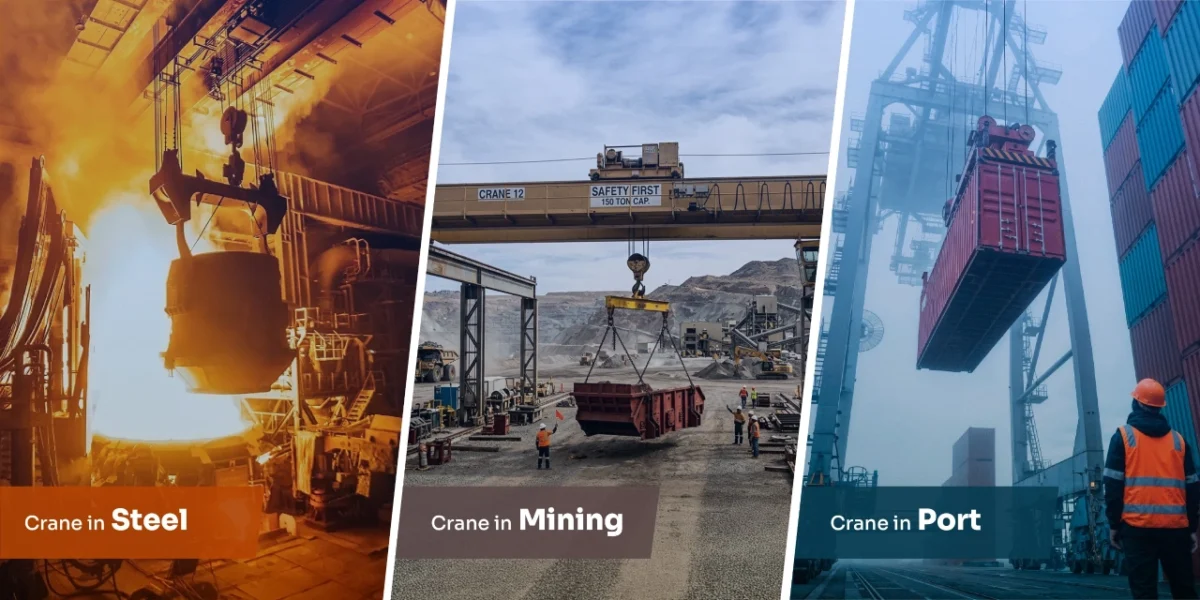
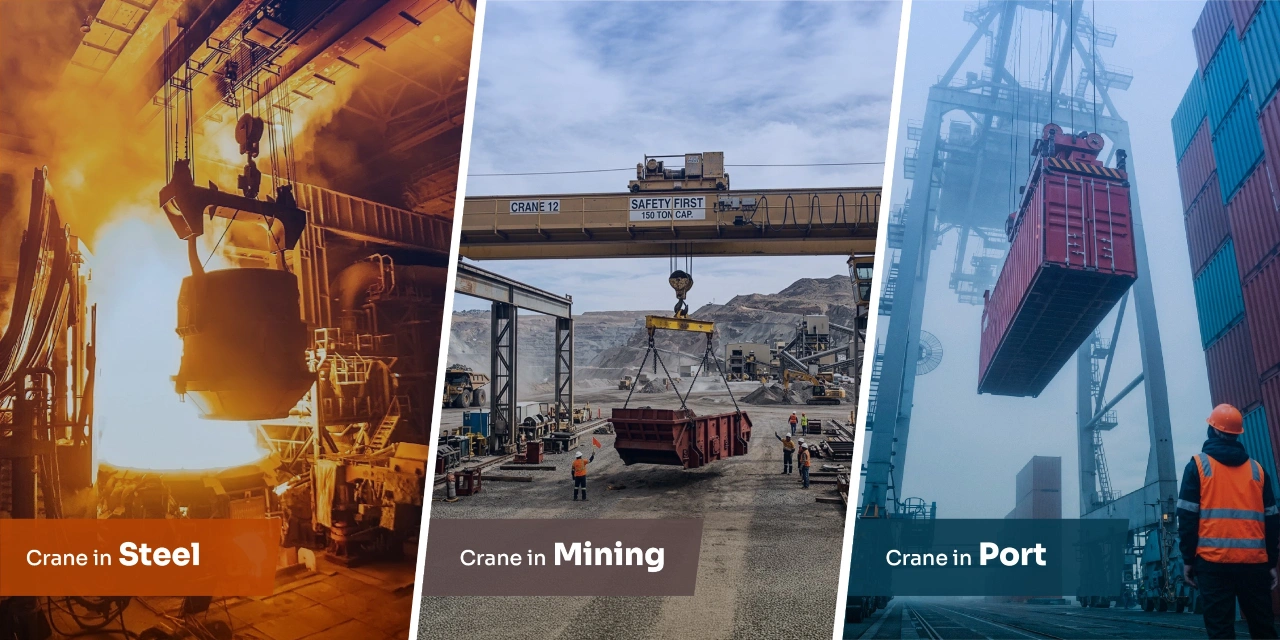
In steel mills, a casting crane failure delays ladle movement, cascading into extended thermal hold times, sub-optimal heat scheduling, and higher kWh per ton. In cement plants, a kiln feed crane outage halts the entire pyro section downstream.
Yet in most facilities today, crane maintenance is still driven by fixed-interval inspections and reactive response. The crane fails. The team responds. The root cause is documented — if at all — after the fact.
This is not a maintenance problem. It is a strategic operations problem. And it has a solvable architecture.
Prescriptive AI for Pumps, Compressors and Agitators
Maintenance managers typically measure crane downtime in repair hours and parts cost. That calculation understates the actual business impact by an order of magnitude.
Here’s what stops when a critical EOT crane goes offline:
- Production flow halts. In port environments, demurrage costs begin accruing; in steel and cement, downstream processes starve for material.
- Yard crane sequencing is disrupted. Stacking plans become invalid.
- Downstream logistics — trucking, rail, conveyor systems — accumulate delays.
- In steel or cement terminals, stockpile buffers deplete faster than they can be replenished, risking production stoppages.
- Safety investigations halt adjacent cranes in the bay pending interlock verification.
The maintenance cost is a line item. The operational impact is a multiplier. For facilities running 24/7 operations, unplanned crane stoppages represent one of the highest-impact disruption events on site — far exceeding the cost of the part that failed.
Industry data indicates that unplanned breakdowns drive 35–50% of total crane-related operational delay. Predictive maintenance using vibration analysis has been shown to reduce downtime by 30–50% and cut maintenance costs by 10–40%. The failure modes are not mysteries — they follow identifiable progression patterns. The problem is that most facilities lack the instrumentation layer to detect them in time.
Why Traditional Monitoring Falls Short
The standard approach to crane reliability combines two layers: scheduled maintenance (OEM-recommended intervals) and operator-reported faults. Both are reactive by design.
Scheduled maintenance creates a false sense of coverage. Intervals are set for average operating conditions — not for actual load cycles, ambient temperature variations, or the specific duty cycle of a given crane in a given bay. A crane running three shifts at 80% load will degrade its brake pads and gearbox bearings substantially faster than the maintenance schedule anticipates.
Operator-reported faults are useful, but they capture failure events, not failure signals. By the time an operator notices abnormal noise, vibration, or erratic behaviour from a hoist mechanism, the degradation has typically been progressing for days or weeks. The window for preventive action has already closed.
| Approach | What It Captures | What It Misses |
| OEM Scheduled Intervals | Average component life based on standard conditions | Actual load cycles, environmental stress, duty variation |
| Operator Observation | Observable failure symptoms (noise, heat, vibration) | Early-stage degradation, electrical health, interlock drift |
| Post-Failure Inspection | Failure mode analysis after the fact | Preventing the failure — response is by definition reactive |
| PlantOS™ CBM Layer | Real-time mechanical, electrical & safety signals — continuous 24/7 coverage | Nothing — full-spectrum instrumented monitoring |
The Three Failure Domains That Determine Crane Availability
EOT crane failures cluster around three domains, each with distinct monitoring requirements and failure signatures.
Mechanical Health: Hoist and Drive Train 01
The hoist mechanism — motor, gearbox, drum bearings, and brake assembly — is the highest-risk failure zone in any EOT crane. Vibration-based monitoring using piezoelectric sensors and FFT analysis provides the clearest early warning signal:
- Gearbox vibration trends above ISO 10816 thresholds indicate bearing wear weeks before failure.
- Hoist motor temperature deviation flags insulation degradation or cooling system compromise.
- Brake pad wear percentage, captured via analog signal, predicts replacement windows accurately — eliminating both premature replacement and brake failure under load.
Electrical Health: Contactors, Drives, and Control Systems 02
Electrical faults are among the most common and most misdiagnosed causes of crane downtime. Industry research indicates that up to 45% of crane failures stem from electrical faults. Drive faults, contactor failures, and control power interruptions frequently appear as ‘unknown stoppages’ in maintenance logs.
- Master Controller position logging confirms command execution vs. actual response — flagging contactor wear before hard failure.
- Drive healthy/fault status monitoring provides real-time visibility, enabling pre-emptive intervention.
- Step contactor sequencing verification identifies timing drift that creates mechanical shock loads on the hoist drivetrain.
Safety Monitoring: Interlocks, Limits, and Compliance 03
Safety interlock failures carry a different risk profile — regulatory, personnel, and operational simultaneously. In regulated port environments, audit-ready digital records for E-stops, limit switches, and overload trips eliminate manual log reconciliation and provide defensible evidence for insurance, certification, and incident investigations.
- Emergency stop event logging creates an audit-ready digital trail for every E-stop activation.
- Anti-collision interlock status monitoring prevents crane-on-crane incidents in multi-crane bays.
- Overload trip feedback logging validates that protection systems are active under live load conditions.
- Limit switch health status (rotary, gravity, brake liner) confirms safety boundaries are enforced in real time.
The PlantOS™ Architecture: From Signal to Prescription
PlantOS™ is built on a three-tier architecture designed for the specific constraints of crane environments — continuously moving assets with no fixed Ethernet connectivity and harsh industrial operating conditions.
Tier 1: Signal Acquisition 01
On-crane instrumentation captures the full spectrum of mechanical, electrical, and safety signals:
- Piezoelectric vibration sensors (vSense 1XT) on hoist motors and gearboxes — engineered to operate in extreme environments up to 150°C.
- Analog input modules (4–20 mA / 0–10V) for brake wear, temperature, and drive signals.
- Digital input modules (110V AC isolated) for all interlock and contactor feedback
Tier 2: Edge Processing and Transmission 02
All IoT hardware — sensors, data logger, and control panel — is installed onboard the crane itself. A SIM-based wireless communication architecture eliminates fixed network dependency:
- Industrial IoT Data Logger with local buffering for network failover protection.
- PLC integration via hardwired or protocol connection.
- Secure encrypted VPN tunnel to PlantOS™ Cloud.
Tier 3: Cloud Analytics and Prescription Engine 03
Data flows into the PlantOS™ platform where it drives actionable output — not just monitoring dashboards:
- Real-time crane dashboard with component health indexing.
- FFT-based vibration analysis with fault frequency mapping (BPFO, BPFI, FTF, BSF).
- Intelligent alert engine with evidence trail: raw signal → trend → diagnosis → prescription.
- CBM maintenance planning module: condition-based work orders replace calendar-based scheduling.
- Digital compliance tracking: automated logging of all safety events with timestamp and evidence.
The evidence trail is the critical differentiator. A PlantOS™ prescription doesn’t say ‘check gearbox.’ It delivers: “Gearbox vibration at MDE bearing trending 23% above baseline over 14 days. BPFO frequency signature indicates outer race wear. Recommend bearing inspection within 7 days. Evidence: trend chart, FFT spectrum attached.”
This is what a 99% prescription adoption rate looks like in practice. Maintenance teams act on prescriptions because the evidence justifies the action — and because the prescription specifies what to do, not just that something is wrong.
Expected Business Impact: From Reactive to
Prescriptive Reliability
| Outcome Domain | Current State (Reactive) | Target State (PlantOS™) | Expected Improvement |
| Unplanned Breakdowns | Failure-triggered response | Pre-emptive repairs from early alerts | 35–50% reduction per quarter |
| MTBF | OEM intervals, not condition-driven | Condition-based — intervene on signal, not schedule | +25% MTBF improvement |
| Emergency Repairs | High frequency, high cost | Planned interventions replace emergency response | Significant reduction in emergency labour cost |
| Fault Detection to Response | Hours to days (operator observation) | Minutes (real-time alert + evidence trail) | Response time reduced by >80% |
| Safety Compliance | Manual logs, periodic inspections | Continuous digital logging, audit-ready | 100% interlock compliance visibility |
Beyond single-crane metrics, the PlantOS™ architecture scales to fleet-level visibility. The Fleet Operations Center view supports centralised monitoring of 100+ cranes with health heatmaps, bay-wise benchmarking, and unified alert management.
Implementation: 5 Days to Live Monitoring
Deployment follows a structured five-day implementation plan, with a single-day downtime requirement limited to sensor installation and PLC handshake:
- Day 1: Hardware mounting, sensor installation, data logger setup, PLC handshake, network connectivity verification.
- Day 2–3: Dashboard configuration, signal validation, baseline calibration, test data verification.
- Day 4–5: Go-live — final validation, user training, system handover to operations. 2–3 week equipment contextualisation period for AI model calibration.
Start with a pilot crane in the highest-criticality bay. Validate the value. Then scale across the fleet. The modular architecture means organisations do not need to commit to full fleet deployment upfront. ROI payback: 6–12 months against an industry norm of 18–24.
The Prescriptive Difference: Why Prediction Alone Is Not Enough
The industrial AI market has spent a decade on prediction. Dozens of platforms now offer vibration anomaly detection and failure probability scores. The industry’s response has been measured — MIT Sloan Management Review India and Infinite Uptime’s joint research found that 44% of industrial practitioners remain neutral, waiting for plant-specific proof before committing trust.
The bottleneck is not prediction accuracy. It is execution. A platform that identifies a gearbox fault at 70% confidence, with no context about what to do next, creates alert fatigue — not reliability improvement.
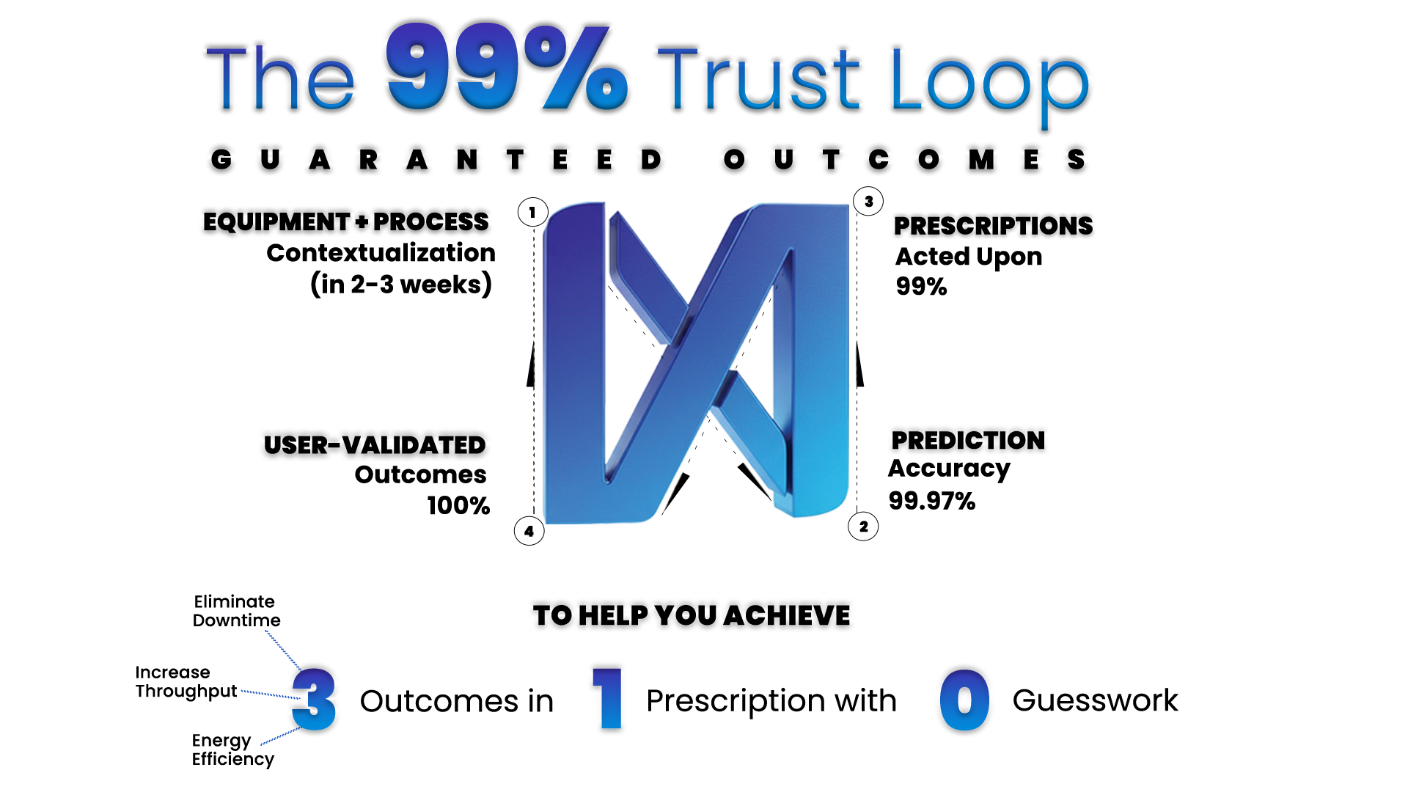
PlantOS™ is built around the 99% Trust Loop™ — a validated cycle where every prescription is acted upon because it is specific, evidence-backed, and contextually grounded:
- 99.97% prediction accuracy (customer-validated across 85,000+ monitoring locations)
- Up to 99% prescription adoption rate
- 100% user-validated outcomes
- 2–3 week equipment contextualisation from deployment
- 140,641+ hours of unplanned downtime eliminated across 881 plants globally
The outcome is not a monitoring system. It is a reliability intelligence platform that transitions crane operations from reactive maintenance to semi-autonomous production management — where human judgment is supported, not replaced, by AI prescriptions backed by machine-verified evidence.
Frequently Asked Questions
Predictive maintenance tells you that a crane component is likely to fail. Prescriptive AI goes further — it tells you exactly what is failing, why, what action to take, and provides the evidence (vibration spectra, trend data, fault frequency analysis) to justify the intervention. PlantOS™ delivers prescriptive intelligence with a 99% prescription adoption rate, and 99.97% Prediction Accuracy, meaning maintenance teams act on virtually every recommendation because the evidence is specific and actionable. This is the core difference between a system that generates alerts and one that drives outcomes.
PlantOS™ uses a SIM-based wireless communication architecture that eliminates the need for fixed Ethernet or Wi-Fi connectivity. All IoT hardware — including piezoelectric vibration sensors, analog and digital input modules, and the industrial data logger — is installed onboard the crane itself. The data logger includes local buffering for network failover protection, ensuring no data loss even during connectivity interruptions. Data is transmitted via a secure encrypted VPN tunnel to the PlantOS™ Cloud for real-time analysis.
PlantOS™ monitors three failure domains: mechanical health (hoist motor vibration, gearbox bearing wear, brake pad degradation), electrical health (contactor wear, drive faults, control power interruptions, step contactor sequencing drift), and safety interlocks (E-stop events, anti-collision systems, overload trip feedback, limit switch health). Vibration analysis using FFT fault frequency mapping can identify bearing and gearbox degradation 2–6 weeks before catastrophic failure, giving maintenance teams a substantial planning window for intervention during scheduled downtime.
Deployment follows a structured 5-day implementation plan with only a single day of crane downtime required for sensor installation and PLC handshake. Days 2–3 cover dashboard configuration and signal validation, and Days 4–5 complete go-live validation, user training, and system handover. The AI model calibrates over a 2–3 week contextualisation period post-deployment. ROI payback is typically achieved within 6–12 months, compared to the industry norm of 18–24 months, driven by reduced unplanned downtime, lower emergency repair costs, and improved safety compliance.
Yes. PlantOS™ is designed for modular, incremental deployment. Most organisations begin with a pilot crane in their highest-criticality bay to validate the value proposition. Infinite Uptime currently operates across 881 plants globally with the largest install base in the steel industry at over 84 MTPA of production capacity monitored. The same architecture that monitors casting cranes in steel mills and kiln feed cranes in cement plants applies to port, mining, and manufacturing EOT crane fleets.