
Prescriptive AI for Continuous Casting Cranes Enabling Semi-Autonomous Steel Mills
Read Time: 8–9 minutes | Author – Kalyan Meduri
- Prescriptive AI for Continuous Casting Cranes
- The Green Steel Mandate Meets Casting Reality
- Why Traditional Predictive Tools Stall at Alarms
- PlantOS™ and the 99% Trust Loop
- Continuous Casting Crane — From Critical Risk to Controlled Variable
- Steel Plant Equipment Outcomes — PlantOS™ Verified Data
- Preventing Caster Breakdowns — Equipment and Process Reliability as One
- Energy Efficiency — Every Avoided Fault Is Dual-Purpose
- What This Means for Plant Leadership
Key Highlights
- How “green steel” goals are quietly derailed by reliability failures in continuous casting cranes and caster lines.
- Why traditional predictive tools stall at alarms — leaving teams to guess the right action in high-risk, high-temperature environments.
- How PlantOS™, powering the 99% Trust Loop, turns streaming sensor data into a single, trusted source of truth for prescriptive maintenance and energy-efficient operations.
- What Prescriptive AI looks like on the shop floor: fewer breakdowns, higher throughput, lower kWh/ton — validated by operators, not dashboards.
across 9 verticals
globally (all verticals)
digitalized
downtime eliminated
vs 18-24 months industry average
844 plants across 9 industrial verticals globally. Steel vertical: 226 plants, 53,208 hours eliminated, 15,255 breakdowns avoided.
Payback: PlantOS™6–12 months vs. typical digital projects 18–24 months.
Prescriptive AI for Continuous Casting Cranes
Green steel is no longer a buzzword — it is a boardroom mandate. Regulators, investors, and customers are pushing steelmakers to decarbonize fast while remaining cost-competitive. But behind every sustainability roadmap lies an inconvenient truth: you cannot claim to be green if your most critical assets are unreliable, energy-hungry, and prone to disruptive breakdowns.
Reliability is the foundation of green steel. Stable, uninterrupted casting operations enable up to 2% reductions in energy consumption per ton through optimized thermal management and consistent casting sequences. In an integrated steel plant, the continuous casting crane and caster line sit at this fragile intersection of reliability, safety, throughput, and energy intensity.
When a crane failure delays ladle movement, or a breakout forces an emergency stoppage, energy, materials, and time are lost in one expensive cascade. That is exactly where Prescriptive AI — and PlantOS™’s 99% Trust Loop — change the script.
Across 844 plants and 9 industrial verticals, PlantOS™ has eliminated 115,704 hours of unplanned downtime. Within the steel vertical alone — 226 plants — the figure stands at 53,208 hours, with 15,255 breakdowns avoided and a 6–12-month payback against an industry norm of 18–24.
The Green Steel Mandate Meets Casting Reality 01
Consider a continuous casting crane unavailable during peak sequence timing. Ladle handling delays cascade into extended thermal hold times, sub-optimal heat scheduling, and higher kWh/ton as reheating compensates for idle losses. A caster breakdown compounds this — scrapped steel, damaged segments, emergency interventions — all driving energy inefficiency that directly undermines green steel targets.
Green steel succeeds when reliability enables energy efficiency — not as a side effect, but as a concrete P&L lever with measurable energy savings per ton produced.
Why Traditional Predictive Tools Stall at Alarms 02
Most plants today are not short of data. Vibration sensors on crane gearboxes, temperature monitoring on motors, torque and brake feedback, plus caster measurements like mould level, oscillation, segment temperature, and hydraulic pressures are all streaming somewhere. Traditional predictive tools do a decent job of turning raw signals into alerts:
• “Crane gearbox vibration trending above threshold.”
• “Segment hydraulic pressure unstable.”
• “Abnormal mould temperature pattern — risk of shell thinning.”
The problem is what happens next.
In many cases, these tools leave engineers with a red or yellow signal and a generic recommendation: “Inspect asset,” “Plan maintenance,” or “Check lubrication.” In a high-pressure casting bay, that is not enough. The result:
• Alarm fatigue: too many alerts with too little context.
• Low trust: operators remember every false alarm, not the saves.
• Outcome gap: insights exist, but they do not reliably translate into timely, precise, executed actions.
You remain in a world of predictive signals without a prescriptive path to prevent the next crane stoppage or caster breakout with confidence.
PlantOS™ and the 99% Trust Loop 03
PlantOS™ — the world’s most user-validated Prescriptive AI — was built to close this outcome gap, not to produce more dashboards. Its vertical AI models are trained on industry-specific failure modes across metals, mining, cement, paper, chemicals, and other asset-intensive sectors, delivering highly contextual machine diagnoses rather than generic “high vibration” flags.
At the heart of the platform is the 99% Trust Loop — a closed loop combining fault prediction, prescriptive recommendations, operator validation, and outcome tracking. PlantOS™ operates across 844 plants and 9 industrial verticals globally, eliminating 115,704 hours of unplanned downtime. Within the steel vertical — 226 plants — outcomes are:
• 99% of recommended actions acted upon by operators
• 53,208 hours of unplanned downtime eliminated — user-validated
• 15,255 breakdowns avoided across steel plant equipment categories
• 6–12-months payback — versus the 18–24 months typical of digital transformation projects

For a continuous casting crane and caster line, the Trust Loop closes like this: raw sensor streams are contextualized by vertical AI models → a 99.97%-accurate fault prediction is generated → a specific, actionable prescription is delivered to the operator → the operator validates and executes → the outcome is tracked and fed back. A living reliability system, not a static rules engine.
Continuous Casting Crane — From Critical
Risk to Controlled Variable04
Cranes in a casting bay live a hard life: heavy loads, heat, dust, and constant starts and stops. Even minor electrical or mechanical failures can halt crane operation and bring casting to an abrupt stop. Within PlantOS™’s verified steel outcomes, gearboxes alone account for 1,592 units monitored, with 5,692 downtime hours saved and 1,059 actions prescribed accurately — making crane-class equipment one of the highest-leverage intervention points in the plant.
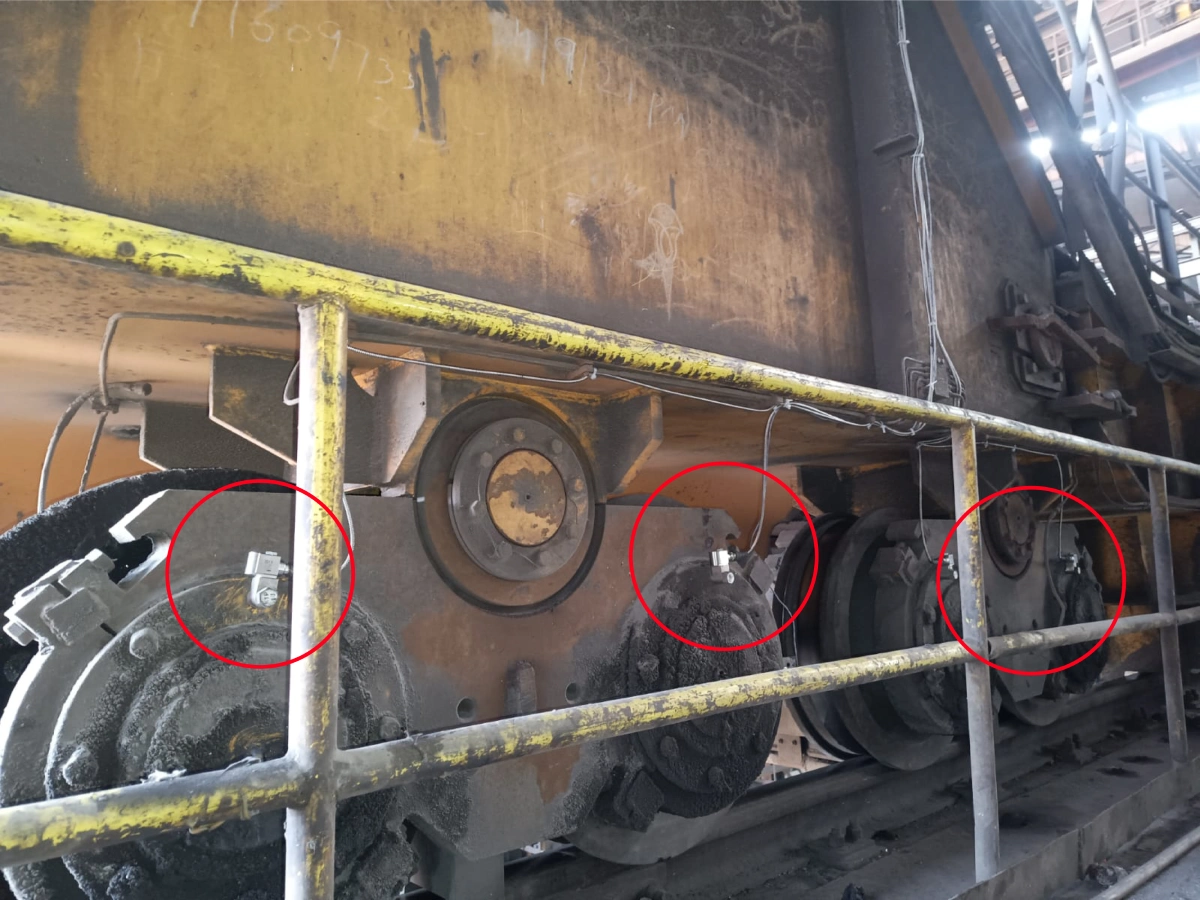
vSense 1XT deployed on the wheels of a Casting Crane – live installation at a leading global steel manufacturer
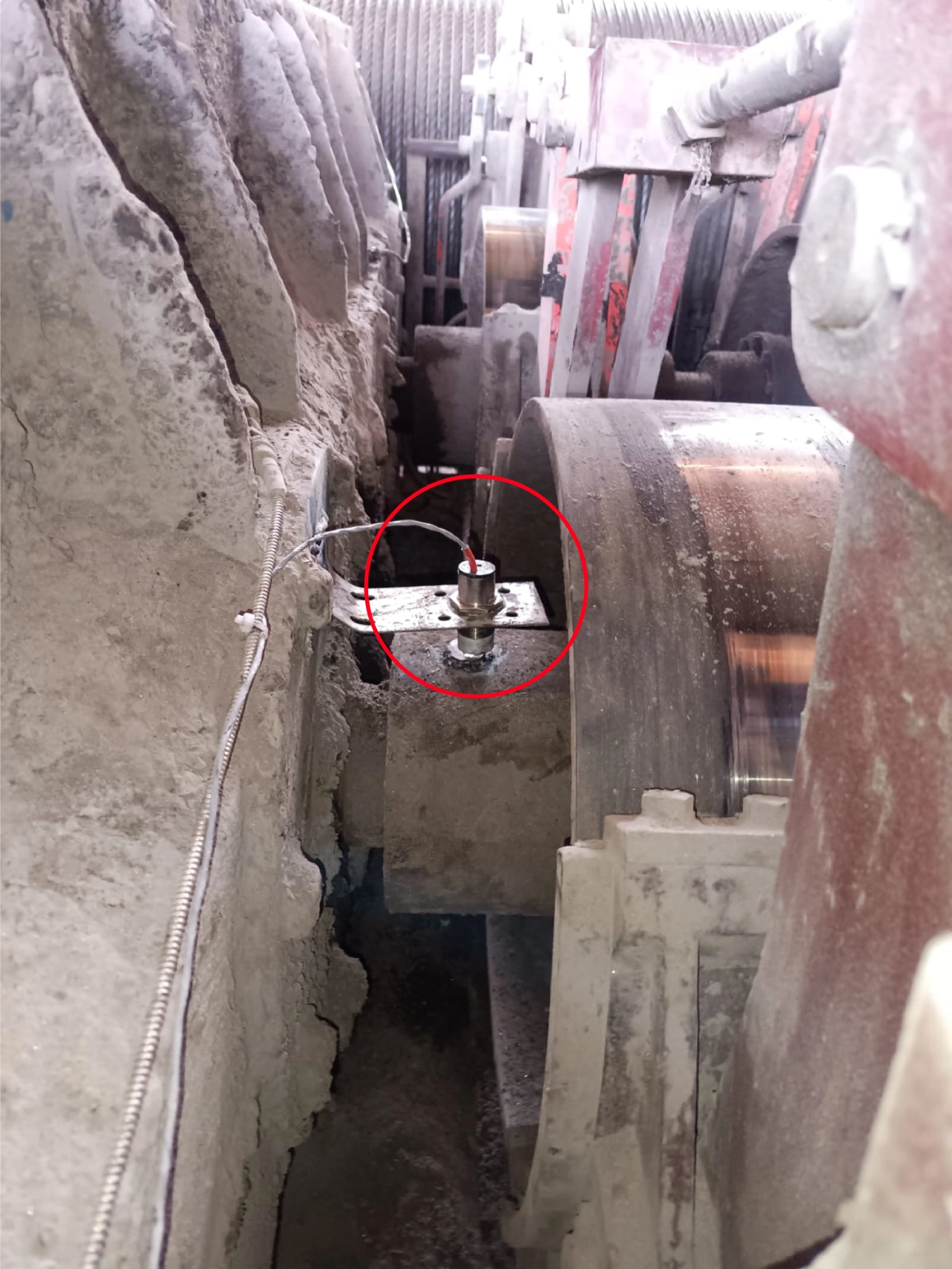
Proximity Sensor installed on the Gearbox Output of a Casting Crane live deployment at a leading global steel manufacturer.
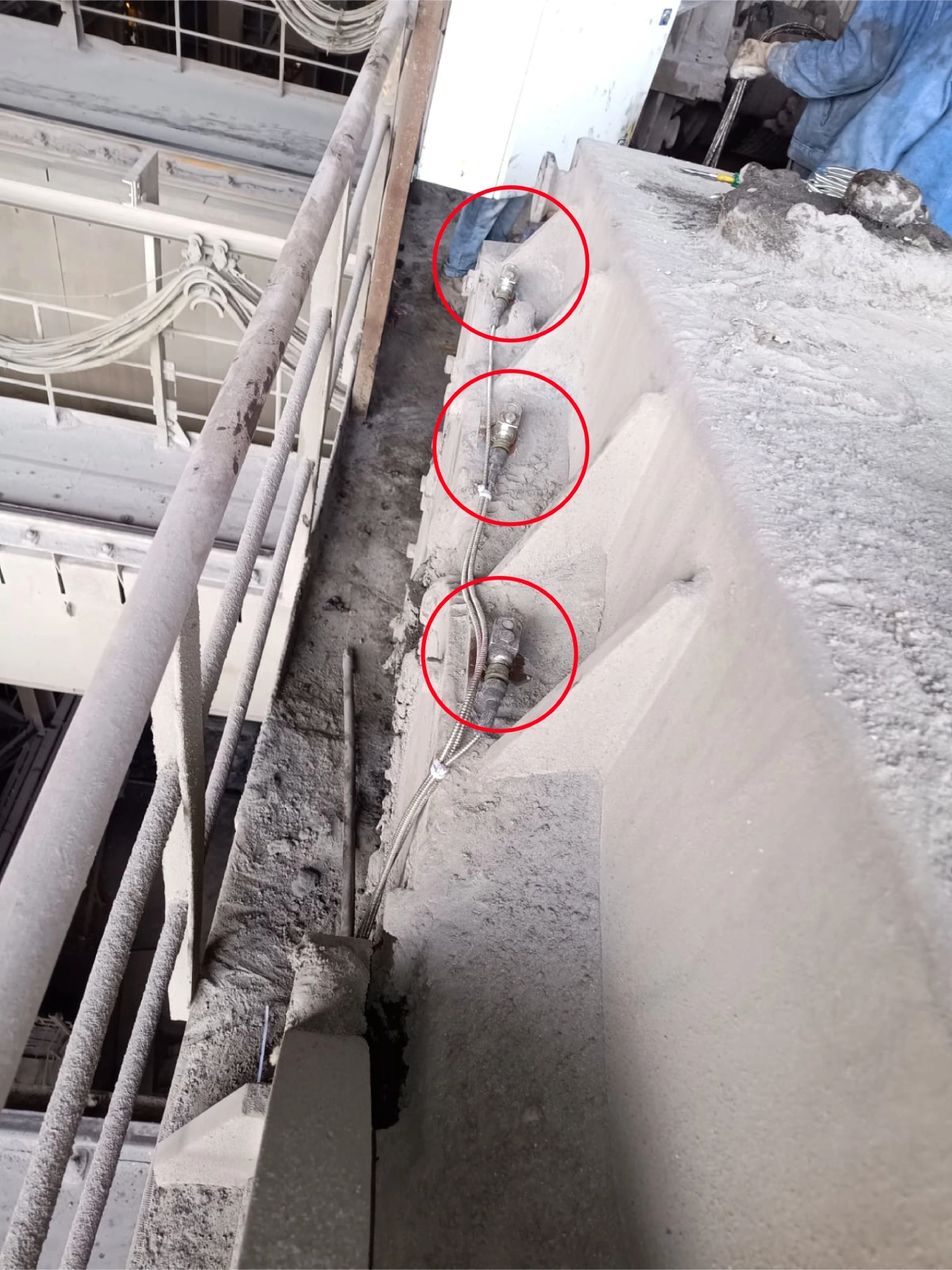
vSense 1XT deployed on the Gearbox Non-Drive End of a Casting Crane– live installation at a leading global steel manufacturer.
Prescriptive AI on PlantOS™ reframes crane reliability around three core questions:
1. Can we see failures earlier, with context?
By combining vibration, temperature, acoustic, magnetic flux, torque, brake status, and duty cycle data, PlantOS™ distinguishes between overload, alignment issues, bearing degradation, and control problems — not just “high vibration.”
2. Can we recommend the right action at the right time?
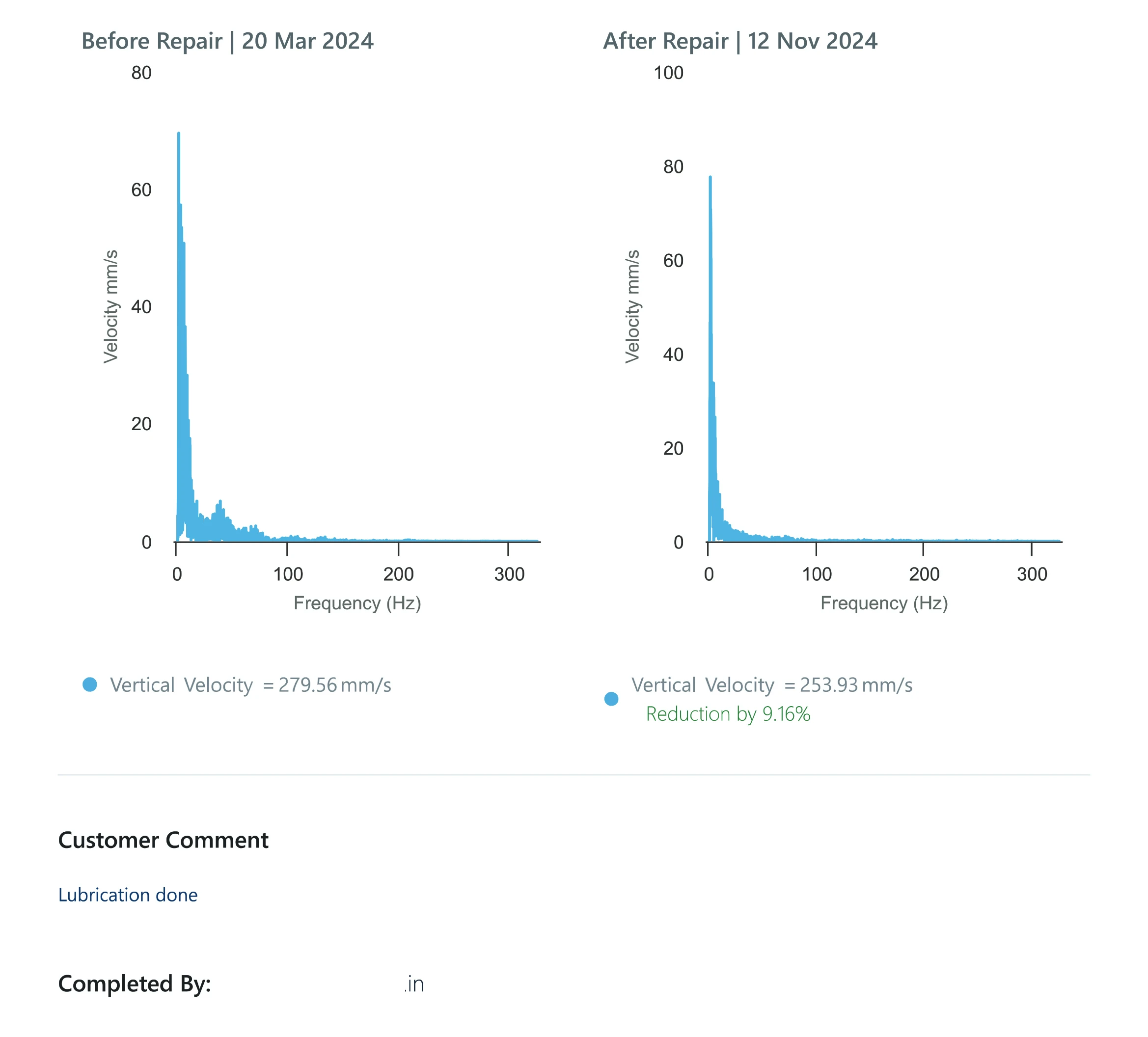
- The precise Fault Diagnosis:
“Amplitude in Total Acceleration is higher in wheel bearing 12 [>400 (m/s²)²]
compared to other wheel bearings.
Vibration characteristics indicate bearing defects at wheel bearing 12.” - The Recommended Action:
“Relubricate Wheel Bearing 12 as a
preliminary action. Inspect LT Wheel
Bearing 12 for defects at the next
available opportunity.” - Expected Outcome:
The expected outcome: “Downtime
savings of 3 hours.”
3. Can we prove it worked?
Steel Plant Equipment Outcomes — PlantOS™ Verified Data 05
The following figures reflect user-validated outcomes across PlantOS™’s 226-plant steel footprint. Equipment marked † maps directly to continuous casting crane and caster line components discussed in this article.
| Equipment Category | Units | Downtime Hours Saved |
Prescriptions Acted Upon |
| Blower | 1,540 | 18,100 | 4,219 |
| Gearbox † | 1,592 | 5,692 | 1,059 |
| Crusher | 51 | 1,042 | 226 |
| Conveyor | 110 | 544 | 125 |
| Rope Drum † | 12 | 184 | 46 |
| Mill Dryer | 19 | 129 | 20 |
| Cylinder | 7 | 79 | 13 |
| Vibroscreen | 4 | 79 | 15 |
| Roll † | 1 | 44 | 21 |
† Gearbox, Rope Drum, and Roll are directly applicable to crane and caster line reliability.
Source: PlantOS™ Digital Reporting System — User-Validated True Positives, November 2025.
Preventing Caster Breakdowns — Equipment and Process
Reliability as
One 06
Caster breakdowns rank among the most disruptive events in a continuous casting shop, triggered by mould oscillation drift, segment hydraulic failures, roll wear, and ladle/crane timing issues. Traditional approaches silo these subsystems — mould here, hydraulics there, crane elsewhere — creating diagnostic blind spots that prescriptive AI eliminates.
PlantOS™ delivers Equipment + Process Reliability as a single source of truth by correlating:
• Equipment Data: Mould oscillation, segment hydraulic pressures, crane wheel bearing acceleration, roll vibration.
• Process Data: Mould level, shell growth rates, ladle thermal profiles, sequence timing.
Rather than surfacing a hydraulic anomaly in isolation, PlantOS™ evaluates it in the context of sequence timing, crane availability, and ladle temperature — and recommends action that addresses the system, not just the component.
Energy Efficiency — Every Avoided Fault Is Dual-Purpose07
In steelmaking, where energy costs dominate the P&L, every minute of unstable casting taxes your kWh/ton. Electrical faults (crane hoist motor overloads), mechanical failures (wheel bearing spalling), and process anomalies (mould oscillation drift) create cascading thermal losses — inefficient ladle and tundish holding, sub-optimal EAF or BOF operation, and reheating penalties.
PlantOS™ stabilizes crane and caster reliability by catching these faults early and prescribing corrective action before thermal losses compound:
• Smoother sequences: Fewer interruptions mean better thermal management and less energy wasted holding or reheating material.
• Higher throughput per energy block: More tons produced within the same scheduled energy window, improving effective energy intensity.
• Validated gains: Prescriptive maintenance via the 99% Trust Loop has delivered up to 2% energy reduction per ton in real-world deployments, alongside 53,208 hours of steel downtime eliminated.
Every avoided crane fault or caster anomaly is dual-purpose: reliability and throughput gains that make green steel claims operationally credible and financially defensible.
What This Means for Plant Leadership 08
For COO, Plant Head, and Reliability Engineering teams, Prescriptive AI-powered closed-loop reliability is now a strategic lever, not just a maintenance tactic.
With PlantOS™ as the single source of truth for continuous casting operations, plants achieve:
• Decisions operators execute: AI-assisted prescriptions replace guesswork with 99.97% prediction accuracy and 99%+ operator action rates.
• Direct KPI linkage: Reliability actions measurably improve MTBF, MTTR, and kWh/ton — making production outcomes an operational reality.
• Scalable reliability playbook: One prescription, three outcomes, zero guesswork. Standardized ODR templates, thresholds, and parts lists across casting lines, plant sites, and steel grades — eliminating site-to-site variation.
• Proven, fast payback: 226 steel plants. 53,208 downtime hours eliminated. 15,255 breakdowns avoided. Payback in 6–12 months, while peers are still waiting at month 18.
This enables semi-autonomous operations where vertical AI handles diagnostics and prescriptions, freeing experts for strategic oversight — delivering safer, more profitable, and greener steel production.
Frequently Asked Questions
Predictive maintenance flags that a component may fail soon but rarely tells you exactly what to do, when, and with what expected impact. Prescriptive AI on PlantOS™ goes further — recommending specific, time-bound actions and learning from operator feedback, driving 99%+ action rates. The ODR report gives your team a step-by-step intervention, not an alert to interpret.
Yes. PlantOS™ ingests data from existing condition monitoring systems, PLCs, historians, and sensors on cranes, casters, and auxiliary equipment. It layers vertical AI models and the 99% Trust Loop on top — without forcing a rip-and-replace hardware strategy.
By reducing unplanned stoppages, breakouts, and crane-related delays, PlantOS™ helps you produce more tons within the same or lower energy envelope, improving kWh/ton and associated emissions intensity. These improvements are operator-validated and auditable — credible inputs into green steel reporting and customer commitments.
Across PlantOS™’s 226 steel plants: 53,208 hours of unplanned downtime eliminated, 15,255 breakdowns avoided, payback in 6–12 months — all user-validated. These steelspecific outcomes sit within a broader global footprint of 844 plants and 9 verticals, where PlantOS™ has collectively eliminated 115,704 downtime hours. For steelmakers, this translates into fewer breakouts, higher continuous caster availability, and more stable, energy-efficient operations that support both P&L and green steel commitments.
See the outcomes for yourself.
Read the world’s most user-validated Prescriptive AI case study — JSW Steel — and explore how 226 steel plants are running smarter with PlantOS™.
Thank you for your interest in PlantOS™ Prescriptive AI.
Read More on Industrial Energy Efficiency
The Four Pillars of Industrial Reliability
In heavy industries today, reliability is no longer just “fewer...
Condition-Based Maintenance vs. Prescriptive Maintenance: Key Differences Explained
As industrial operations become more complex and cost pressures increase,...

Prescriptive Maintenance + Energy Efficiency: A Practical Path to Stable Industrial Operations
In the United States, unplanned downtime costs manufacturers over $1...