The Prescriptive AI Platform
Behind Every Outcome.
See PlantOS™ in Action
Decision & Planning
VALUEThe strategic layer — turning condition and process intelligence into defensible, risk-aligned plant decisions, with Dynamic FMEA re-ranking every failure mode against live equipment behaviour.
Plant Fusion – Maintenance
Decision authority that continuously prescribes a dynamic, risk-first PM program.
- A decision authority that continuously prescribes a dynamic PM program and asset strategy
- Replaces static time-based plans with ISO-aligned, risk-first PM logic
- Gives Reliability, Maintenance, and Plant leadership defensible logic for what, how, and when to maintain
- Purpose: OPEX reduction with lower unmanaged risk
- 15–25% PM cost reduction via over-maintenance detection on low-risk assets
- 20–35% MTBF improvement driven by cross-asset correlation
- 5–10% planned replacement CAPEX deferral through better run/repair/replace decisions
- 3–7% total cost of ownership reduction across maintenance, spares, and risk
- ISO-aligned governance — every recommendation traceable with audit trail
- Plants have sensors, APM, CMMS, ERP — yet still suffer surprises and over-maintenance
- Fixed OEM PM schedules are worst-case assumptions applied uniformly across asset classes
- Spreadsheet heuristics and calendar rules produce both over- and under-maintenance
- Leaders need defensible, risk-aligned logic — not one-size-fits-all schedules
Plant Fusion – Spares
Governed engine prescribing risk-aligned min/max levels and ordering triggers.
- A governed decision engine prescribing risk-aligned min/max levels and ordering triggers
- Replaces static ABC classifications and manual min/max rules with risk-fusion logic
- Fuses failure behaviour, lead times, and criticality into inventory decisions
- Eliminates over-stocking and critical stockouts simultaneously
- Zero critical stockouts on assets with active RUL tracking in Plant Fusion
- 20–40% reduction in emergency procurement and expedited logistics cost
- Safety-critical items remain mandatory — reductions only applied where risk is quantified
- Supplier reliability tracking — actual vs. promised lead time per vendor
- ERP ABC/XYZ rules are cost-only — ignore risk, reliability, and lead time
- Over-stocking low-criticality parts ties up capital; under-stocking critical parts stops plants
- Emergency procurement and expedited logistics inflate OPEX
- Safety-critical inventory cannot be touched without governed approval
Plant Fusion – Decision
Fuses reliability physics with business plans, finance, energy, and spares into one decision.
- The ultimate orchestrator fusing reliability physics, production plans, financials, energy, and spares
- Provides unified decision-support for Capex/Opex allocation and risk governance
- Translates engineering health into business risk metrics ($)
- Unified executive cockpit comparing risk vs cost across plants
- Evidence-based CAPEX justification replacing historical guessing
- Continuous alignment of engineering action with corporate ESG and financial goals
- Board-ready reports generated dynamically in real-time
- Engineering health (vibration, temperature) disconnected from business risk ($)
- Capex decisions based on history rather than actual asset risk
- ESG goals (energy, waste) conflict with production schedule without unified planning
Analytics & Prescription
VALUEThe AI brain — verticalized AI models converting condition and process data into evidence-backed prescriptions, distinguishing equipment-reliability from process-induced faults and mapping fault progression to the right action window.
Prescription Engine
AI engine converting vibration, condition signatures, process stress signals, and operational parameters into structured mechanical and process fault prescriptions.
- The AI Prescription engine converting vibration, condition signatures, process- induced stress signals, and operational parameters into structured mechanical and process fault prescriptions
- Combines spectrum analysis, envelope detection, bearing/gear mesh analysis, process parameter correlation, and multi-variable energy and throughput modelling
- Four domain modules running simultaneously — Energy, Throughput, Yield, and Quality — layered on top of continuous mechanical health monitoring
- Outputs plain-language, machine-readable prescriptions with RUL and urgency class — covering equipment-borne faults, process-driven failure modes, and operational inefficiencies
- Issues specific, evidence-backed corrective actions like a clinical prescription — with quantified expected impact per action and historical evidence
- Feeds directly into Plant Fusion — Maintenance and AI Worx
- 18–25 days average advance warning vs. 7–10 day industry benchmark
- Zero manual interpretation — fault type, location, RUL, and urgency in every prescription
- Covers Mechanical 20+ specific faults including Bearing wear, Unbalance, Misalignment, Looseness, Cavitation, Resonance, Lubrication degradation, Gear-mesh anomalies etc
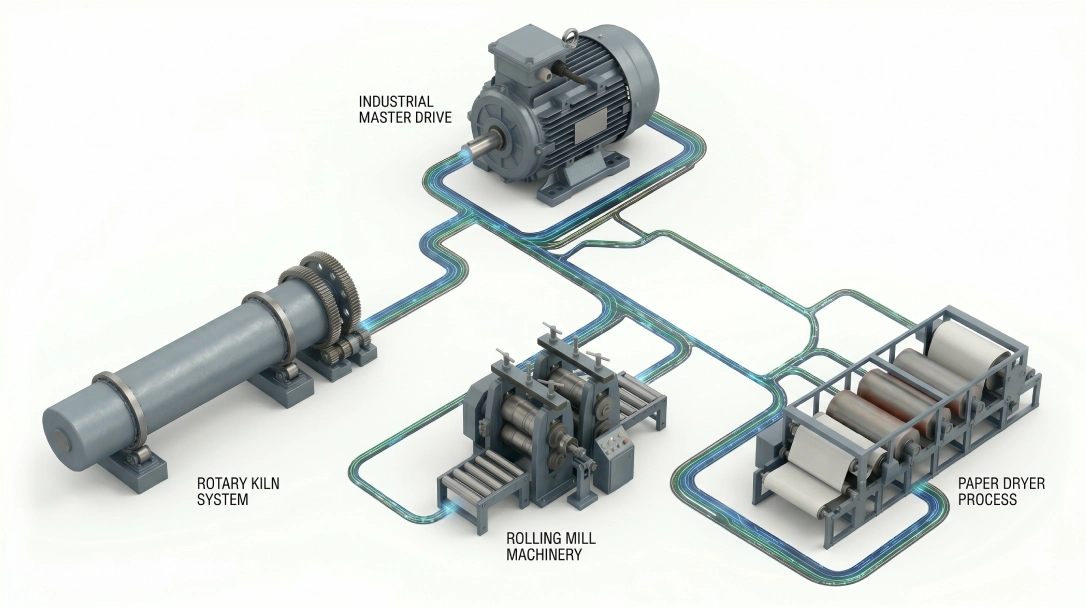
- Covers 20+ Process induced faults including Kiln ring formation, Thermal overstress, Cyclone coating buildup, Ladle heat profile drift, Hot-strip thermal fatigue, Wet-end web tension drift, Coupling thermal loads, Roll thermal overload etc
- Distinguishes between equipment-borne degradation and process-induced acceleration — so corrective action targets the right root cause
- Multi-variable correlation prevents single-sensor false positives and alert fatigue
- Every prescription includes deviation, action, expected impact, and historical evidence
- Raw vibration spectra and process anomalies require expert interpretation - most plants can't scale specialists across every asset or every domain simultaneously
- Manual fault diagnosis is slow, inconsistent, and misses subtle mechanical signatures - while process anomalies causing energy waste, yield loss, and quality failures go undetected before operators notice them
- Multi-variable correlations remain invisible in single-sensor dashboards - making it impossible to distinguish equipment-borne degradation from process-induced acceleration
- Without structured prescriptions, AI detections don't convert into work orders - operators receive alerts, not evidence-backed actions with expected impact
- Single-sensor alerts cause false positives and alert fatigue - eroding trust in the system and delaying critical interventions
- RUL estimates are essential for run/repair/replace decisions - but meaningless without the process context driving the degradation rate
Platform & Execution
INFRAThe operational layer — process contextualization structuring raw data into intelligence, while CMMS integration, third-party sensor connectors, and digital logbooks turn AI prescriptions into executed, recorded work.
Process Canvas
Operational intelligence platform converting plant historian data into structured live KPIs.
- The operational intelligence platform that converts DCS/PLC/SCADA/historian data into structured live KPIs
- Delivers role-specific dashboards, AnalytiX workspace, and downtime attribution
- The mandatory intake layer for Process Prescript — prerequisite for AI process prescriptions
- Delivers value from day one during commissioning, before AI prescriptions activate
- Zero manual dashboard rebuild — live views update straight from historian
- One unified operational picture replacing multiple disconnected screens
- CEMLine vertical installer — pre-built cement KPI pack, deployment in days not weeks
- Multi-plant fleet benchmarking when deployed as part of Plant Enterprise
- Real-time KPI updates direct from DCS/historian — no manual extraction
- Plants generate enormous DCS data but lack a layer converting it into role-appropriate intelligence
- Engineers spend 2+ hours daily manually rebuilding Excel dashboards
- Process Prescript cannot activate without the structured data baseline Canvas provides
- Multiple disconnected operational screens prevent a unified plant view
AI Worx
Maintenance execution layer closing the loop between AI prescriptions and real work.
- The maintenance execution layer of PlantOS™ — closing the loop between AI prescriptions and real work
- Converts Plant Fusion and Process Prescript outputs into governed, tracked work orders
- Native mobile app for field technicians with full audit trail and compliance support
- Coexistence layer — not a replacement for SAP PM or IBM Maximo
- 100% of AI prescriptions tracked to work order status — zero silent drop-offs
- Criticality-based auto-escalation ensures high-risk tasks never slip through
- Auditable trail for every PM change, technician action, and completion
- Execution feedback improves prescription quality with each cycle
- Multi-location support — manage work orders across multiple plant units from one instance
- Most industrial AI programmes fail in the execution gap — recommendations lost in WhatsApp and Excel
- Without structured work order conversion, AI prescriptions remain suggestions
- Completion data must feed back into AI models for continuous improvement
- Plants without a strong CMMS need a native execution layer
DigiLogBook
Digital replacement for paper shift logs — structured handover and field observation capture.
- Digital replacement for paper shift logs — structured shift handover and field observation capture
- Mobile-first capture with photo, voice-to-text, and structured form entries
- Makes operator observations AI-accessible in PlantOS™
- Preserves institutional knowledge before retirement walks it out the door
- Zero paper logbooks — 100% of shift observations digitized and searchable
- Operator institutional memory preserved as AI-accessible context
- 20–30% improvement in Equipment Fault Prescription accuracy from operator observation context
- Reduced false positive prescriptions through human-in-the-loop context
- Paper logbooks trap observations in unsearchable silos
- Critical operator context lost at retirement — institutional memory evaporates
- AI fault prescriptions without human context are less accurate
AI Integration
Integrates data directly into third party CMMS (SAP PM / IBM Maximo) via APIs, Webhooks, MCP.
- Integrates data directly into third-party CMMS (SAP PM / IBM Maximo)
- Seamless transfer of prescriptions and work orders via APIs, Webhooks, MCP
- Coexists with existing software without replacing core ERP investments
- Zero manual data entry between platforms — 100% automated synchronization
- Leverages existing EAM investments while injecting prescriptive intelligence
- Reduces integration timeline to weeks rather than months
- Siloed systems prevent AI from initiating actual workflow
- Custom API integrations are expensive and take months to deploy
- Manual synchronization of work orders is error-prone
SenseLink
Connects existing third party sensor systems to PlantOS™ EAM.
- A connective layer for third-party sensors and asset systems
- Unifies disparate telemetry streams into a single structured schema
- Feeds external condition data directly into the prescription loop
- Protects existing hardware capital expenditure
- Unified asset risk views including third-party vibration/temp nodes
- Ensures continuous condition updates without vendor lock-in
- Plants have already invested in third-party sensor platforms
- Existing sensor data assets must feed the AI prescription loop, not sit isolated
- A unified fault prescription engine requires all condition data in one place
Edge & Connectivity
INFRAThe connective tissue — secure, multi-protocol transmission from plant floor to PlantOSTM via a universal edge gateway, with edge inferencing and RPM-triggered edge spectroscopy processing data at the source.
EdgeIU
Process Edge Intelligence Unit capturing temperature, pressure, and energy data via tag reading.
- The Process Edge Intelligence Unit capturing temperature, pressure, and energy data via tag reading
- Three variants: EDGEIU-PLC, EDGEIU-DCS, and EDGEIU-Touch
- Fits seamlessly into any existing control architecture
- Secure, continuous data transmission into the PlantOS™ collaborative AI ecosystem
- Multi-protocol support across every industrial asset class
- 100% technology onboarding with zero plant downtime
- Zero rip-and-replace deployments — existing control architecture fully preserved
- Secure, continuous data transmission validated for enterprise IT/OT requirements
- PlantOS™ AI is only as good as the plant data it can securely access
- Most control architectures use proprietary protocols that block AI integration
- Plants resist rip-and-replace of existing PLC/DCS investments
- IT/OT security concerns block many conventional edge solutions
Sense & Ingest
INFRAThe foundation layer — complete condition data capture from every critical rotating asset, built on the market's broadest sensing portfolio: wired, wireless, piezo, MEMS, self-powered, and third-party sensors.
Critical Sensor Kit
Five purpose-built sensors providing complete critical rotating asset coverage.
- Five purpose-built sensors providing complete critical rotating asset coverage
- Each sensor matched to a specific deployment context, machine class, or criticality profile
- Feeds raw vibration, temperature, and RPM data directly into PlantOS™ Equipment Prescript
- Covers virtually all industrial rotating equipment scenarios from one integrated kit
- 100% critical asset visibility from day one — no asset left unmonitored
- <2 hours per asset commissioning with validated signal quality at installation
- Sub-harmonic fault detection weeks before breakdown via high-resolution spectrum analysis
- RPM-normalised analysis for VFD-driven assets — no external tachometer required
- Every detection feeds Plant Fusion — Maintenance for automatic risk re-assessment
- Most plants have patchy sensor coverage — critical assets remain blind spots
- Wired sensors impractical for retrofit; wireless often lacks resolution for fault classification
- Hazardous zones and high-temperature assets typically excluded from monitoring
- Without high-resolution spectrum data, AI fault classification is unreliable
IDRS Managed Diagnostics
Managed reliability service combining offline CBM, online oil monitoring, and RCFA.
- A managed reliability service combining offline CBM, online oil monitoring, and Root Cause Failure Analysis
- Integrates six complementary diagnostic technologies into one unified service
- Delivers structured condition data directly into PlantOS™ as inputs for Plant Fusion — Maintenance
- Field execution by certified partner network and/or customer personnel
- Six technologies: oil analysis, thermography, manual vibration, ultrasonic, NDT, MCSA
- 48-hour SLA for RCFA reports — prescriptive, not just descriptive
- 100% of assets receive severity class at commissioning — mandatory for AI Worx triage
- Online oil monitoring tracks contamination and wear metals between scheduled changes
- Post-RCFA findings automatically update PlantOS™ PM optimisation logic
- Many critical assets cannot be continuously monitored due to environment, access, or cost constraints
- Fills the coverage gap with structured periodic diagnostics and managed RCFA
- Provides the condition data Plant Fusion requires for risk-aligned PM decisions
- Eliminates the need for plant-side vibration analyst headcount during ramp-up