
Prescriptive AI for Pumps, Compressors and Agitators Closing the Outcomes Gap in Chemicals and Fertilizer Plants
Read Time: 8–9 minutes | Author – Kalyan Meduri
- Prescriptive AI for Pumps, Compressors and Agitators
- The Process Variability Trap in Chemicals & Fertilizer
- Why Predictive Tools Fail Process Industries
- PlantOS™ and the 99% Trust Loop
- Pumps: From Cavitation Chaos to Flow Stability
- Compressors: Surge Prevention, Pressure Predictability
- Agitators: Misalignment to Mixing Mastery
- What This Means for Plant Leadership
Key Highlights
- How equipment reliability gaps in pumps, compressors, and agitators create
process variability that kills throughput and spikes kWh per ton in chemicals/fertilizer plants. - Why traditional predictive tools stall at generic alerts, leaving process engineers & energy managers to guess the impact on yield, grade, and energy.
- How PlantOS™ and the 99% Trust Loop turn equipment + process data into
Equipment + Process Reliability—delivering precise ODRs that stabilize operations and boost throughput. - Shop-floor proof: 99.97% diagnosis accuracy, 99%+ operator execution, validated
downtime savings improvements across 41 chemical/fertilizer plants of the 844 plant footprint globally.
across 9 verticals
globally (all verticals)
digitalized
downtime eliminated
vs 18-24 months industry average
844 plants across 9 industrial verticals globally. Steel vertical: 226 plants, 53,208 hours eliminated, 15,255 breakdowns avoided.
Payback: PlantOS™6–12 months vs. typical digital projects 18–24 months.
Prescriptive AI for Pumps, Compressors and Agitators
In chemicals and fertilizer plants, 60–70% of equipment alerts are ignored—not because operators don’t care, but because generic predictions offer no process context, no action, no consequence. The result: small equipment anomalies cascade into yield loss, grade instability, and energy waste that regulators and shareholders won’t tolerate. Equipment + Process Reliability is the antidote, turning unstable operations into predictable throughput machines.
Pumps cavitating, compressors surging, agitators misaligning—these aren’t isolated failures; they’re process disruptors that force constant adjustments, spiking kWh per ton and eroding margins. PlantOS™’s Prescriptive AI and 99% Trust Loop close this reliability gap, correlating equipment health (vibration, pressure) with process outcomes (flow stability, reaction rates) to deliver operator-validated prescriptions that stabilize the plant.
Across 844 plants and 9 industrial verticals, PlantOS™ has eliminated 115,704 hours of unplanned downtime. Within the Chemical & Fertilizer vertical alone — 41 plants — the figure stands at 4,138 hours, with 1,921 breakdowns avoided and a 6–12-month payback against an industry norm of 18–24.
The Process Variability Trap in Chemicals & Fertilizer 01
In chemicals and fertilizer production, even minor equipment issues create chaos. A pump impeller wearing unevenly drops flow 5%, forcing downstream reactors & agitators to compensate with higher temperatures or recycle rates—directly hitting throughput and energy efficiency. Compressor valve leaks trigger surges that destabilize pressure profiles, while reactor agitator faults alter mixing and residence times, compromising product grade.
Traditional approaches treat these as separate silos: pump mechanics here, process control there. The result? Reactive fixes after variability hits KPIs, with energy costs climbing as systems overcompensate.
Reliability through prescriptive intelligence & analytics reframes this: one unified view of equipment + process data enables stable operations and measurable throughput gains.
Why Predictive Tools Fail Process Industries02
Plants generate rich data—pump discharge pressure, compressor interstage temps, reactor pH/vibration—but legacy predictive systems deliver generic alerts:
“High vibration on Pump P-101”
“Compressor surge detected”
Process engineers & Energy managers are left guessing: Is this cavitation affecting reactor feed? Will it cascade to grade off-spec?
This creates the classic outcome gap: insights exist, but without prescriptive actions tied to process impact—the result is a widening gap between data generated and decisions made.
In high-stakes chemicals/fertilizer, where a single surge can mean batch rejection or safety shutdown, you need more than prediction—you need a closed-loop system: Equipment + Process Reliability that prescribes the fix and proves the throughput/energy win.
PlantOS™ and the 99% Trust Loop 03
PlantOS™—deployed across 844 plants including chemicals/fertilizer—uses vertical AI models
trained on process industry failure modes to deliver 99.97% prediction accuracy. The 99%
Trust Loop transforms data chaos into operator-validated reliability:
1. Contextualize: Equipment + Process Data (Baselining Live in 2-3 Weeks)
Ingests pump flow/pressure/vibration, compressor stage temps/surge signals, reactor agitator
torque/pH—plus process KPIs (yield curves, recycle rates, grade specs)—calibrated to your
plant in weeks.
2. Observation & Diagnose: 99.97% Prediction Accuracy, Quantified Anomalies
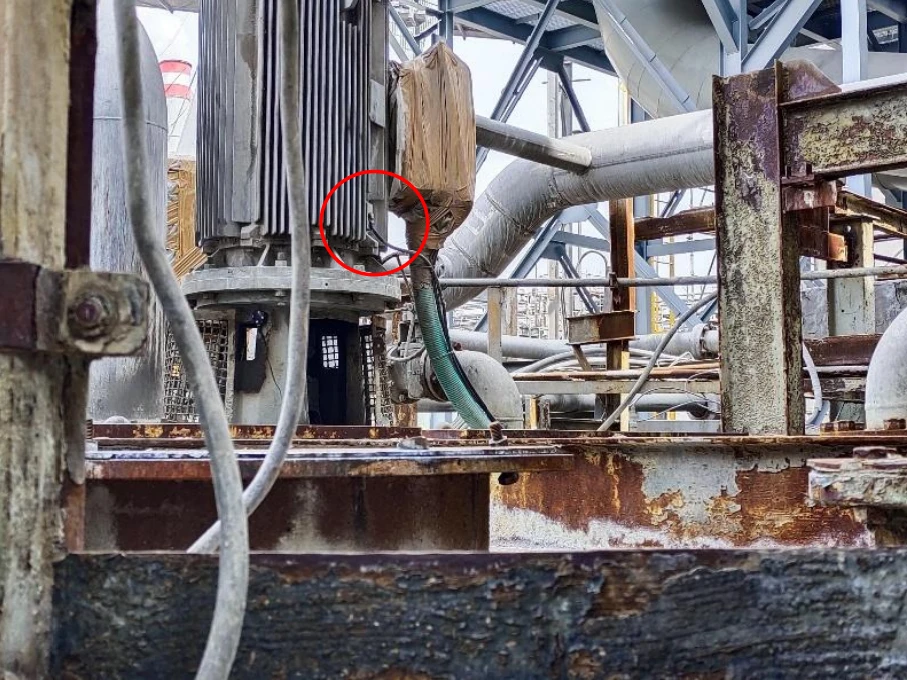
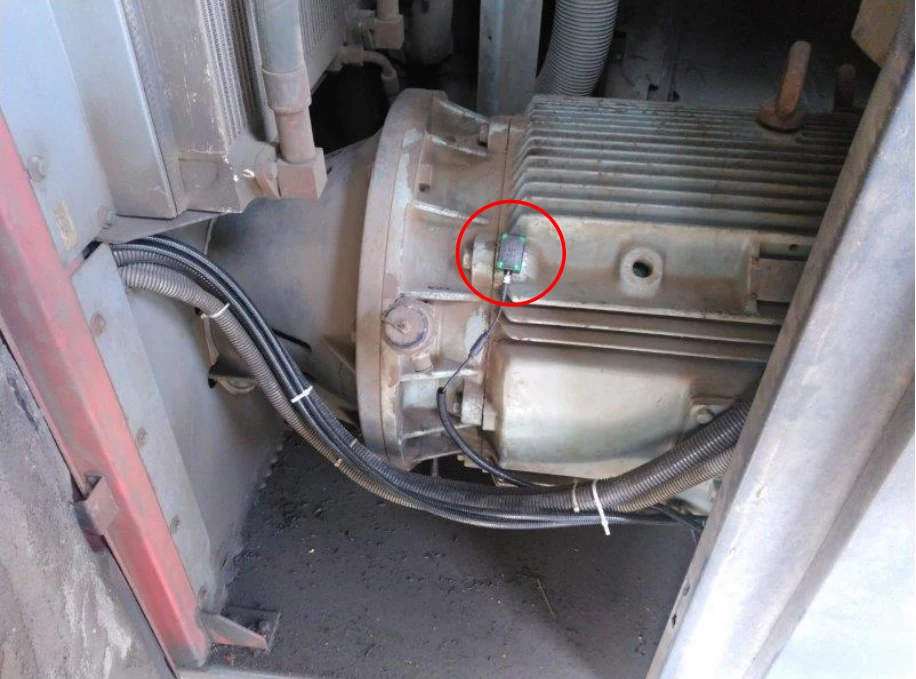
| Pumps | Compressor | Agitator – Reactor |
Observation for Sulphuric Acid Circulation Pump – Chemical Plant
Diagnostic | Observation for Air Compressor – Fertilizer Plant
Diagnostic | Observation for Agitator – Chemical Plant
Diagnostic |
3. Prescribe: Structured ODR Reports
| Pumps | Compressor | Agitator – Reactor |
Recommendation for Sulphuric Acid Circulation Pump – Chemical Plant As a preliminary action, Re-lubricate the Pump bearing. | Recommendation or Air Compressor – Fertilizer Plant In the next available opportunity, replace motor de bearing with respect to defects within inner raceway & rolling elements | Recommendation for Agitator – Chemical Plant Inspect the coupling between motor and gearbox for defects like abnormal wear, excessive looseness, repair/replace the same. Reassess precision alignment between motor & gearbox |
4. Execute & Validate: Corrective Actions taken & Business Impact
| Pumps | Compressor | Agitator – Reactor |
|
Lubrication done & carried out bearing replacement
Business Impact Downtime savings of 2 hrs |
Lubrication done
Business Impact Downtime savings of 4 hrs |
High speed coupling lubrication & gearbox bearing lubrication done.
Oil level checked and found normal
Business Impact Downtime savings of 3 hrs |

Pumps: From Cavitation Chaos to Flow Stability04
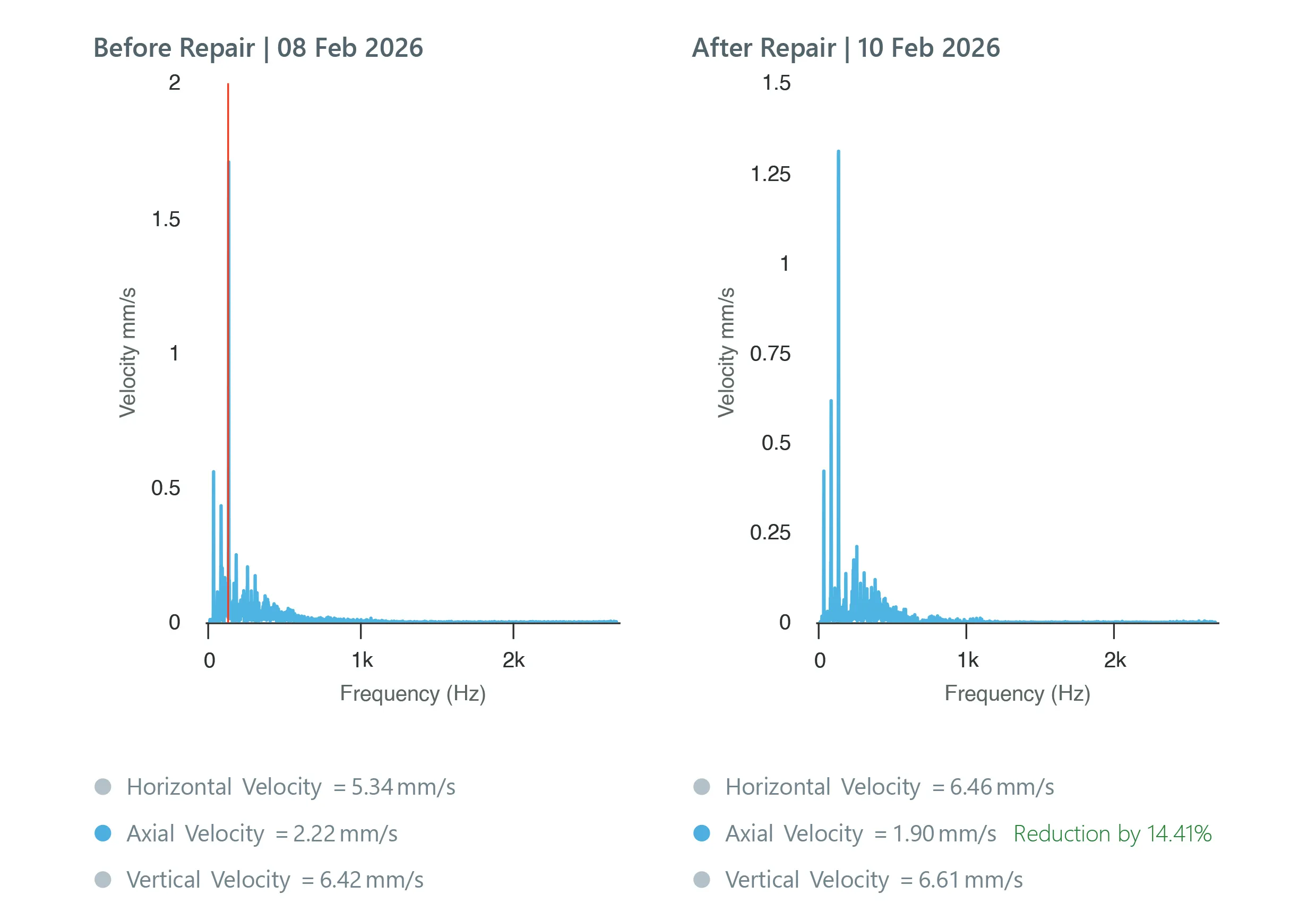
Pre-scrubber pumps at India’s leading chemical manufacturer battle cavitation chaos in
slurry service, where flow restrictions spiked DE (Drive End) bearing velocity from 2.1 to 6.4
mm/s—123Hz vane pass dominance signalling strainer blockage or throttling that disrupts
scrubber chemistry, forces reactor pressure swings, and burns energy on compensatory
recycles.
PlantOS™ flagged “DE velocity 6.4 mm/s (3x baseline); 123Hz confirms cavitation/flow
restriction”, directing operators to check cavitation/strainer/valve issues.
Momentary pump stop/start (operator note: “vibration normalized, flow related issue”)
delivered axial vibration velocity -14.41%, with trends snapping back to stability.
Compressors: Surge Prevention, Pressure Predictability 05
At India’s leading chemicals manufacturer, high-capacity centrifugal compressors
handling synthesis gas service began showing a pattern PlantOS™ caught before operators
noticed anything wrong.India’s leading chemicals manufacturer in synthesis gas service.
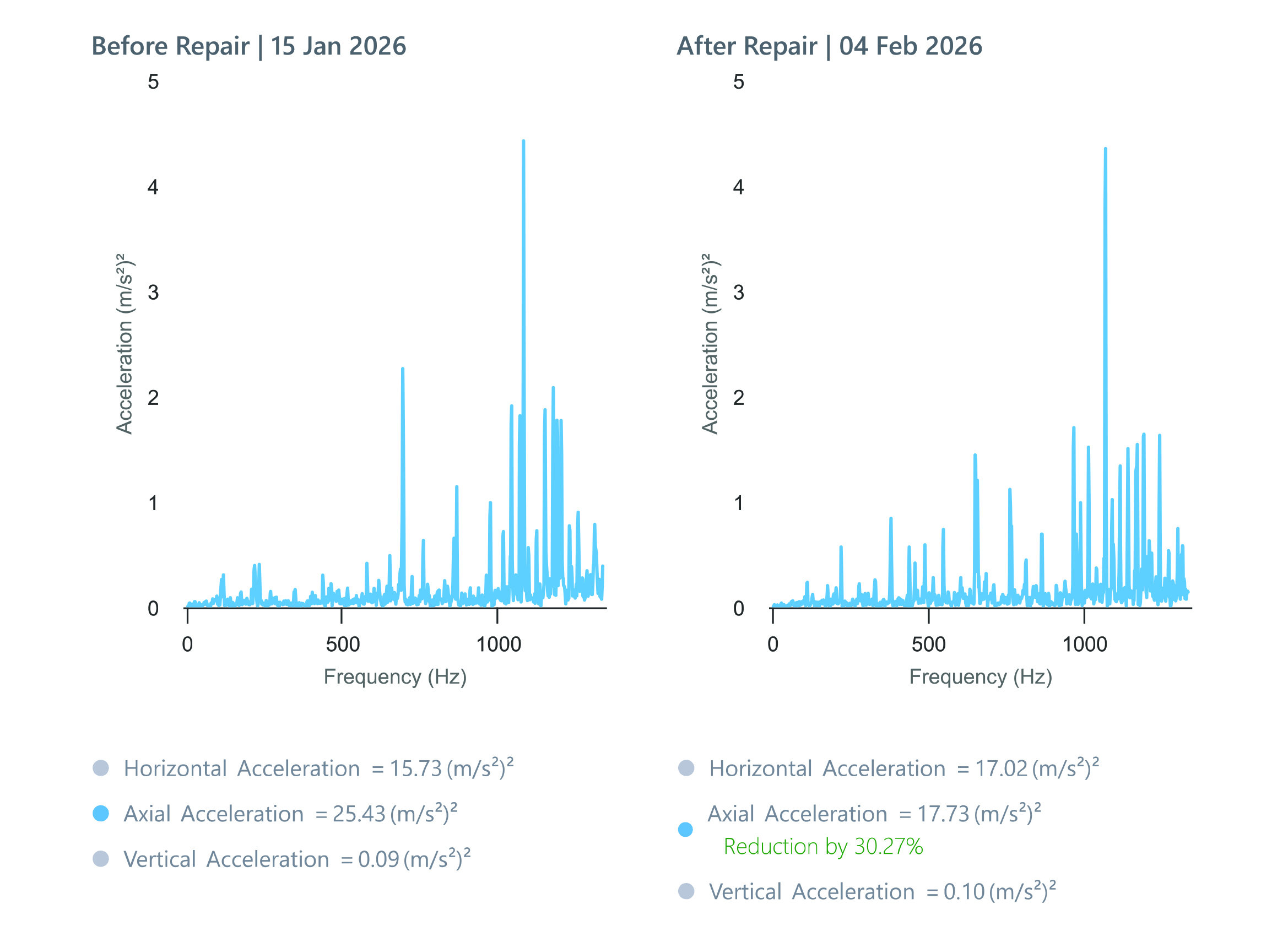
PlantOS™ detected “Motor DE acceleration max 1186 (m/s²)² fluctuating; spectrum shows
lubrication inadequacy”, prescribing DE bearing re-lubrication.
Operators executed immediately (note: “Lubrication Done”), yielding axial acceleration –
30.27% (25.43 → 17.73 (m/s²)², trends stabilized within 2 weeks.
Agitators: Misalignment to Mixing Mastery 06
PlantOS™ identified “Gearbox Output
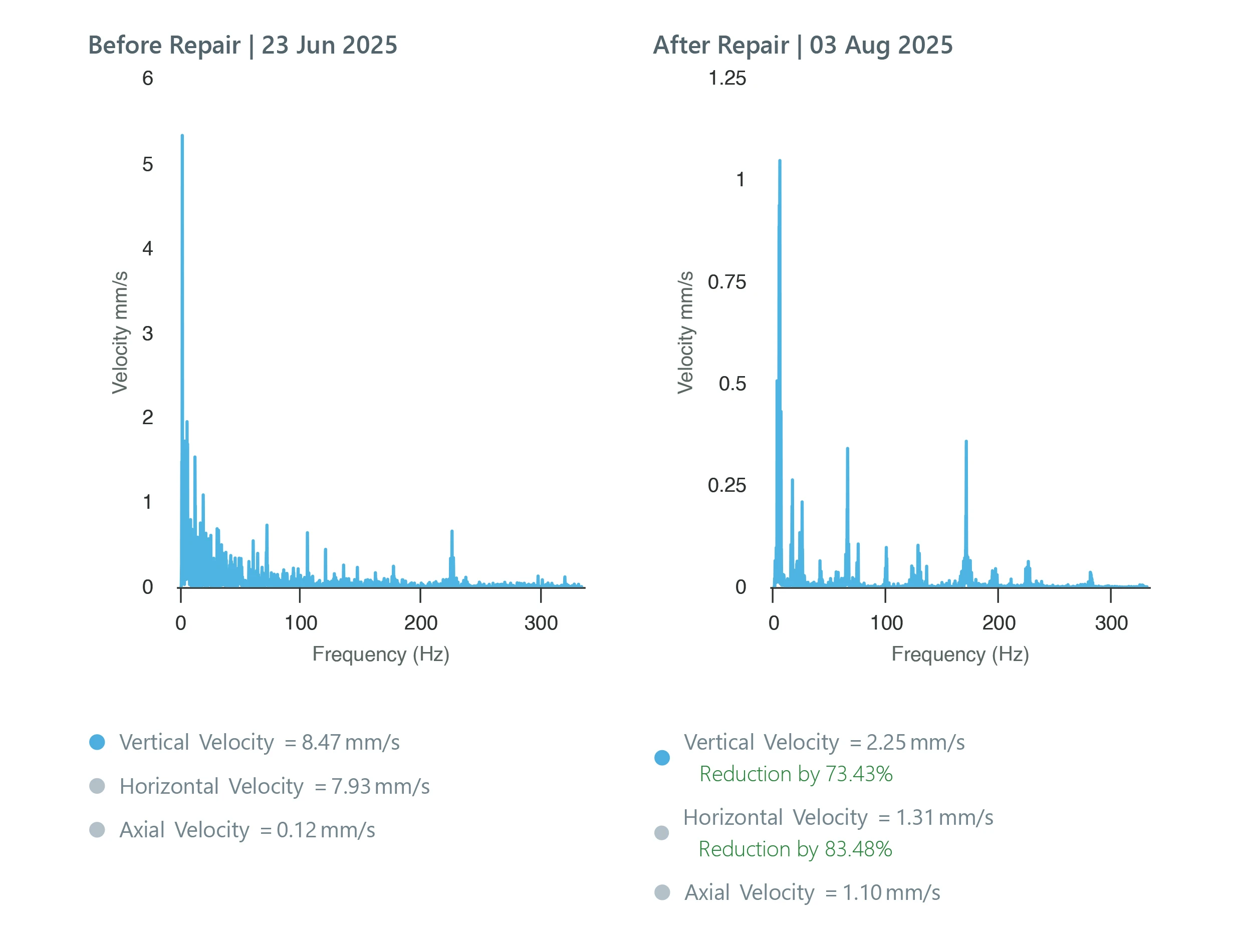
Drive End velocity spike: Vertical 8.47
mm/s, Horizontal 7.93 mm/s; 1x
harmonics confirm misalignment”,
prescribing precise alignment between
gearbox output drive end and driven
equipment.
Operators executed alignment service +
gearbox renewal (note: “gear box
renewed”), slashing: Vertical -73.43% (8.47
→ 2.25 mm/s), Horizontal -83.48% (7.93 →
1.31 mm/s).
Business im
Business impact: 14 hours downtime
saved, uniform mixing restored →
consistent phosphoric acid grade → yield
protection, optimized energy.
What This Means for Plant Leadership 07
- Decisions operators execute: AI-assisted prescriptions replace guesswork with 99.97% prediction accuracy and 99%+ operator action rates.
- Direct KPI linkage: Reliability actions measurably improve MTBF, MTTR, and kWh/ton — making production outcomes an operational reality.
- Scalable across formulations/sites: One prescription, three outcomes (reliability/throughput/energy), total accountability—standardized ODRs for sulphuric acid pumps, syngas compressors, phosphoric agitators scale reactor-to reactor, plant-to-plant.
- Proven, fast payback: 41 Chemical & Fertilizer plants. 4,138 downtime hours eliminated. 1,921 breakdowns avoided. Payback in 6–12 months, while peers are still waiting at month 18.
The result is semi-autonomous operations: vertical AI handles diagnostics and prescriptions, freeing experts for strategic oversight—AI prescribes, operators validate—safer, higher-yield, energy-efficient plants.
Frequently Asked Questions
Traditional predictive flags “high vibration” without process linkage. PlantOS™ delivers 99.97% accurate ODRs tying equipment to throughput:
• Pre-scrubber Pump: “DE velocity 6.4 mm/s, 123Hz vane pass → cavitation/strainer check” → -14.41% axial vibration velocity, 4hr saved, stable reactor feed.
• High-capacity Centrifugal Compressor: “Motor DE 1186 (m/s²)² lubrication fault → relubricate” → -30.27% axial acceleration, 3hr saved, surge-free pressure.
• Phosphoric acid Agitator: “GB output DE 8.47 mm/s vertical, 1x 1.17 Hz misalignment → precise alignment” → -73% vertical acceleration, 14hr saved, uniform mixing.
99% Trust Loop closes the gap between insight and action at a speed and scale traditional predictive tools cannot match. PlantOS™ doesn’t just flag faults—it closes the loop, validating every prescription against real outcomes. That’s what makes it a system operators trust and execute on, not another alert they ignore.
NOTE- All ODR data from live PlantOS™ deployments at active chemicals/fertilizer plants
Yes—PlantOS™ connects directly to DCS/PLC historians, ingesting pump discharge pressure, compressor interstage temps, reactor pH/torque, and process KPIs (yield, recycle rates). Plantspecific contextualization completes in 2-4 weeks, layering vertical AI models over your infrastructure. No rip/replace needed; vSense & vEdge (MEMS and Piezoelectric technology) sensors for blind spots. Deployed across 41 chemicals/fertilizer plants within the 844-plant footprint globally.
See the outcomes for yourself.
Read the world’s most user-validated Prescriptive AI case studies such as Coromandel— to explore how 41 chemical/fertilizer plants are driving outcomes with PlantOS™
Thank you for your interest in PlantOS™ Prescriptive AI.
Read More on Industrial Energy Efficiency

The Four Pillars of Industrial Reliability
In heavy industries today, reliability is no longer just “fewer...
Condition-Based Maintenance vs. Prescriptive Maintenance: Key Differences Explained
As industrial operations become more complex and cost pressures increase,...

Prescriptive Maintenance + Energy Efficiency: A Practical Path to Stable Industrial Operations
In the United States, unplanned downtime costs manufacturers over $1...