The AI Impact Summit's Biggest Blind Spot - Who Validates AI Success
Read Time: 5–6 minutes | Author – Dr. Raunak Bhinge
☰ In This Article
- The Summit Promised "Impact." Let's Talk About Whose Impact.
- The Inconvenient Truth About the World's "Biggest" AI Success Stories
- The Numbers That Expose the Gap
- JSW Steel - The World's Most User-Validated Success Story
- Why 95% of AI Pilots Fail: The Trust Architecture Was Never Built
- India's Real AI Story Isn't About Language Models
- A Challenge to the Summit: Adopt the User-Validation Standard
- The Question the Summit Must Answer
- About the Author
- References:
By Dr. Raunak Bhinge
As world leaders gather in New Delhi for the India–AI Impact Summit 2026, the conversation remains dangerously fixated on foundation models, compute democratization, and low-cost AI applications. But there’s a far more consequential question the Summit must confront: When we say AI “works,” who exactly is doing the saying?
The Summit Promised "Impact." Let's Talk About Whose Impact.
India has done something bold with this Summit. By shifting the global AI conversation from “Safety” (Bletchley Park, 2023) and “Action” (Paris, 2025) to “Impact” (New Delhi, 2026), the host nation has signalled that the era of AI navel-gazing is over. The three Sutras—People, Planet, Progress—and the seven Chakras are ambitious. They demand measurable outcomes, not more whitepapers.
But here is where the narrative cracks.
Scan the Summit’s agenda. The dominant discourse revolves around foundational LLMs for Indian languages, affordable compute infrastructure, AI governance frameworks, and yes—the inevitable parade of AI startups doing clever things with chatbots and image generators. All important. None sufficient.
What’s glaringly absent is the hardest, most honest question in enterprise AI today: Are we measuring AI success by what the C-suite reports to investors, or by what the human operator confirms on the factory floor?
This distinction isn’t semantic. It is the difference between AI theatre and AI impact.
The Inconvenient Truth About the World's "Biggest" AI Success Stories
Let me be direct. The world’s most celebrated industrial AI deployments—the ones that headline Forbes features and analyst reports—are riddled with a fundamental measurement flaw.
Consider what the global AI community currently celebrates as best-in-class:
A leading Fortune 500 food and beverage company’s widely lauded predictive maintenance deployment—the one referenced in countless case studies about “escaping pilot purgatory”—reports approximately 900 avoided downtime events across 36 pilot sites, saving roughly 4,500 hours of downtime. These are impressive numbers. They earned multiple magazine covers.
But ask this: Who validated those 900 events? Was it the machine learning model’s own scoring rubric? Was it the technology vendor’s internal assessment? Was it the corporate data science team’s dashboard? Or was it the maintenance technician who physically opened the motor, confirmed the bearing failure, replaced the part, and documented the outcome?
The answer, in most celebrated AI deployments globally, is uncomfortable: validation happens at the corporate level, not the operator level. The AI model predicts, the dashboard displays, the annual report claims. What’s missing is the closed loop—the operator who says, “Yes, this prediction was correct. Yes, I acted on it. Yes, the outcome was real.”
This isn’t a minor nuance. It is the single biggest reason MIT’s NANDA initiative found in 2025 that 95% of enterprise AI pilots fail to deliver measurable P&L impact. Not because the algorithms are bad. Not because the compute is insufficient. But because enterprises are measuring AI with the wrong ruler.

Let me define the terms clearly, because the AI industry has been deliberately vague about this for too long.
Corporate-Validated AI means: A model generates a prediction. An internal team reviews dashboards. A slide deck claims value. Success is measured by model accuracy scores, alert volumes, or estimated savings calculated by the vendor’s own methodology. The operator—the person closest to the physical reality—is a passive consumer of alerts, not an active validator of outcomes.
User-Validated AI means: A model generates a prediction. That prediction becomes a specific prescription—not an alert, but a work order with a clear action. The operator executes. The operator confirms: Did the predicted failure actually exist? Was the prescribed action correct? What was the measurable outcome? Every single outcome carries an auditable, human-confirmed signature.
The difference is not incremental. It is categorical.
Corporate validation tells you what the AI thinks happened. User validation tells you what actually happened. And until we are honest about which one we’re counting, the 95% failure rate will persist, and “AI Impact” will remain a Summit theme rather than an enterprise reality.
The Numbers That Expose the Gap
Consider a side-by-side comparison that should give pause to every CXO and policymaker at this Summit:
The globally celebrated predictive maintenance benchmark—36 pilot sites, ~900 avoided events, ~4,500 downtime hours saved. Technology: predictive (alert-based). Validation method: corporate and vendor-reported.
JSW Steel - The World's Most User-Validated Success Story
Now consider what a Made-in-India prescriptive AI platform—PlantOSTM, built by Infinite Uptime—has achieved at a single enterprise. JSW Steel, India’s leading integrated manufacturer, deploying across 139 sites in India and the USA: 8,610 AI-assisted work orders generated with 99.97% prediction accuracy; 93% prescriptions acted upon by frontline operators; 30,096 downtime hours eliminated; every single outcome confirmed by the operator who executed the work.
The multiplier isn’t marginal. It is 6.7× more downtime hours saved, 9.6× more validated work orders, at 3.9× the deployment scale. And the fundamental architectural difference? Every outcome in the Indian and American deployment is user-validated—confirmed by the human who turned the wrench, not by the algorithm that suggested it.
This is not just about Predictive AI Vs Prescriptive AI. This is about a measurement philosophy that the world hasn’t yet adopted but desperately needs to.
Why 95% of AI Pilots Fail: The Trust Architecture Was Never Built
MIT’s 2025 study, The GenAI Divide: State of AI in Business 2025, deserves more attention at this Summit than any foundation model announcement. Based on 150 executive interviews, surveys of 350 employees, and analysis of 300 public AI deployments, the findings are unequivocal:
Only 5% of enterprise AI pilots achieved measurable business impact. The remaining 95% stalled—not because the technology failed, but because the enterprise integration failed. The core issue, as MIT’s lead researcher Aditya Challapally put it, is not model quality but the “learning gap” between tools and organizations.
Translate this into manufacturing: A predictive model that achieves 95% accuracy sounds impressive until you realize that the remaining 5% error rate destroys operator trust. When one in twenty alerts is wrong, operators learn to second-guess all alerts. The system degrades not through technical failure but through human withdrawal. Dashboards keep updating. Nobody acts.
This is precisely the phenomenon that industrial operators describe as the Outcome Gap—the chasm between AI-generated insights and validated operational outcomes. Alerts are abundant. Dashboards are comprehensive. Real, repeatable EBITDA impact remains elusive.
The only architectural solution is to build trust into the AI system itself—not as an afterthought, not as a user adoption initiative, but as a quantifiable KPI that the system measures, tracks, and optimizes. This is precisely the insight that inspired me to architect what some of our trusted users call it as – The 99% Trust Loop: a closed-loop Prescriptive AI orchestration methodology where every AI prescription must survive the gauntlet of operator action and outcome confirmation before it counts as “impact.”
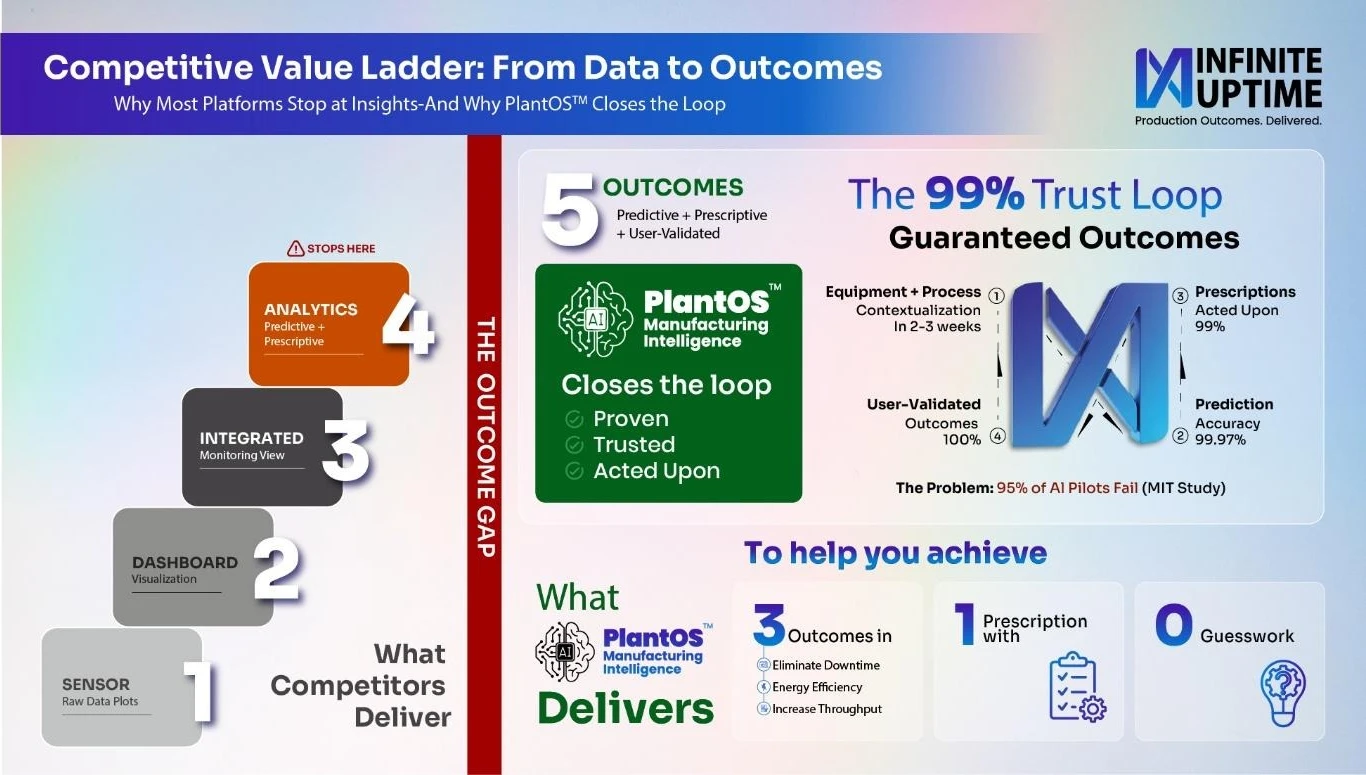
We follow a Show & Grow Model of Outcome Value Delivery. We don’t ask manufacturers to trust our algorithms on faith. We show validated outcomes first—operator-confirmed, auditable, measurable—and then we grow across the enterprise. The industry has been celebrating AI accuracy as if the algorithm’s confidence score is the finish line. It isn’t. The finish line is when a maintenance/production technician in Bellary or Baytown opens a motor, confirms the failure we predicted, replaces the part, and signs off that the downtime was avoided/utilization rate is increased. Until that signature exists, you don’t have AI impact—you have AI opinion.
When prediction accuracy crosses 99%, something profound shifts in human behaviour: operators stop second-guessing and start acting. When prescriptions are specific and pin-pointed enough to eliminate interpretation burden, action rates rise from industry-typical 30-40% to above 90%.
This is not a technology problem. It is a design philosophy problem. And it is one that Indian innovation has already solved at scale.
India's Real AI Story Isn't About Language Models
Let me be clear about what I’m arguing. The IndiaAI Mission’s investments in Bhashini, in compute infrastructure, in AI skilling—these are necessary and commendable. India’s AIRAWAT initiative to provide affordable GPU access at under a dollar per hour is genuinely democratizing. The Youth Challenge, the Global Impact Challenge, the Research Forum—all worthy.
But India’s most globally significant AI contribution isn’t a language model. It is the demonstrated proof—pioneered by my colleagues at Infinite Uptime, and validated at industrial scale across 844+ plants in 26 countries and 9 industry verticals—that AI outcomes can be user-validated, operator-confirmed, and auditably guaranteed.
This matters for the Global South narrative that the Summit champions. When an Indian AI platform deploys across steel plants in India and USA, cement factories in the Middle East, and chemical plants in Southeast Asia and Africa—with each outcome validated by the local operator in that facility—it creates something the world’s largest technology companies have not yet achieved: a trust infrastructure for AI that scales across geographies, cultures, and skill levels.
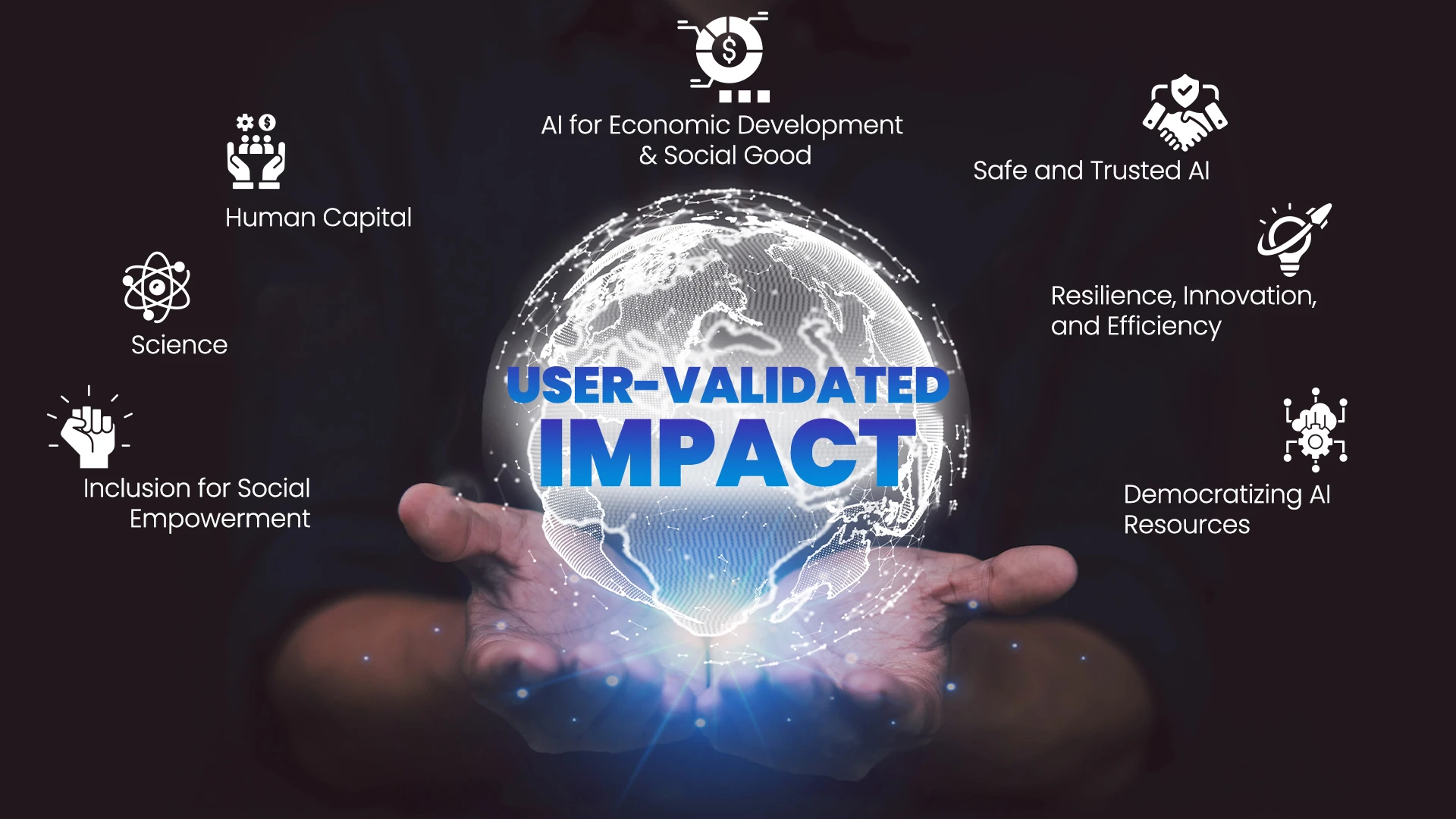
The Summit’s “Resilience, Innovation, and Efficiency” Chakra asks how AI can drive productivity and operational resilience. The answer is already deployed at 844 sites globally. The Chakra asks how trust can be built into AI systems. The answer is a methodology where trust isn’t a subjective perception but a measurable KPI—tracked at 99% action rates across hundreds of facilities.
A Challenge to the Summit: Adopt the User-Validation Standard
As India hosts 100+ countries, 15-20 heads of government, and 40+ global CEOs, I want to propose something concrete for the Leaders’ Declaration:
Establish User-Validated Outcomes (The 99% Trust Loop) as the global standard for measuring AI impact in industrial and enterprise applications.
This means:
Every enterprise AI deployment claiming “impact” must disclose whether its outcomes are validated by end-users (the operators, workers, and professionals who interact with the AI) or by corporate/vendor teams. Every government initiative measuring AI ROI—from healthcare to agriculture to manufacturing—must include user-confirmation data, not just model performance metrics. Every AI vendor seeking public procurement contracts must demonstrate closed-loop validation, not open-loop prediction.
This standard would do more to accelerate genuine AI adoption than any compute subsidy or model benchmark. It would finally give meaning to the Summit’s own promise: that AI Impact is measurable, inclusive, and real.
The Question the Summit Must Answer
The India–AI Impact Summit 2026 has every right to celebrate India’s AI ambitions. The country’s foundation model initiatives, its compute democratization, its AI governance guidelines—all signal a nation that takes AI seriously.
But if the Summit ends with declarations about LLM benchmarks and affordable GPU hours without addressing the fundamental question of how we measure whether AI actually works for the humans using it, then “Impact” will remain a word on a banner, not a standard for the world.
The global AI industry has spent two decades perfecting prediction. It is time to perfect validation.
India has already shown the way. The question is whether the world is ready to adopt the standard.
About the Author
Dr. Raunak Bhinge is the Founder and Managing Director of Infinite Uptime Inc, an industrial AI pioneer that offers PlantOSTM—the world’s most user-validated Prescriptive AI platform for semi-autonomous manufacturing outcomes. Under his leadership, Infinite Uptime has grown into a trusted partner for some of the world’s largest process manufacturers across cement, steel, mining & metals, paper, chemicals, tires, energy, food & beverage, and pharma verticals, delivering the 99% Trust Loop and production outcomes such as MTBF, throughput, and energy per ton.
With a B.Tech/M.Tech from IIT Madras and a PhD in Smart Manufacturing from the University of California, Berkeley, Raunak has spent his career at the intersection of advanced manufacturing, digital transformation, and artificial intelligence. He holds 5 patents and 14 international publications, and is a frequent speaker at global industry forums on Industry 4.0, industrial AI, and the future of manufacturing intelligence.
References:
- MIT NANDA Initiative, The GenAI Divide: State of AI in Business 2025 (July 2025)
- India–AI Impact Summit 2026, Official Summit Framework: Three Sutras and Seven Chakras
- Forbes, How PepsiCo Avoids Pilot Purgatory with Innovation Partnerships (2024)
- LNS Research, JSW Steel Case Study — Third-party validation of PlantOSTM deployment outcomes
- PlantOSTM Platform Data, Infinite Uptime Inc. (November 2025)
- Crowell & Moring, Setting the Agenda for Global AI Governance: India to Host AI Impact Summit (2025)
Disclaimer: The views expressed are the author’s own and do not represent the official position of any organization. Data cited is sourced from publicly available reports and third-party validated platform metrics.