
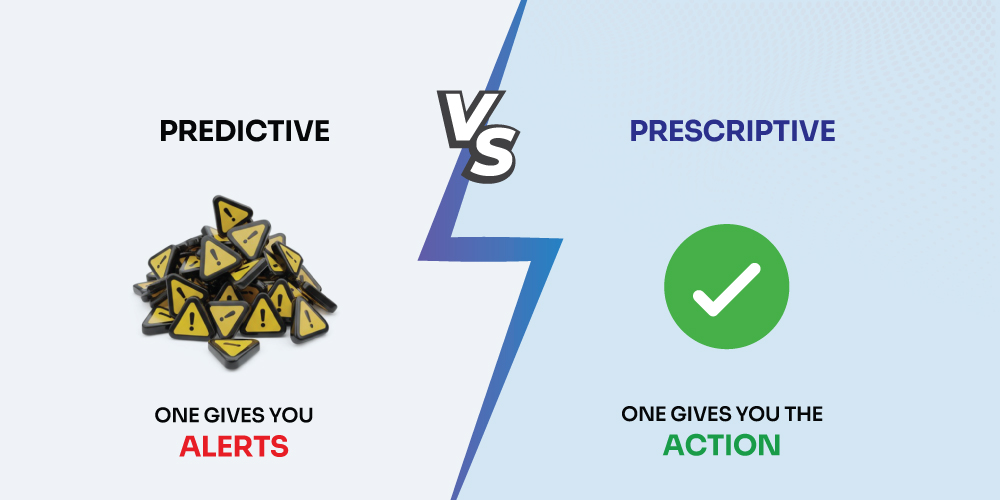
Prescriptive vs Predictive Maintenance: What’s the Difference?
Read Time: 5–6 minutes | Author – Kalyan Meduri
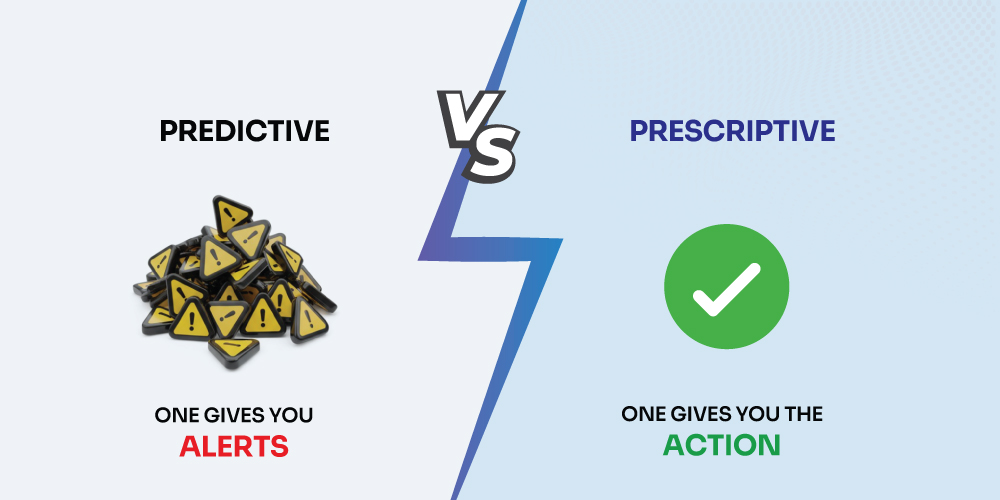
Prescriptive vs predictive maintenance refers to two different industrial maintenance strategies. Predictive maintenance uses condition monitoring and predictive analytics to estimate when equipment is likely to fail, while prescriptive maintenance goes further by recommending what actions to take, when to take them, and why to prevent failure. Prescriptive maintenance uses prescriptive AI, operational context, and outcome feedback loops, such as Infinite Uptime’s 99% Trust Loop, to ensure recommendations are trusted, acted upon, and continuously validated, resulting in higher reliability, reduced unplanned downtime, and measurable ROI.
Key Takeaways
- Downtime reduction
- Maintenance costs
- Asset reliability
- ROI from industrial AI investments
What Is Predictive Maintenance?
Predictive maintenance uses historical and real-time data to predict when equipment is likely to fail. It relies on condition monitoring techniques such as vibration analysis, temperature tracking, oil analysis, and machine learning models to detect early warning signs.
Key Characteristics of Predictive Maintenance
- Focuses on when a failure may occur
- Identifies abnormal conditions or degradation patterns
- Triggers alerts or warnings
- Requires human interpretation and decision-making
Predictive maintenance answers the question:
“What is likely to fail, and when?”
Common Predictive Maintenance Technologies
- Vibration monitoring
- Thermal imaging
- Acoustic sensors
- Oil and lubricant analysis
- Predictive analytics models
These tools are powerful, but they often generate large volumes of alerts, many of which never result in action.
What Is Prescriptive Maintenance?
Prescriptive maintenance answers a more critical question:
“What should we do right now to prevent failure and achieve the best outcome?”
How Prescriptive Maintenance Works
- Combine sensor data, operational context, and historical outcomes
- Apply prescriptive AI models and domain expertise
- Prioritize risks based on business impact
- Recommend specific corrective actions
- Continuously learn from outcomes
Prescriptive maintenance ensures that recommendations are acted on, validated, and continuously improved, turning AI insights into trusted operational decisions.
Prescriptive vs Predictive Maintenance at a Glance
| Feature | Predictive Maintenance | Prescriptive Maintenance |
|---|---|---|
| Primary Goal | Predict failures | Prevent failures with action |
| Focus | Detection and forecasting | Decision and execution |
| Output | Alerts and predictions | Actionable recommendations |
| Human Effort | High (interpretation required) | Reduced (guided actions) |
| Business Impact | Variable | Measurable and repeatable |
| ROI Confidence | Inconsistent | High |
Limitations of Predictive Maintenance
Alert Fatigue
Too many alerts with unclear urgency lead to inaction.Pilot Paralysis
Teams struggle to scale predictive pilots into enterprise-wide programs.Predictions still require expert interpretation, slowing response times.
Unclear ROI
If predictions are not acted upon, failures still occur.This is where many predictive maintenance programs stall.
Why Prescriptive Maintenance Delivers Better ROI
Key Advantages
- Prioritized actions tied to business impact
- Higher action rates on AI insights
- Faster decision-making
- Reduced dependency on scarce experts
- Proven reduction in unplanned downtime
By closing the loop between prediction, prescription, and execution, prescriptive maintenance—supported by the 99% Trust Loop – delivers consistent, auditable ROI instead of theoretical value.
Real-World Use Cases
Predictive Maintenance Use Cases
- Monitoring asset health trends
- Identifying early degradation
- Supporting condition-based maintenance
Prescriptive Maintenance Use Cases
- Preventing catastrophic gearbox and bearing failures
- Optimizing maintenance schedules
- Reducing energy waste linked to equipment inefficiencies
- Standardizing best practices across plants
Prescriptive Maintenance and the Future of Industrial AI
As industrial AI matures, the market is shifting from:
- Dashboards → Decisions
- Predictions → Prescriptions
- Insights → Outcomes
Prescriptive maintenance is the foundation for semi-autonomous and autonomous operations, where systems don’t just inform humans, they actively guide them toward the best outcome with measurable confidence and trust.
Which Maintenance Strategy Is Right for You?
- “Which alerts matter most?”
- “What should we fix first?”
- “How do we prove ROI from AI?”
The 99% Trust Loop
Move Beyond Predictions. Start Driving Outcomes.
Learn how prescriptive maintenance transforms reliability programs by turning AI insights into trusted, prioritized actions, validated through Infinite Uptime’s 99% Trust Loop. Contact an Infinite Uptime outcomes expert today.
