
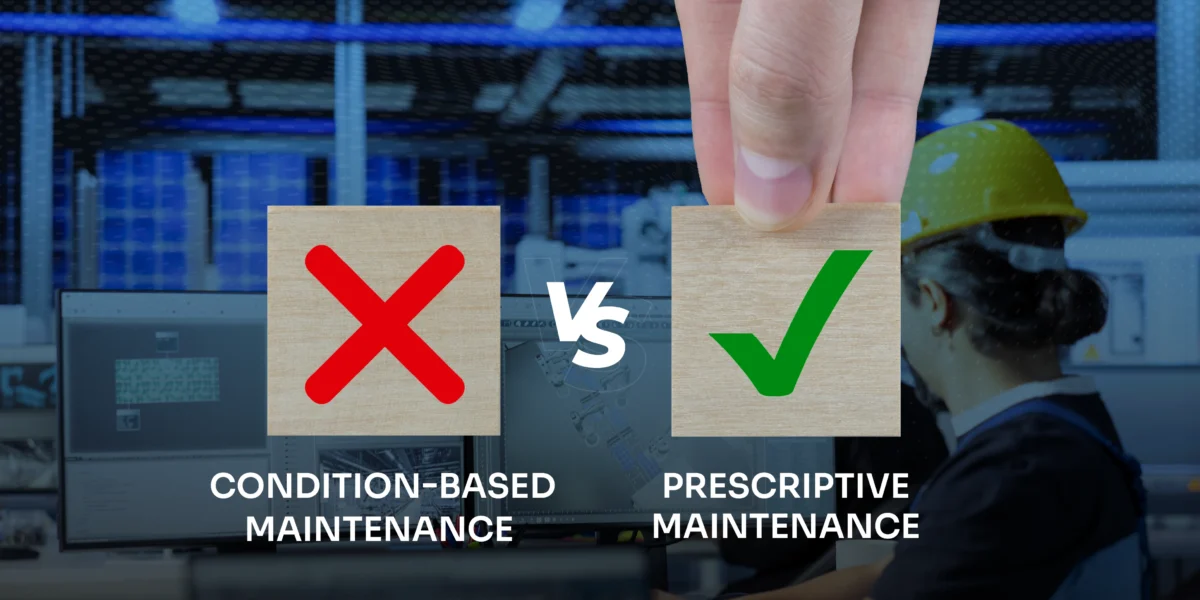
Condition-Based Maintenance vs. Prescriptive Maintenance
Read Time: 5–6 minutes | Author – Kalyan Meduri
- What Is Condition-Based Maintenance (CBM)?
- What Is Prescriptive Maintenance?
- Key Differences Between Condition-Based and Prescriptive Maintenance
- Operational Impact of Condition-Based Maintenance
- Operational Impact of Prescriptive Maintenance
- Benefits of Prescriptive Maintenance Over Condition-Based Maintenance
- Conclusion: Which Strategy Is Right for You?
- The 99% Trust Loop
As industrial operations become more complex and cost pressures increase, maintenance strategies are evolving beyond reactive and time-based approaches. Two commonly discussed modern strategies are Condition-Based Maintenance (CBM) and Prescriptive Maintenance. While both aim to reduce failures and improve reliability, they differ significantly in how decisions are made and how effectively downtime is prevented.
What Is Condition-Based Maintenance (CBM)?
-
- Vibration
- Temperature
- Pressure
- Lubrication quality
- Electrical current or load
If vibration levels on a motor exceed acceptable limits, maintenance teams are alerted to inspect or repair the asset before failure occurs.
Key Characteristics of CBM
-
- Reacts to the current health state of equipment
- Uses threshold-based alerts
- Prevents some unexpected failures
- Reduces unnecessary preventive maintenance
What Is Prescriptive Maintenance?
-
- Equipment condition
- Process behavior
- Energy consumption
- Operational context
- Risk and impact on production
“1. Inspect & correct the coupling condition for any abnormal wear /looseness and reassess precision alignment between the motor & gearbox.
2. Ensure proper & uniform tightness of all base fixing locations of the motor and improve the base rigidity if required.”
– Prescription for a Banbury Mixer with a business impact of downtime savings of 16 hours post corrective actions, successfully implemented as prescribed.
Key Differences Between Condition-Based and Prescriptive Maintenance
| Aspect | Condition-Based Maintenance (CBM) | Prescriptive Maintenance (RxM) |
|---|---|---|
| Decision Trigger |
Maintenance is initiated when asset condition indicators cross predefined health limits or show clear deterioration, independent of business impact. | Maintenance is initiated when models predict a specific failure mode, quantify its risk window, and link it to concrete business consequences such as downtime, safety, or quality loss. |
| Primary Question |
“Is the asset healthy now, and do I need to intervene soon based on its current condition?” | “What exactly should be done, by whom, and by when to avoid the predicted failure and its business impact?” |
| Data and Context Usage |
Relies primarily on real-time sensor readings and periodic inspections, with limited consideration of load, product, or operating mode. | Fuses real-time, historical, and contextual data (process conditions, recipes, schedules, environment, past work orders) to explain why the issue is emerging and what will happen if ignored. |
| Analytics and Reasoning |
Uses thresholds, simple trends, and basic diagnostics; deeper interpretation and root-cause analysis are largely left to human experts. | Uses advanced analytics and AI to identify failure modes, simulate future scenarios, and recommend the optimal set of actions with supporting rationale. |
| Guidance and Actionability | Generates alerts, alarms, and health indices that inform technicians something is wrong but do not specify the precise corrective steps. | Delivers clear, prioritized prescriptions that define specific actions, timing, and expected impact on risk, downtime, and cost. |
| Failure and Downtime Impact |
Reduces unexpected failures compared to reactive maintenance but can still lead to late, ambiguous, or non-prioritized interventions. | Enables earlier, more targeted interventions that systematically cut unplanned downtime, repeat failures, and unnecessary maintenance work. |
| Integration with Operations |
Primarily supports maintenance decision-making with limited integration into production planning or quality management. | Aligns maintenance, operations, and planning by tying recommendations directly to production plans, process constraints, and business KPIs. |
Operational Impact of Condition-Based Maintenance
Operational Impact of Prescriptive Maintenance
-
- Fewer unplanned stoppages and emergency interventions
- More predictable and effective maintenance planning
- Higher equipment availability and utilization
- More stable energy consumption and process behavior
Benefits of Prescriptive Maintenance Over Condition-Based Maintenance
1. Actionable Guidance Instead of Threshold Alerts
CBM triggers alerts when predefined limits are crossed, leaving teams to interpret severity and next steps. Prescriptive Maintenance provides clear, prioritized recommendations, telling teams what to do, when to act, and why it matters, reducing ambiguity and delay.
2. Earlier Intervention and Better Failure Prevention
Prescriptive Maintenance analyzes trends, risk, and impact—often identifying degradation before condition thresholds are breached. This enables earlier, targeted intervention and more effective prevention of failures.
3. Reduced Alert Fatigue
CBM systems can generate frequent alerts of equal importance. Prescriptive Maintenance prioritizes issues based on operational and financial risk, allowing teams to focus only on what truly impacts uptime and safety.
4. Better Alignment with Production Planning
Prescriptive recommendations are designed to fit within planned shutdowns or low-impact windows, minimizing production disruption. This improves coordination between maintenance and operations—something CBM alone cannot achieve.
5. Prevention of Secondary and Cascading Failures
By addressing root causes early, Prescriptive Maintenance reduces mechanical stress on connected assets, stabilizes processes, and prevents secondary damage—extending overall equipment life.
6. Greater Impact on Uptime and Cost Control
Plants using Prescriptive Maintenance typically achieve fewer unplanned stoppages, higher equipment availability, and lower maintenance and energy costs compared to CBM-based approaches.
7. Scalable Across Complex Operations
As asset complexity and data volume increase, CBM becomes harder to manage. Prescriptive Maintenance scales effectively by using AI to process large data sets and guide decisions at scale.
8. Addressing Process-Induced Faults
Prescriptive Maintenance links equipment behavior with process conditions like load, speed, and other variables to detect when operations are inducing faults, then prescribes both mechanical fixes & process changes to remove the underlying stress & prevent repeat failures.
Conclusion: Which Strategy Is Right for You?
Infinite Uptime’s PlantOS™ Manufacturing Intelligence is the world’s most user‑validated Prescriptive AI platform for heavy and process industries, trusted across 844 global plants. With 99.97% prediction accuracy, 99% prescription adoption, and 100% user‑validated outcomes, PlantOS™ delivers measurable reliability at scale. In an environment where MIT study shows 95% of AI pilots fail due to lack of adaptability and real workflow integration, PlantOS™ closes this credibility and outcomes gap through its 99% Trust Loop—a continuously learning feedback system where every user‑validated prescription is digitally verified and fed back to strengthen future recommendations.
By ingesting equipment, process, and energy data, PlantOS™ contextualizes insights in under two weeks and delivers “3 Outcomes in 1 Prescription with 0 Guesswork”—aligning uptime, energy efficiency, and throughput for all outcome champions, from maintenance and process teams to C‑suite executives.
Explore how PlantOS™ can transform your maintenance strategy—experience the world’s most trusted Prescriptive AI platform and achieve outcomes you can measure.
The 99% Trust Loop
Read more Blogs

The Four Pillars of Industrial Reliability
In heavy industries today, reliability is no longer just “fewer...

Predictive Maintenance: A Comprehensive Guide 2025
Predictive maintenance is an advanced strategy used to ensure that...

Condition-Based Maintenance vs. Predictive Maintenance: A Comprehensive Comparison
In the ever-evolving world of industrial operations, maintenance strategies play...