
The Trust Architecture
of Industrial AI
Part 1 | Context and Prediction
Accuracy

Executive Summary
The Contextualization Gap
This white paper on AI-based Maintenance and Adoption, developed by MIT Sloan Management Review India, finds a sharp shortfall in Digital Core readiness. Data fragmentation, cited by 62% of respondents, caps achievable AI accuracy regardless of model architecture. Practitioners report material gaps across the operational dimensions required for credible action:
62% cite data fragmentation capping AI accuracy.
71% lack sufficient context regarding Process Constraints, including safety boundaries and throughput commitments.
56% report inadequate Maintenance History, often due to uninterpreted paper logs or knowledge retained informally by veteran technicians.
81% lack visibility into Throughput Interdependencies, limiting a model’s ability to understand how a single asset failure propagates downstream.
The Trust Threshold and Operational Barriers
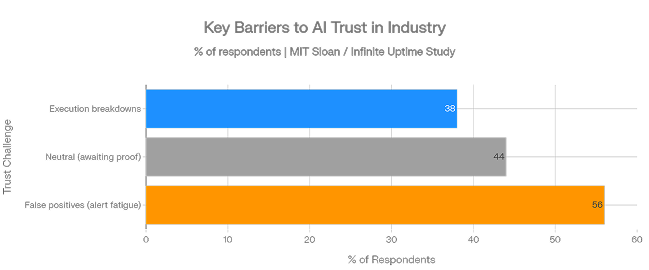
Validation Discipline: The Linchpin of Credibility
The study highlights a significant effectiveness gap, with 81% of maintenance professionals rating their current systems as only moderately effective in converting digital insights into plant-floor action. This gap stems from the absence of a closed outcome loop. Many deployments stop at alert generation and fail to systematically capture post-recommendation results. 67% of finance respondents emphasize that without structured validation and measurable ROI attribution, scaling AI investments remains constrained.
The Path Forward: The Trust Loop
To move beyond the pilot stage, organizations must adopt a Trust Loop framework, a structured cycle that converges machine data, human expertise, and operational execution. Trust is an evidence challenge. Practitioners identify real use cases from comparable plants and contextually grounded models as essential drivers for shifting from neutrality to operational confidence. This paper argues that trust begins with context and is reinforced through demonstrated accuracy under real operating conditions. Context defines the ceiling of accuracy, and accuracy without execution fails to accumulate trust. The next phase of industrial AI adoption lies in closing the gap between credible prediction and disciplined execution, ensuring that AI-driven insights translate into measurable production impact across MTBF, efficiency, and throughput.
Unlock Part 1:
Trust Threshold to
Trust Loop
Discover how to convert Prescriptive AI into
measurable Production Outcomes (Reliability, Efficiency, Throughput) – full Part 1 available now.